

Fifty-five may sound early…
But for millions of people, it’s exactly the right time to stop trading hours for a paycheck and start living on their own terms.
The number-one question that holds people back isn’t motivation. It’s math. Specifically: “How much do I actually need?”
The answer varies more than any single headline figure can capture, because your retirement is not your neighbor’s retirement.
Your spending habits, your healthcare situation, whether you plan to travel every year or stay close to home — all of it shapes your real number.
A generic benchmark gets you started. A personalized calculation gets you there.
The good news is that the math isn’t complicated once you break it into steps. And the strategies available to early retirees, from special withdrawal rules to health coverage bridges, are more powerful than most people realize.
The key? Build your number from your life, not from someone else’s spreadsheet.
Article Highlights
- Most benchmarks suggest saving 6x to 10x your annual salary by age 55, depending on your expected lifestyle spending.
- The 4% rule implies a $1.25M to $2.5M portfolio for retirees drawing $50,000 to $100,000 per year before Social Security.
- Healthcare before Medicare can cost an unsubsidized 55-year-old couple $25,000 to $40,000+ per year in premiums and out-of-pocket costs, a figure that rose sharply in 2026.
- The Rule of 55 (IRS) lets you withdraw from a current employer’s 401(k) penalty-free starting at 55 if you’ve left that job.
- Claiming Social Security at 62 instead of 67 permanently reduces your monthly benefit by up to 30% — waiting until 67 means a check roughly 43% larger than you’d receive at 62.
How Much Money Do You Actually Need to Retire at 55?
There’s no single magic number, but there are proven frameworks that give you a solid starting point.
Most guidance lands somewhere between 6x and 25x your expected annual spending, depending on which method you use.
The Salary Multiple Benchmarks
Fidelity recommends having 6x your salary saved by age 50 and 8x by age 60, which puts a rough 55-year-old target at around 7x your current salary. So if you earn $80,000 a year, that benchmark points to roughly $560,000.
These multiples are a starting point, not a finish line. They assume you’ll work until 65 and collect Social Security on schedule. Retiring at 55 means a longer runway with no paycheck, so many planners push that multiple closer to 10x or even 12x for early retirees.
Use the salary multiple to gut-check your progress. Use the spending-based method below to find your real target.
The Spending-Based Approach (More Accurate)
A more precise method starts with what you actually plan to spend each year in retirement, not what you earn today. Most retirees spend between 70% and 90% of their pre-retirement income, though early retirees who travel or pursue active hobbies often stay closer to 90% or even 100% in their first decade.
Once you have your annual spending figure, divide it by your safe withdrawal rate (more on that below) to get your portfolio target. Spending $60,000 a year and using a 4% withdrawal rate means you need $1,500,000 saved.
This method puts you in control because you’re building toward a life you’ve actually designed.
Savings Targets by Income Level
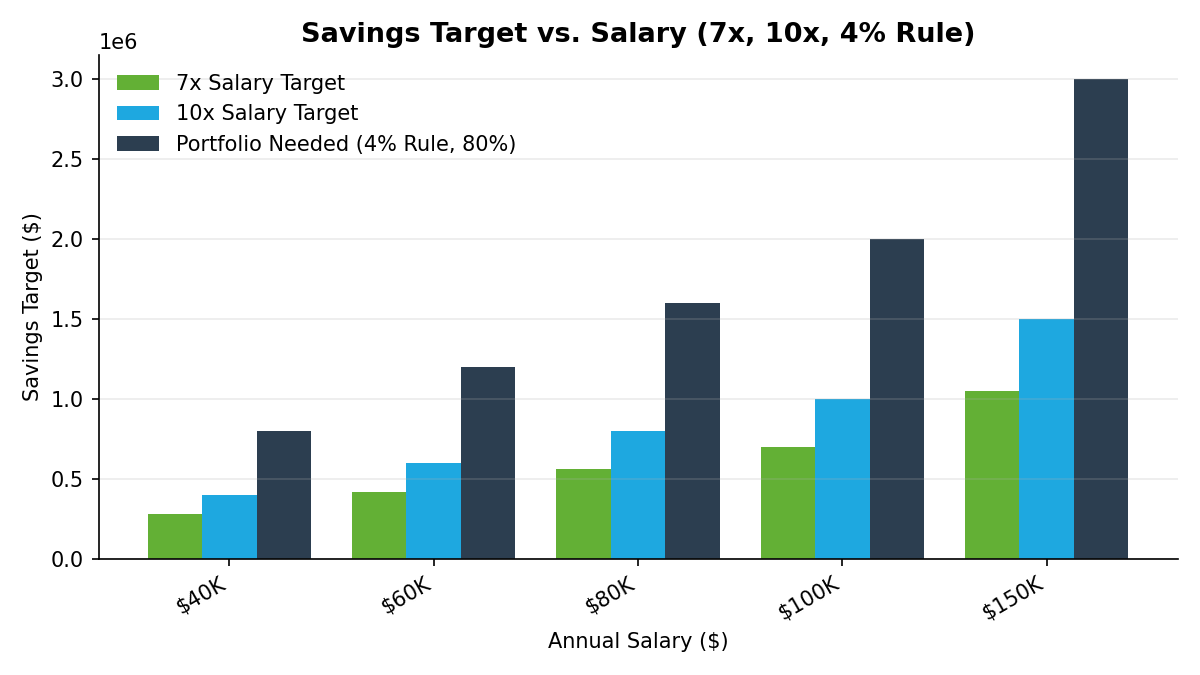
The table below combines both approaches — salary multiples and a 4% spending estimate — to show you a practical range by income level. Assume 80% income replacement and a 4% withdrawal rate.
| Annual Salary | 7x Salary Target | 10x Salary Target | Est. Annual Spend (80%) | Portfolio Needed (4% Rule) |
|---|---|---|---|---|
| $40,000 | $280,000 | $400,000 | $32,000 | $800,000 |
| $60,000 | $420,000 | $600,000 | $48,000 | $1,200,000 |
| $80,000 | $560,000 | $800,000 | $64,000 | $1,600,000 |
| $100,000 | $700,000 | $1,000,000 | $80,000 | $2,000,000 |
| $150,000 | $1,050,000 | $1,500,000 | $120,000 | $3,000,000 |
Notice the gap between the salary multiples and the spending-based portfolio target. That gap is partly filled by Social Security later in retirement, which is exactly why your withdrawal strategy in your 50s matters so much.
Step-by-Step: Calculate Your Personal Retirement Number
Benchmarks show you the ballpark. This four-step process gets you to your personal target. You can work through this with a spreadsheet or a simple calculator.
Step 1: Estimate Your Annual Retirement Spending
Start with your current take-home pay and subtract anything that goes away in retirement: commuting costs, work clothing, payroll taxes, and retirement contributions themselves.
Then add what increases: travel, hobbies, healthcare.
A useful shortcut is to review your last 12 months of actual spending, then adjust line by line. For most people retiring at 55, healthcare is the category that needs the biggest upward adjustment.
Aim for a number you’d genuinely enjoy living on, not a number designed to sound modest.
Step 2: Apply the 4% Rule (and Its Limits)
The 4% rule (originally from the 1994 Bengen study) suggests you can withdraw 4% of your portfolio in year one, then adjust for inflation each year, with a high probability the money lasts 30 years. Divide your annual spending by 0.04 to get your target.
Here’s the honest caveat for age-55 retirees: a 30-year window may not be long enough.
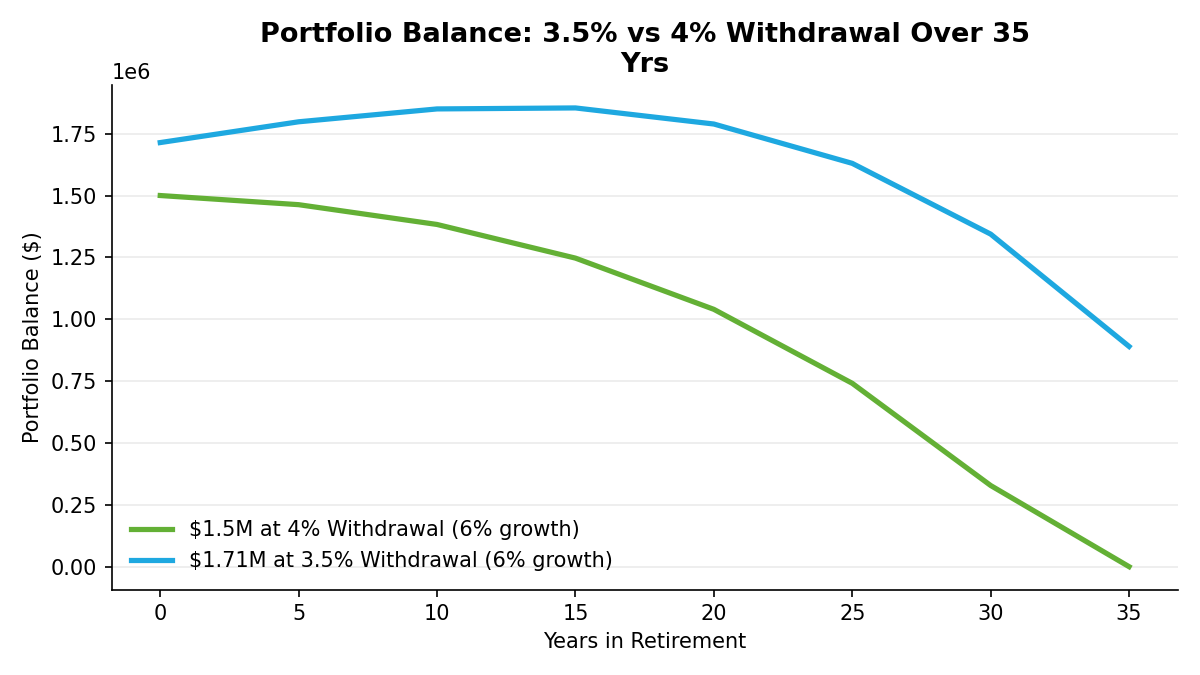
If you retire at 55 and live to 90, you need 35 years of coverage. Some planners recommend a 3.5% withdrawal rate for early retirees, which raises your target but also raises your confidence.
At 3.5%, a $60,000 annual spend requires a portfolio of about $1,714,000 instead of $1,500,000. That difference is worth planning for.
Step 3: Account for Social Security and Other Income
Social Security won’t arrive the day you retire at 55.
Per SSA rules, the earliest you can claim is 62, and benefits are reduced permanently if you claim before your full retirement age (67 for most people born after 1960).
During the gap years (55 to 62 or 67), your portfolio carries the full load. After benefits begin, your required withdrawal drops, which is why modeling two distinct phases (pre-Social Security and post-Social Security) gives you a much cleaner picture.
If you have a pension, rental income, or part-time earnings planned, subtract those from your required portfolio withdrawal as well.
Every dollar of guaranteed income reduces the portfolio you need to build.
Healthcare Costs: The Hidden Expense Before Medicare
Medicare eligibility starts at 65. If you retire at 55, you face up to a decade of private health insurance costs. This is the expense category that most early retirement plans underestimate.
What Private Coverage Actually Costs
A 55-year-old purchasing coverage on the ACA marketplace can expect to pay roughly $800 to $1,100 per month before any subsidy, depending on state and plan tier.
For a couple, that figure roughly doubles. And 2026 premiums rose approximately 20% on average compared to prior years, so older estimates in circulation may significantly understate what you’ll actually pay.
The standard ACA subsidy range remains 100% to 400% of the federal poverty level in 2026, but an important planning note: the enhanced premium tax credits that had extended subsidies above 400% FPL and reduced costs for all income levels expired at the end of 2025.
As a result, the income-management strategy of structuring withdrawals to stay within subsidy range is less powerful in 2026 than it was in recent years. If your projected retirement income falls within the 100%–400% range, you may still qualify for meaningful premium reductions. But use current-year premium quotes, not figures from 2024 or 2025.
Budgeting at least $25,000 to $40,000+ per year for a couple’s health coverage (premiums plus out-of-pocket costs) before Medicare is a realistic baseline for 2026 and beyond.
Some years will cost more, especially if one or both of you reaches an out-of-pocket maximum.
HSAs: Your Best Friend for Early Retirement Healthcare
If you’re still working and contributing to a Health Savings Account (HSA), every dollar you save now can cover healthcare costs in retirement completely tax-free.
That triple tax advantage — deductible contribution, tax-free growth, tax-free withdrawal for medical expenses — makes the HSA the most efficient healthcare savings vehicle available.
You can also use a technique sometimes called the Shoebox Strategy: pay medical expenses out of pocket now, save your receipts, and reimburse yourself from the HSA years later in retirement. There’s no deadline on reimbursement.
For a deeper look at how that works, see our guide on The Shoebox Strategy To Pay Medical Expenses Tax-Free. It’s one of the most underused tools in early retirement planning.
COBRA, Marketplace, and Spouse’s Plan
When you leave your job, COBRA lets you keep your current employer coverage for up to 18 months, but you pay the full premium (including the employer’s share).
That can be a shock.
If your spouse is still working, joining their employer plan is usually the most cost-effective bridge. If that’s not an option, compare COBRA against ACA marketplace plans for your situation. Marketplace plans are often cheaper after age 55, especially if you qualify for subsidies based on your projected retirement income.
Healthcare planning alone can shift your required savings target by hundreds of thousands of dollars. Get specific numbers before you finalize your retirement date.
Tax Strategies for Early Retirement Withdrawals
Retiring at 55 means navigating tax rules that were mostly designed for people retiring at 65. Understanding which accounts to tap, and in what order, can save you tens of thousands of dollars over your retirement.
The Rule of 55: Your Penalty-Free Window
Under IRS rules, if you leave your job in the year you turn 55 or later, you can take distributions from that specific employer’s 401(k) without the usual 10% early withdrawal penalty. This is called the Rule of 55, and it applies to 403(b) plans as well.
The critical detail: it only applies to the 401(k) from the job you just left.
Funds rolled into an IRA or sitting in a previous employer’s plan don’t qualify. Keep that money in the current employer plan if you plan to use this strategy.
This rule can be a significant bridge between 55 and 59½, when all retirement account withdrawals become penalty-free.
Roth Conversions in Early Retirement
The years between 55 and when Social Security begins are often your lowest-income years. That low-income window is a prime opportunity to convert traditional IRA or 401(k) funds into a Roth IRA at a lower tax rate.
Converted funds grow tax-free and qualified withdrawals are never taxed again. Converting strategically during your early retirement years can reduce your lifetime tax bill significantly.
If you’re a high earner still in the workforce, check out our guide on Mandatory Roth Catch-Up for High Earners 2026 for rules that may already apply to you.
Withdrawal Sequencing: Which Account First?
A common strategy for early retirees is to draw from taxable brokerage accounts first, letting tax-advantaged accounts keep growing. After 59½, traditional IRA and 401(k) funds become fully accessible without penalty, giving you more flexibility.
Roth accounts are typically drawn last because their tax-free growth is most valuable over the longest time horizon. Required minimum distributions (RMDs), which the IRS mandates starting at age 73 under current rules, will eventually force withdrawals from traditional accounts anyway.
For a foundational look at how traditional IRAs work within this sequencing, see Traditional Individual Retirement Accounts: How They Work.
Real Examples: Different Incomes, Different Retirement Targets
Numbers mean more when they’re attached to real situations.
Below are four scenarios at different income levels, each using the spending-based approach with a 3.5% withdrawal rate to account for a longer early-retirement timeline.
Here’s what these numbers really represent: a well-funded early retirement isn’t just a balance sheet win.
It’s the foundation for filling your 50s and 60s with travel, hobbies, and experiences that make the years between 55 and 75 the richest of your life. Getting the math right is how you give yourself permission to actually live them.
Example 1: The $60K Household
Maria and her husband earn $60,000 combined and plan to spend about $48,000 per year in retirement (80% replacement). They expect Social Security totaling $24,000 per year starting at 67.
From 55 to 67, their portfolio covers the full $48,000 per year. After 67, they need only $24,000 from savings. Using a blended approach, their target portfolio is approximately $900,000 to $1,100,000 depending on healthcare costs and sequence-of-returns risk.
For context on what smaller portfolios can realistically support, see our guide on Can You Retire with $300K?
Example 2: The $100K Household
James earns $100,000 and wants to maintain roughly $85,000 in annual retirement spending to keep his current lifestyle, including travel a few times a year and home projects.
He expects about $30,000 in Social Security starting at 67. From 55 to 67, he needs his portfolio to generate $85,000 per year. At a 3.5% withdrawal rate, that points to a target of around $2,400,000 before the Social Security bridge kicks in.
After 67, his required withdrawal drops to $55,000, and his portfolio can sustain a more relaxed withdrawal rate for the remainder of retirement.
Example 3: The $150K Household
Linda earns $150,000 and is a high saver. She plans a retirement spending level of $110,000 per year. With a $40,000 Social Security benefit projected at 67 (individual), she needs her portfolio to cover $70,000 per year in later years and $110,000 in the gap years.
Her target portfolio lands in the $2,800,000 to $3,200,000 range.
She’s been maxing her 401(k) and using catch-up contributions aggressively. Because her prior-year FICA wages exceeded $150,000, the mandatory Roth catch-up rules apply to her 2026 contributions — workers below that threshold may still make catch-up contributions on a pre-tax basis — which actually works in her favor for long-term tax planning.
High earners have the most to gain from sequencing Roth conversions in low-income early retirement years.
Social Security Impact: Claim at 62, 67, or Wait?
Social Security is your largest guaranteed income source in later retirement. The age you choose to claim it has consequences that last for decades. For 55-year-old early retirees, this decision deserves serious thought.
The Permanent Cost of Claiming at 62
Per SSA guidelines, claiming at 62 (the earliest eligible age) permanently reduces your benefit by up to 30% compared to claiming at your full retirement age of 67. Looked at from the other direction, waiting until 67 instead of claiming at 62 results in a monthly check roughly 43% larger — because the age-62 benefit is only about 70% of your full retirement amount.
For a couple where one spouse has a significantly higher earning record, claiming the lower earner’s benefit early while delaying the higher earner’s can be a smart strategy. The higher earner’s delay also protects the surviving spouse, who will eventually receive only one benefit.
Don’t treat 62 as the default just because it’s available. Do the math for your specific benefit amounts.
Bridging the Gap Without Social Security
From 55 to 62 at minimum, your portfolio carries everything. That’s a 7-year bridge with no Social Security income. Your portfolio needs to absorb early withdrawal pressure without being permanently impaired by a bad market at the start of retirement.
This is why many planners recommend holding two to three years of spending in cash or short-term bonds at retirement. That buffer lets your invested assets ride out market dips without forcing you to sell at a loss.
The goal is simple: protect the first five years so the next thirty can take care of themselves.
The Break-Even Calculation
If you delay claiming from 62 to 67, your monthly benefit grows by roughly 43%. The break-even point, where the larger delayed benefit surpasses the cumulative total of smaller early payments, typically falls around age 78 to 80.
If you’re in good health and your family has longevity, delaying almost always wins. If you have significant health concerns, earlier claiming may make more financial sense.
Either way, build your portfolio withdrawal plan around the Social Security timing you actually choose, not an assumption you’ve never tested.
The SSA’s retirement planner lets you see your personalized estimates for any claiming age.
Common Mistakes That Derail 55 Retirements
Most early retirement plans that fail don’t fail because of bad math. They fail because of predictable, avoidable blind spots. Here’s what to watch for.
Underestimating the Healthcare Gap
This is the most common and most expensive mistake. People model retirement income carefully and then forget that a decade of private health insurance isn’t a small line item. It’s a major budget category.
Build healthcare costs in from day one. Use real premium quotes, not estimates. And factor in out-of-pocket maximums, not just premiums.
For practical ways to keep medical costs from eating your retirement budget, see 10 Ways Retirees Waste Money Without Realizing It.
Ignoring Sequence-of-Returns Risk
A major market downturn in your first three to five years of retirement is far more damaging than the same downturn ten years in. Selling assets at depressed prices to fund living expenses permanently reduces your portfolio’s ability to recover.
The fix isn’t avoiding stocks. It’s having a cash or bond buffer so you never have to sell equities at the wrong time. Think of it as giving your investments time to do their job.
This is especially important for 55-year-old retirees who face a longer period before Social Security arrives to supplement withdrawals.
Treating Retirement as a Fixed Finish Line
Retirement at 55 doesn’t mean zero income forever. Many early retirees earn consulting fees, do part-time work they enjoy, or generate income from a hobby or side business in their 50s and 60s.
Even $10,000 to $20,000 per year of flexible income dramatically reduces the pressure on your portfolio. It keeps your withdrawal rate lower in the critical early years and gives your investments more room to grow.
Retirement is a chapter, not a cliff. Designing it with some income flexibility often makes the whole plan more resilient and more enjoyable.
Your Next Steps
Retiring at 55 is a real and reachable goal. The target number looks big in a headline, but it becomes manageable the moment you break it into steps: estimate your actual spending, choose your withdrawal rate, account for healthcare and the Social Security gap, and pick the right accounts to draw from in the right order.
You don’t need a perfect plan on day one. You need a real plan you can refine as you go. Every year you run the numbers honestly puts you closer to a retirement that actually fits the life you want to live.
The time between now and 55, or between 55 and your next decade, is full of opportunity to optimize. Start building that bridge today, one calculation at a time.
Take action now: run your personal retirement number using the four-step method in this guide, then schedule a review of your current savings rate, healthcare plan, and withdrawal sequencing to make sure all three are working together.
Frequently Asked Questions
Is $2 million enough to retire at 55?
$2 million supports a very comfortable retirement at 55 for many people, but whether it’s enough depends on your annual spending. At a 3.5% withdrawal rate designed for a long early-retirement timeline, $2 million generates about $70,000 per year before Social Security begins to supplement your income. If your expected spending is at or below that level, $2 million is a strong foundation.
Is $1,000,000 enough to retire at 55?
$1 million can work at 55, but it requires careful planning. At a 3.5% withdrawal rate, it produces roughly $35,000 per year, which covers a modest lifestyle and may need to be supplemented by part-time income or a spouse’s earnings until Social Security begins. Healthcare costs before Medicare eligibility at 65 are the biggest variable to stress-test against a $1 million portfolio.
What is the 4% rule for retirement spending?
The 4% rule is a guideline suggesting you can withdraw 4% of your portfolio in your first year of retirement, then adjust that dollar amount for inflation each year, with a historically high probability the money lasts 30 years. For early retirees at 55, a slightly more conservative rate of 3.5% is often recommended because the retirement window may stretch 35 years or more. Divide your desired annual income by your chosen withdrawal rate to calculate the portfolio you need.
Can I retire at 55 with no Social Security?
Yes, but your portfolio needs to carry the full load for your entire retirement rather than just a bridge period. Without Social Security, a retiree drawing $60,000 per year at a 3.5% rate needs roughly $1,714,000 saved. Social Security won’t disappear — you’ve earned those credits — but structuring your plan to be self-sufficient first means any benefit you eventually collect becomes a bonus rather than a necessity.