

You’ve been diligently maxing out your 401(k) catch-up contributions…
But then Congress passed SECURE 2.0, and in 2026 the rules shift for high earners in a meaningful way.
If your FICA wages last year were above $150,000, the IRS now requires that all of your catch-up contributions go in as after-tax Roth dollars.
Not a choice. A requirement.
For some people that feels like a restriction. In reality it can be a wealth-building gift: a forced move into tax-free growth territory at exactly the time your career earnings are at their peak.
The details matter, though.
The threshold, the limits by age group, what happens if your employer’s plan is not set up yet — these are the specifics you need before open enrollment rolls around.
The key: once you understand the mechanics, you can turn a compliance requirement into one of the smartest tax moves of your final working years.
Article Highlights
- $150,000 FICA wage threshold: If your prior-year FICA wages exceeded this amount, every catch-up dollar must go in as Roth starting in 2026.
- $32,500 total 401(k) limit (age 50-59 and 64+): That is the $24,500 base plus the $8,000 catch-up, all of which must be Roth if you clear the threshold.
- $35,750 super catch-up for ages 60-63: Workers in this age window get the largest contribution room available, and the entire catch-up portion must be Roth if wages topped $150,000.
- Tax-free growth ahead: Roth contributions mean no taxes on qualified withdrawals in retirement, which can lower your future taxable income significantly.
- Employer plan must offer Roth: If your plan does not yet have a Roth feature, you cannot make catch-up contributions at all until it does — so check with HR now.
What Is the Mandatory Roth Catch-Up Rule for 2026?
Under the SECURE 2.0 Act, Congress redesigned how catch-up contributions work for high-wage employees.
Beginning January 1, 2026, workers whose prior-year FICA wages exceeded $150,000 can no longer direct catch-up contributions to a pre-tax account. The entire catch-up amount must go into a designated Roth account inside the plan.
The SECURE 2.0 Background
SECURE 2.0, signed into law in late 2022, included dozens of retirement rule changes phased in over several years. The mandatory Roth catch-up provision was one of the most debated because it required both employees and payroll systems to adapt.
The statutory requirement is effective January 1, 2026, and compliance is required.
The IRS’s final regulations (issued September 2025) are technically effective January 1, 2027; for 2026, plans must comply in good faith while the final regulatory rules are not yet formally binding. You can review the IRS’s SECURE 2.0 guidance page for the official statutory background.
What “Catch-Up Contribution” Means Here
Every worker under 50 can put up to $24,500 into a 401(k) in 2026. Catch-up contributions are the extra dollars workers 50 and older are allowed to add on top of that base limit.
The new rule does not touch the base $24,500. It only controls where the extra catch-up dollars land: pre-tax or Roth.
Pre-Tax vs. Roth in Plain Terms
Pre-tax contributions lower your taxable income today, but every withdrawal in retirement is taxed. Roth contributions give you no upfront deduction, but qualified withdrawals — including all the growth — come out completely tax-free.
For someone in peak earning years, that trade-off often favors Roth more than people realize.
Who Qualifies as a “High Earner” Under the New Rule?
Per IRS guidance, a high earner for this purpose is any employee whose prior-year FICA wages from a single employer exceeded $150,000. That is the only test. Filing status, total household income, and other accounts do not factor in.
The $150,000 FICA Wage Test
The look-back period is the calendar year immediately before the year you want to make the catch-up contribution. So for 2026, the IRS looks at your 2025 FICA wages from your current employer.
FICA wages are generally your W-2 Box 3 Social Security wages, not gross income. Some deferred compensation arrangements can affect this number, so it is worth reviewing your W-2 carefully.
Multiple Employer and Mid-Year Scenarios
If you worked for two employers in the prior year, the $150,000 threshold is applied separately per employer. Wages are not combined.
If you change jobs in 2026, your new employer uses your prior-year wages from them — which may be zero, meaning the rule may not apply at your new job in the first year.
These edge cases are worth raising with your HR department directly.
Self-Employed Workers
Sole proprietors and single-member LLC owners who use a Solo 401(k) are not subject to the mandatory Roth catch-up rule as currently written, because they do not receive FICA wages in the traditional sense.
If you work through a corporation and pay yourself W-2 wages above $150,000, you likely are covered. S
elf-employed savers looking at other plan structures can review the SEP IRA guide at HeroRetirement.com for comparison.
How Much Can High Earners Contribute in 2026?
The mandatory Roth rule does not reduce your contribution limits. It only changes the tax treatment of the catch-up portion. Your total potential 401(k) room in 2026 depends on your age.
Age 50-59 and Age 64 Plus: The Standard Catch-Up
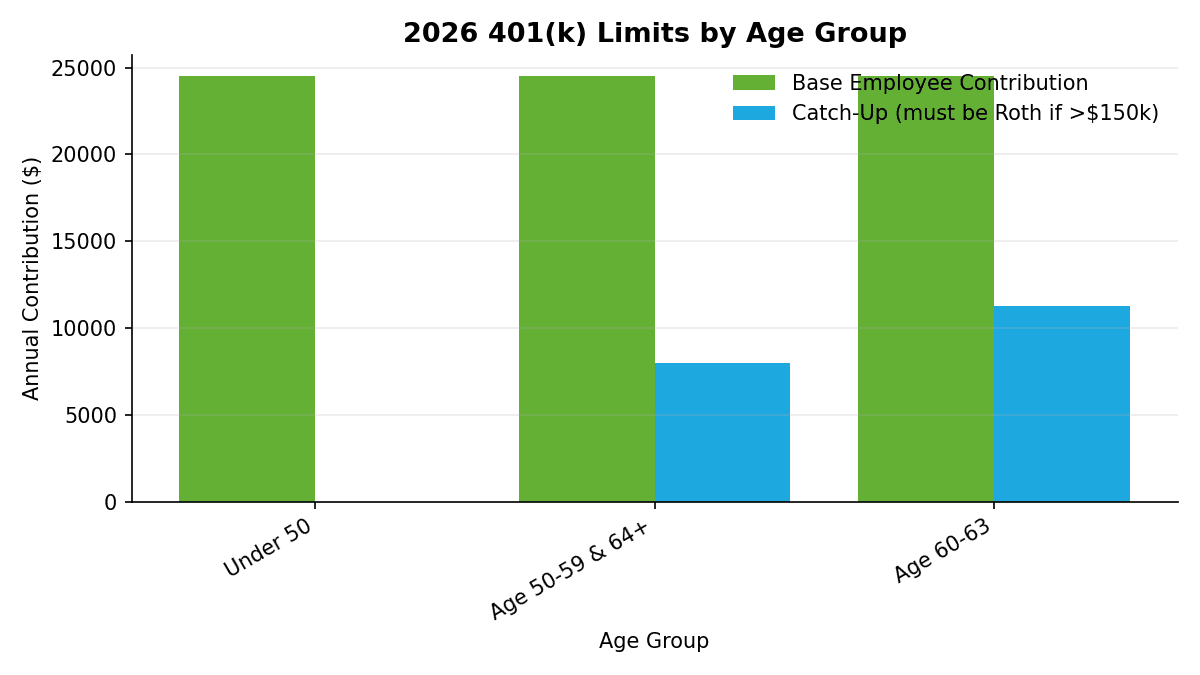
Workers in these age brackets can contribute the $24,500 base plus an $8,000 catch-up, for a total of $32,500. If your prior-year FICA wages exceeded $150,000, the full $8,000 catch-up must go into a Roth account. The base $24,500 can still be pre-tax if you prefer.
Ages 60-63: The Super Catch-Up
SECURE 2.0 created a special higher limit for workers aged 60, 61, 62, and 63. Instead of the $8,000 catch-up, these workers can contribute an $11,250 super catch-up, bringing their total to $35,750 in 2026.
If they are high earners under the FICA test, the entire $11,250 must be Roth. This four-year window is one of the most powerful savings opportunities in the tax code right now.
2026 Contribution Limits at a Glance
The chart below shows the full picture side by side. One thing to notice: the base employee contribution and any employer match are not affected by the Roth mandate. Only the employee catch-up portion changes character.
The combined employee-plus-employer limit reaches $72,000 regardless of age, giving high earners plenty of room to grow wealth even outside the catch-up layer.
| Age Group | Base Limit | Catch-Up | Total Employee Limit | Catch-Up Must Be Roth if >$150k? |
|---|---|---|---|---|
| Under 50 | $24,500 | — | $24,500 | N/A |
| Age 50-59 & 64+ | $24,500 | $8,000 | $32,500 | Yes |
| Age 60-63 | $24,500 | $11,250 | $35,750 | Yes |
Key Differences: Roth vs. Traditional Catch-Up Contributions
The choice between Roth and pre-tax used to be voluntary. Now it is required for high earners on the catch-up portion.
Understanding what changes — and what does not — keeps you from making adjustments you do not need to make. For more on how traditional accounts work alongside these rules, see our guide on traditional IRAs.
What Changes for High Earners
Your catch-up contributions will no longer reduce your current-year taxable income. If you were using a large pre-tax catch-up to manage your tax bracket in peak earning years, your taxable income will appear higher starting in 2026.
That shift is real and worth factoring into your withholding or estimated tax payments.
What Stays the Same
Contribution limits are identical whether you use Roth or pre-tax. Employer matching contributions are unaffected and will almost certainly remain pre-tax (employers match into pre-tax by default unless your plan specifies otherwise). The base $24,500 employee contribution is still your choice to put wherever you want.
Roth IRA vs. Roth 401(k) Catch-Up
A Roth 401(k) has no income limit for contributions. A Roth IRA phases out for single filers between $153,000 and $168,000, and for married-filing-jointly filers between $242,000 and $252,000.
High earners who are phased out of the Roth IRA can still benefit from the mandatory Roth catch-up inside their workplace plan. For a deeper look at how multiple accounts fit together, see How Many Retirement Accounts Can You Have.
Tax Implications of Mandatory Roth Catch-Ups
Paying taxes now instead of later is not automatically bad.
Whether the mandatory Roth catch-up helps or hurts your lifetime tax bill comes down to two things: your tax rate today versus your expected tax rate in retirement, and how long the money stays invested.
The Tax Rate Crossover Point
If you expect to be in the same or a higher tax bracket in retirement — because of required minimum distributions, Social Security, rental income, or a pension — then paying Roth taxes now at today’s rates is likely a net win.
The RMD rules under SECURE 2.0 require distributions starting at age 73 (rising to 75 in 2033), and those forced withdrawals can push taxable income up quickly for savers with large pre-tax balances. A bigger Roth balance means smaller, more manageable RMDs later.
The IRS’s RMD FAQ page has the full rules in one place.
Compounding Inside a Roth Account
Every dollar that grows inside a Roth account is permanently sheltered. Decades of compounding on after-tax dollars with zero tax drag on withdrawal is the real power here.
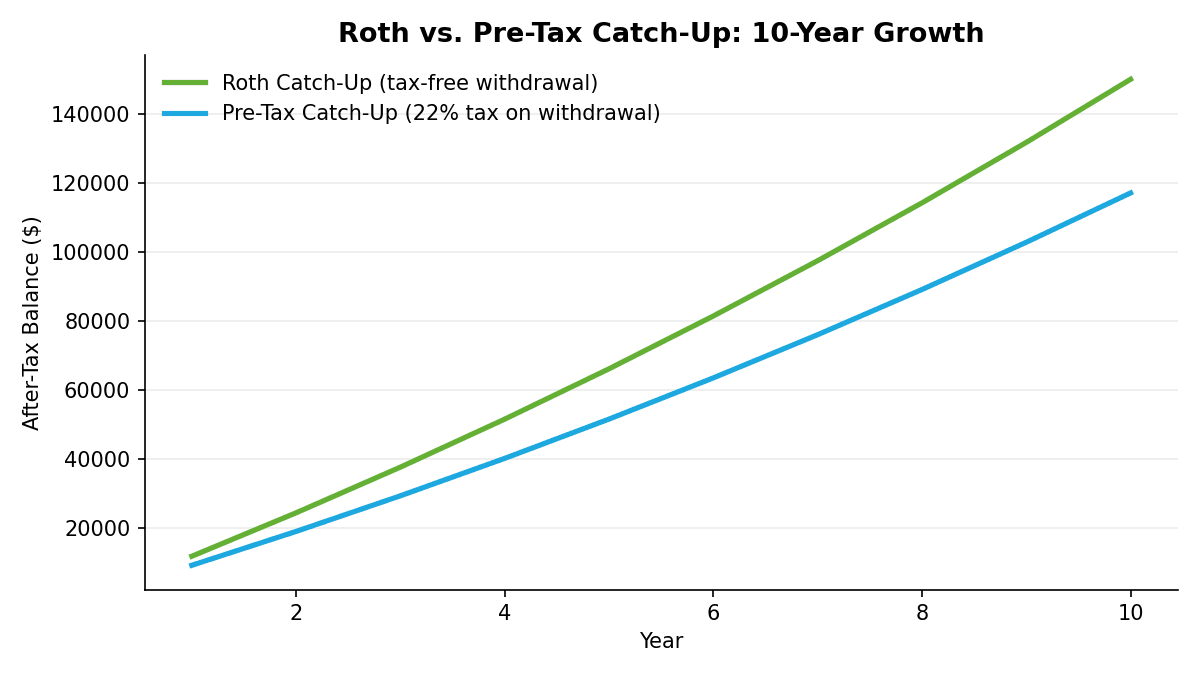
The chart below shows how $11,250 annual Roth catch-up contributions, compounded over ten years, compare to the same amount in a pre-tax account after accounting for a 22% withdrawal tax rate. The gap may surprise you.
Coordinating With a Roth Conversion Strategy
If you already do annual Roth conversions, the mandatory Roth catch-up stacks on top of that strategy rather than replacing it. More Roth dollars flowing in each year accelerates the diversification of your tax exposure.
There is a broader benefit worth naming here.
A larger Roth balance in retirement means a smaller slice of every dollar you spend goes to taxes — and that frees up real money each month for travel, hobbies, and the active life most people picture when they imagine their best years ahead.
For broader context on managing retirement income streams, see 7 Ways to Prepare Your Budget for Retirement.
Action Steps for Affected Employees
The rule is live January 1, 2026. The window to prepare is now. These steps are listed in order of priority.
Step 1: Confirm Whether You Are Affected
Pull your 2025 W-2 when it arrives in January 2026 and look at Box 3 (Social Security wages). If that number exceeds $150,000 from your current employer, the rule applies to you for 2026 catch-up contributions.
If you are close to the line, it is worth knowing early so you can update your deferral elections before contributions are processed incorrectly.
Step 2: Verify Your Plan Offers a Roth Option
If your 401(k) plan does not yet have a designated Roth account feature, your employer cannot accept your catch-up contributions at all under the new rule. The IRS has stated that affected employees cannot simply shift catch-up dollars to pre-tax as a workaround.
Contact your HR or benefits team now. Most large employers have already updated their systems, but smaller employers may still be catching up.
Step 3: Adjust Your Deferral Election and Withholding
Once you confirm your plan is Roth-ready, update your contribution election to direct catch-up dollars to the Roth source. Then revisit your W-4 or quarterly estimated payments.
Because catch-up contributions no longer reduce your taxable wages, you may owe more in taxes than your current withholding covers. Adjusting early prevents a surprise bill in April.
For help thinking through the full income picture in retirement, the $1,000 a Month Rule article is a useful starting point.
Common Mistakes to Avoid
Even well-informed savers make predictable errors when a rule changes. Here are the ones that show up most often with the mandatory Roth catch-up.
Assuming Pre-Tax Is Always Better
Many high earners default to pre-tax contributions because it feels like paying less now. But a large pre-tax balance feeds large taxable RMDs at 73.
For someone who already has significant pre-tax savings, the Roth catch-up mandate may be the most efficient repositioning tool available. Resist the reflex to see it as a penalty.
Ignoring the Rule Because Your Employer Has Not Said Anything
Employer communication about benefit changes is often slow. The rule applies regardless of whether your company has sent an email about it.
If you are over 50 and earned above $150,000 in FICA wages last year, take the initiative. Do not wait for an open enrollment reminder that may arrive after contributions have already been processed incorrectly.
Forgetting to Recheck Each Year
The $150,000 threshold is tested annually against your prior-year FICA wages. If your compensation fluctuates — due to a bonus year, a reduced schedule, or a job change — your status can change.
Someone subject to the rule in 2026 might not be in 2027. Build a quick annual W-2 review into your January routine.
The Bottom Line
The mandatory Roth catch-up rule for 2026 is one of the biggest retirement savings changes in years for high earners. It removes a choice but opens a door: the door to more tax-free money in retirement, lower future RMD pressure, and a more balanced tax picture across the decades ahead.
Roth contributions made now will compound without the drag of future taxes. The ages when most people earn the most are also the years when Roth contributions do the most long-term work. This rule, for many savers, is a push in exactly the right direction.
Know your prior-year FICA wages. Confirm your plan has a Roth option. Update your deferral elections and your withholding. Then let compounding do its job.
Take action now: review your 2025 W-2 in January, confirm your plan’s Roth feature with HR, and update your 401(k) deferral election before your first paycheck of 2026 is processed.
Frequently Asked Questions
What is the income threshold for mandatory Roth catch-up contributions in 2026?
The threshold is $150,000 in prior-year FICA wages from a single employer. If your 2025 W-2 Box 3 shows more than $150,000 from your current employer, every catch-up contribution you make in 2026 must go into a designated Roth account inside your plan. Filing status and household income do not affect this test.
Do I have to use Roth catch-up if I’m a high earner in 2026?
Yes. If your prior-year FICA wages exceeded $150,000, the IRS requires your catch-up contributions to be Roth. You cannot redirect them to a pre-tax account as a workaround. If your plan does not offer a Roth option, you will be unable to make catch-up contributions at all until the plan adds one.
How does the Roth catch-up contribution affect my taxes?
Roth catch-up contributions do not reduce your taxable income in the year you make them, so your current-year tax bill may be higher than you are used to. The trade-off is that qualified withdrawals in retirement, including all the growth, come out completely tax-free. Adjusting your withholding or estimated tax payments early prevents an April surprise.
What happens if I become a high earner mid-year in 2026?
The test is based on your prior-year FICA wages, not what you earn during 2026 itself. Your 2026 catch-up status is locked in by your 2025 wages, so mid-year income changes in 2026 do not affect which rule applies this year. They will, however, determine whether you are subject to the rule in 2027.