

You’ve heard that retirement planning is complicated. Spreadsheets, Monte Carlo simulations, withdrawal ladders. It’s enough to make anyone’s eyes glaze over.
The $1,000 a month rule cuts through all of that. It’s a back-of-the-envelope formula that translates a savings balance into monthly income — fast.
One number in, one number out.
Is it perfect? No rule this simple ever is. But it’s a surprisingly useful starting point, and millions of people have used it to set a first savings target and start moving.
Whether you’re just beginning to think about retirement income or you’re fine-tuning a plan you’ve already built, this guide walks you through exactly how the rule works, where it shines, and where you need to go further.
The key? Use the $1,000 rule as your launch pad, not your landing spot.
Article Highlights
- The core formula: Every $1,000/month of desired retirement income requires $240,000 in savings.
- The withdrawal rate: The rule is built on a 5% annual withdrawal rate, higher than the widely cited 4% rule.
- Scaling up: To generate $3,000/month, you need $720,000 saved; $5,000/month requires $1,200,000.
- Catch-up potential: In 2026, savers aged 60–63 can contribute up to $35,750 per year to a 401(k) using the SECURE 2.0 super catch-up.
- The income stack: Most retirees combine the rule with Social Security and pension income to reduce the savings target they actually need to hit.
What Is the $1,000 a Month Rule for Retirement?
The $1,000 a month rule is a retirement income heuristic created by financial educator Wes Moss. The core idea is straightforward: for every $1,000 of monthly retirement income you want, you need $240,000 saved.
That’s it. Simple math, powerful implications.
Where the Number Comes From
Multiply $1,000 by 12 months and you get $12,000 a year. Divide $12,000 by $240,000 and you get 0.05 — a 5% annual withdrawal rate. That’s the engine under the hood of this rule.
The math runs in reverse just as cleanly. Pick your desired monthly income, multiply by 240, and you have your savings target.
The Quick-Reference Savings Table
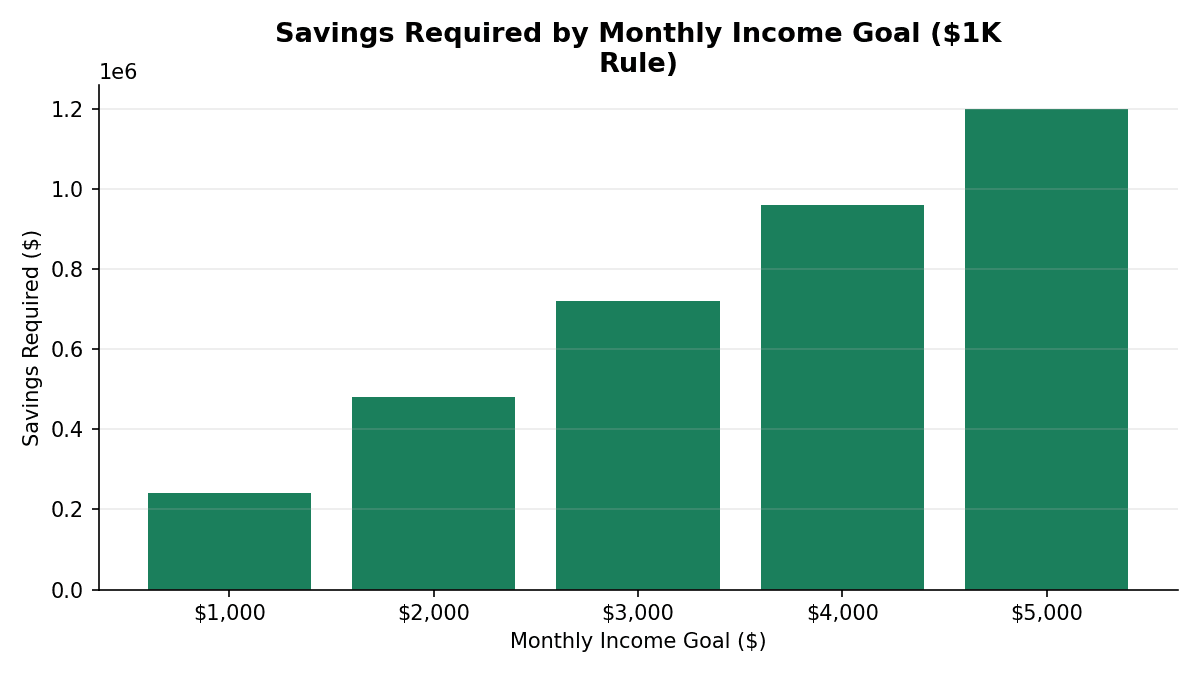
Here’s how different income goals translate into required savings using the $1,000 rule:
| Monthly Income Goal | Savings Required |
|---|---|
| $1,000 | $240,000 |
| $2,000 | $480,000 |
| $3,000 | $720,000 |
| $4,000 | $960,000 |
| $5,000 | $1,200,000 |
Think of this as your first planning benchmark. Most retirees need $3,000–$5,000 a month from savings after accounting for Social Security — which means a target in the $720,000–$1,200,000 range is a reasonable place to start aiming.
Why a Rule of Thumb Matters
Complex retirement models are valuable, but they require data most people don’t have at hand: future tax rates, exact investment returns, precise healthcare costs. A rule of thumb gives you a working number today so you can take action today.
That action — saving more, adjusting your timeline, stress-testing your portfolio — is what actually moves the needle.
How the $1,000 a Month Rule Works: The 5% Withdrawal Rate
The rule is anchored to a 5% annual withdrawal rate. You pull out 5% of your starting balance each year to fund your spending. That’s the mechanical core — and it’s also the source of most of the rule’s limitations.
Static vs. Dynamic Withdrawals
In its simplest form, the rule assumes you withdraw a fixed dollar amount each year. Year one: 5% of $240,000 equals $12,000. Year two: same $12,000, regardless of what the market did.
That fixed-dollar approach is easy to understand, but it ignores two realities: your portfolio balance fluctuates, and prices rise over time.
How Sequence of Returns Risk Enters the Picture
Sequence of returns risk is the danger that a string of bad market years early in retirement forces you to sell shares at low prices to meet spending needs. Once those shares are gone, they can’t recover when the market bounces back.
At a 5% withdrawal rate, your portfolio has less cushion against a bad early sequence than it would at 4%. That margin matters most in the first decade of retirement, when your balance is largest and the damage from poor returns is greatest.
What the Rule Assumes About Your Portfolio
For a 5% rate to work over a 20-to-30-year retirement, your portfolio needs to grow enough to partially offset withdrawals. That typically means a meaningful allocation to growth assets like stocks.
A heavily conservative portfolio — mostly bonds and cash — is unlikely to sustain a 5% withdrawal rate for 25 or 30 years. The rule quietly assumes you’re invested to grow, not just to preserve.
Calculating Your Retirement Needs With the $1,000 Rule
The rule becomes genuinely useful when you personalize it. Plug in your own numbers and you’ll quickly see where you stand — and what levers you can pull.
Step 1: Estimate Your Monthly Income Gap
Start with your expected monthly spending in retirement. Then subtract guaranteed income sources: Social Security, a pension, annuity payments. Whatever’s left is your income gap — the amount your savings must cover.
If your spending estimate is $4,500 a month and Social Security will pay $1,800, your gap is $2,700 a month. Multiply by 240 and your savings target is $648,000.
Step 2: Build the Gap, Not the Gross Number
This is the most common upgrade people make to the basic rule: apply it to the gap, not your total desired income. Targeting the gap shrinks the savings hurdle dramatically.
For a deeper look at structuring your spending plan before retirement, the framework in 7 Ways To Prepare Your Budget For Retirement pairs well with this calculation.
Step 3: Adjust for Inflation Over Time
One important limitation of the basic rule is that it doesn’t automatically adjust for inflation. A fixed $1,000 a month in year one becomes meaningfully less purchasing power by year fifteen.
A practical fix: recalculate your target using your spending needs in today’s dollars, then plan to increase withdrawals by roughly 2–3% per year. Some planners build a slightly larger initial balance to absorb that drift — sometimes called a buffer cushion approach.
The $1,000 Rule vs. the 4% Rule:
Key Differences
The 4% rule is the more famous cousin. Both rules translate savings into income, but they make different bets about longevity, returns, and safety.
The Math Side by Side
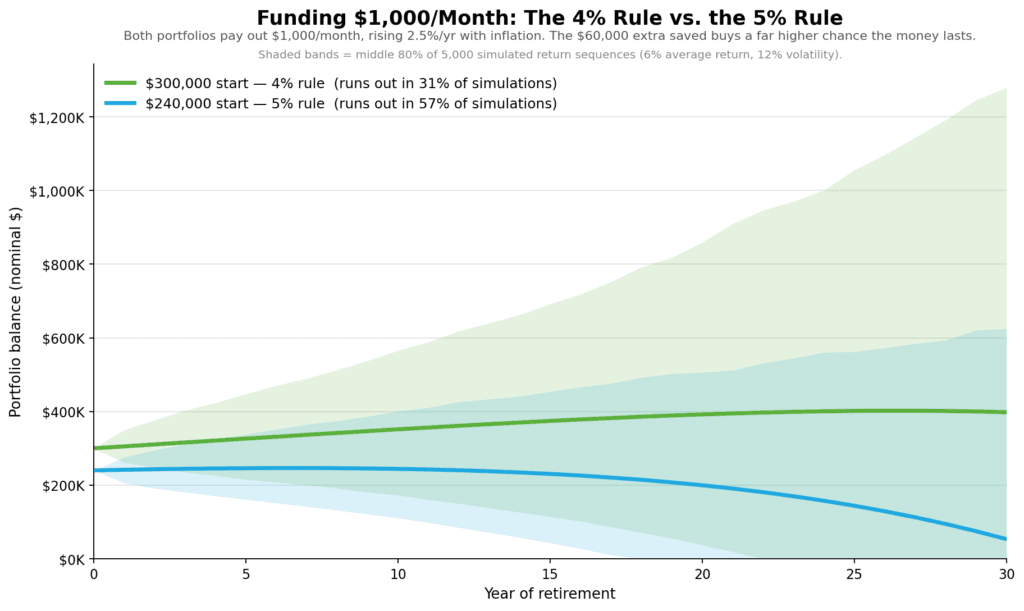
Under the 4% rule, $1,000 a month requires $300,000 in savings — $60,000 more than the $1,000 rule’s $240,000 target. That gap comes entirely from the difference in withdrawal rate: 4% vs. 5%.
The 4% rule was developed by financial planner William Bengen in 1994 and was designed to survive a 30-year retirement across historical market cycles, including the worst periods on record. The $1,000 rule makes no such explicit durability claim.
Which Rule Is More Conservative?
The 4% rule is more conservative by design. Its lower withdrawal rate leaves more money in the portfolio to compound, providing a larger buffer against long retirements and bad markets.
The $1,000 rule’s 5% rate works well as a quick estimate, but it leaves less margin. If you’re planning for a 25- or 30-year retirement — which is realistic if you retire at 62 or 65 — the 4% rule’s math is a safer anchor for your core plan.
When the $1,000 Rule Makes More Sense
The $1,000 rule earns its place when you need a fast reality check, when you’re early in the planning process, or when a shorter retirement horizon (say, 15–20 years) reduces the longevity risk that makes 5% feel stretched.
It also works well as a motivational tool. The clean $240,000-per-$1,000 formula is easy to remember and easy to explain to a spouse or partner planning together.
Combining the $1,000 Rule With Social Security and Pensions
The single biggest upgrade you can make to the $1,000 rule is treating it as one piece of an income stack — not the whole picture. Social Security and pensions are guaranteed income streams that reduce how much your savings need to do.
How Social Security Changes the Target
According to the Social Security Administration, the estimated average monthly Social Security retirement benefit in January 2026 is $2,071. A benefit in that range wipes out nearly two full “units” of the $1,000 rule — meaning $480,000 less you need to accumulate.
Delaying your Social Security claim past your full retirement age increases your benefit by 8% per year up to age 70. That’s one of the most reliable return improvements available to any pre-retiree.
Pensions, Annuities, and Other Guaranteed Income
If you have a pension or have purchased an income annuity, those payments work exactly like Social Security in this framework: subtract them from your monthly spending need before you apply the $240,000 multiplier.
For couples coordinating multiple income streams across joint accounts, the planning in Joint Retirement Accounts: Benefits and Considerations for Couples can help you organize whose assets cover which gap.
Building Your Personal Income Stack
A practical income stack for many retirees looks like this: Social Security as the base, pension or annuity income in the middle (if available), and portfolio withdrawals calculated via the $1,000 rule on top.
This layered approach means your savings only need to cover what guaranteed income doesn’t. That’s a much more achievable target for most people — and it builds in resilience if markets underperform.
Limitations and Risks of the $1,000 a Month Rule
No single formula can capture every variable in a 30-year retirement. Knowing where the $1,000 rule runs thin helps you plan smarter — not worry more.
Inflation Erodes Fixed Withdrawals
The rule’s most significant blind spot is inflation. At a 3% annual inflation rate, the purchasing power of a fixed $1,000 monthly withdrawal drops to roughly $640 in today’s terms after 15 years.
The fix is building an inflation adjustment into your withdrawal plan from the start. Many planners increase withdrawals by 2–3% per year to maintain purchasing power across a long retirement.
Healthcare Costs Are Unpredictable
Healthcare spending tends to rise in the later years of retirement, often precisely when portfolio growth slows. The $1,000 rule uses one flat number for all spending. It can’t capture that late-retirement spending surge.
One tax-efficient strategy to handle unexpected medical bills is covered in The Shoebox Strategy To Pay Medical Expenses Tax-Free. Layering a strategy like that on top of the $1,000 rule helps protect your withdrawal plan from healthcare surprises.
The Rule Doesn’t Account for Account Type or Taxes
A dollar in a traditional 401(k) and a dollar in a Roth IRA are not the same in retirement. Withdrawals from a traditional account are taxed as ordinary income. Roth withdrawals are tax-free. The $1,000 rule ignores this entirely.
If your savings are mostly in pre-tax accounts, your real after-tax income per $240,000 will be lower than the rule suggests. Factor in your expected tax rate when you convert the rule’s output into spending power. The IRS guidance on retirement plan distributions is a useful reference for understanding how withdrawals are taxed.
Common Mistakes to Avoid With the $1,000 Rule
The rule is simple enough to misuse. These are the most common errors (and how to sidestep each one).
Applying the Multiplier to Total Income, Not the Gap
The most expensive mistake is multiplying your full desired monthly income by 240 without subtracting Social Security and pension payments first. That can inflate your savings target by hundreds of thousands of dollars.
Always subtract your guaranteed income sources before applying the formula. Your savings only need to cover what’s left over.
Treating a 5% Rate as Universally Safe
A 5% withdrawal rate can work, but it demands the right portfolio mix and a realistic retirement timeline. Using it as a safe rate for a 35-year retirement with a conservative portfolio is a mismatch.
If your retirement could last 30 years or more, run the numbers at 4% as well. The difference in required savings is real, but so is the difference in how long your money lasts under stress scenarios.
Forgetting to Revisit the Calculation
The $1,000 rule is a point-in-time snapshot. Markets move, spending changes, and Social Security benefits update. A rule of thumb you set at 55 may need adjusting by 62.
Building an annual review into your planning habit — checking your portfolio balance, your projected Social Security benefit at ssa.gov, and your spending estimate — keeps the formula working for you over time.
Real-World Examples: Is the $1,000 Rule Right for You?
Abstract formulas become real when you run them through actual scenarios. Here are three examples across different savings levels and income situations.
Example 1: The Single Retiree With a Solid Social Security Benefit
Maria, 64, wants $3,500 a month in retirement. Her Social Security benefit at 66 will be $1,600 a month. Her gap is $1,900 a month. Using the $1,000 rule: $1,900 x 240 = $456,000 in savings needed.
That’s a very different (and more achievable) number than the $840,000 she’d calculate if she applied the multiplier to her full $3,500 target. The income-gap approach matters.
Example 2: The Couple Catching Up in Their Early 60s
David and Linda, both 61, have $380,000 saved and want to retire at 65. Together they expect $3,200 a month in Social Security. Their target spending is $5,500 a month, leaving a $2,300 gap and a savings target of $552,000.
They need to add roughly $172,000 over four years. In 2026, David is eligible for the SECURE 2.0 super catch-up: up to $35,750 per year into his 401(k) if he’s between ages 60 and 63. Combined with Linda’s contributions, hitting that gap is within reach.
For couples coordinating savings across multiple accounts, How Many Retirement Accounts Can You Have? walks through the options.
The ability to accelerate savings in this window — and build toward a genuinely comfortable retirement — is exactly the kind of momentum that transforms a good plan into a great one.
Reaching that target doesn’t just solve a math problem: it frees up mental bandwidth and creates real budget room for the travel, hobbies, and experiences that make retirement worth living.
Example 3: The Retiree Already Drawing Down
James, 70, retired two years ago with $600,000. He’s withdrawing $2,500 a month ($30,000 a year) — a 5% rate on his starting balance. Markets have been mixed, and his balance is now $580,000.
His actual current withdrawal rate is closer to 5.17% of his current balance. That’s a signal worth watching.
If his portfolio dips further, dropping to $2,200 a month temporarily would reduce the rate and give the portfolio room to recover. Flexibility in early retirement withdrawals is one of the most effective tools available.
The Bottom Line
The $1,000 a month rule is one of the best starting tools in retirement planning precisely because it’s simple enough to use today. Multiply your monthly income gap by 240. You have a target. Now you can act.
Beyond the starting point, the upgrades are straightforward: account for inflation, apply the rule to your income gap (not gross income), stress-test against a 4% rate for long retirements, and layer in Social Security and any other guaranteed income to bring the savings hurdle down to a realistic level.
None of this requires a finance degree. It requires a clear number and a plan to reach it — both of which you now have.
Take action now: calculate your personal income gap using the table in this article, then check your current savings trajectory against your target. One honest look today can change everything about where you land.
Frequently Asked Questions
How much do I need in a 401(k) to get $2,000 a month?
Using the $1,000 a month rule, you need $480,000 saved to generate $2,000 a month at a 5% withdrawal rate. If you have Social Security or pension income that covers part of your spending, your 401(k) only needs to fund the remaining gap — which could bring that target down significantly. For example, $800 a month in Social Security would reduce your required 401(k) balance to $288,000.
Is the $1,000 a month rule safe for a 30-year retirement?
The $1,000 rule’s 5% withdrawal rate carries more risk over a 30-year retirement than the more conservative 4% rule. A 5% rate leaves less portfolio cushion against a bad sequence of early returns, which is the biggest threat to a long retirement. For a 30-year horizon, most financial planners recommend stress-testing your plan at 4% as well to confirm your savings can hold up.
How does inflation affect the $1,000 a month rule?
The basic rule assumes a fixed monthly withdrawal, which means inflation quietly erodes its purchasing power each year. At 3% annual inflation, a fixed $1,000 monthly withdrawal loses roughly a third of its real value over 15 years. The practical fix is to build in annual withdrawal increases of 2–3% from the start, or to calculate your target using a slightly larger initial savings figure as a buffer.
How much do you need to save to get $3,000 a month from your portfolio?
The $1,000 a month rule puts the savings target at $720,000 to generate $3,000 a month. That assumes the full $3,000 comes from your portfolio at a 5% withdrawal rate. If Social Security or a pension covers a portion of that $3,000, you only need $240,000 saved for every $1,000 of the gap that remains after guaranteed income.