

Here is the honest truth: $300,000 is well below the commonly cited retirement benchmarks.
Financial headlines will tell you that you need $1 million, $1.5 million, or more. That can feel discouraging if you are looking at your balance right now.
But those headlines are selling anxiety, not information.
Millions of Americans retire every year with far less than the “recommended” amount — and they live well.
The question is not whether $300K is theoretically perfect. The question is whether it can work for you, in your specific situation.
The answer depends on your age, your other income sources, your spending habits, and a few strategic decisions you can start making today.
This guide gives you the real numbers, real monthly budgets, and a real action plan.
The key: knowing exactly which levers to pull to turn $300K into a foundation you can build on — not a finish line you missed.
Article Highlights
- The 4% rule turns $300,000 into roughly $12,000 per year in portfolio withdrawals — a meaningful income floor to build on.
- Social Security can add $18,000–$24,000+ annually, more than doubling your income and changing the entire retirement picture.
- Age at retirement matters: retiring at 65 vs. 55 changes your required portfolio lifespan by a full decade, which drives your withdrawal strategy.
- Geographic arbitrage can cut living costs by 30–50%, making $300K stretch dramatically further without sacrificing quality of life.
- Catch-up contributions let workers 60–63 save up to $35,750 per year in a 401(k) in 2026, closing savings gaps faster than you might expect.
Can You Actually Retire with $300K? The Honest Answer
What $300K Means Compared to Average Savings
According to the Federal Reserve’s 2022 Survey of Consumer Finances, the median retirement savings for families headed by someone aged 55–64 is approximately $185,000. At $300K, you are meaningfully above that median (ahead of the majority of near-retirees, not behind).
That does not mean $300K alone is enough for everyone. But it is a meaningful starting point, especially when combined with Social Security and a deliberate spending plan.
Think of $300K as one engine of a two- or three-engine plane. It generates income, it grows, and it buys you time. The other engines — Social Security, part-time income, a pension if you have one — do the heavy lifting alongside it.
The Variables That Decide Everything
Two people can both have $300K and have completely different retirements. The variables that matter most: the age you stop working, where you live, your monthly spending target, and whether you claim Social Security early or late.
A 65-year-old with a paid-off home in a low-cost state, collecting $1,800 per month in Social Security, is in a fundamentally different position than a 55-year-old renting in a high-cost city with no benefits yet.
The sections below walk through each variable so you can see exactly where you stand.
Comparing Your Situation to the Benchmarks
Most financial planners use a “10x your final salary” rule of thumb. That benchmark assumes you need to fund retirement entirely from your portfolio. If you have other income streams — and most retirees do — the math changes significantly.
The more reliable question is: how much monthly income do you need, and how much of that can sources other than your portfolio provide? Once you answer that, you will know exactly how hard your $300K needs to work.
How Much Income Will $300,000 Generate in Retirement?
Withdrawal Rate Comparison
The withdrawal rate you choose determines your annual income and how long your money lasts. Here is how the most common strategies compare for a $300,000 portfolio:
| Strategy | Annual Withdrawal | Monthly Income | Notes |
|---|---|---|---|
| 4% Rule | $12,000 | $1,000 | Classic 30-year benchmark |
| 3.5% Rule | $10,500 | $875 | More conservative; suits early retirees |
| 3% Rule | $9,000 | $750 | Maximum longevity protection |
| 5% Rule | $15,000 | $1,250 | Higher risk of depletion after 20 years |
These numbers assume a balanced portfolio and inflation adjustments over time. They are starting points, not guarantees.
How Long Will $300,000 Last?
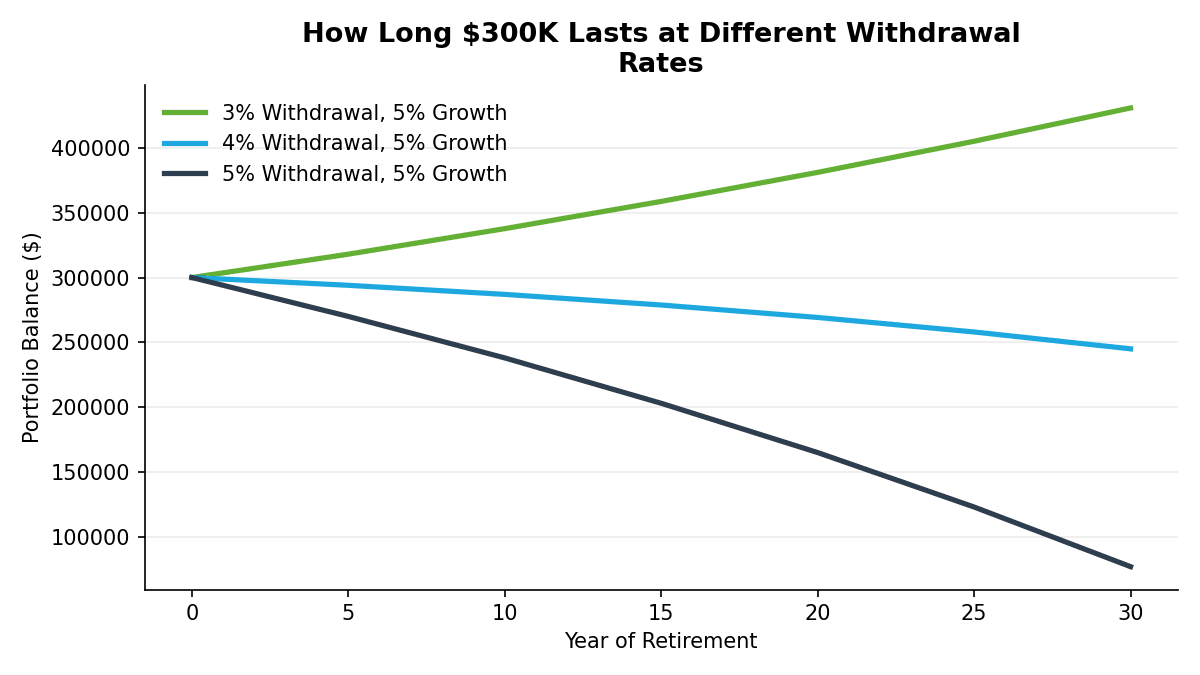
At a 4% withdrawal rate, a balanced portfolio historically lasts 30 years or more in most market scenarios. At 5%, the risk of running out within 20–25 years increases meaningfully.
If you retire at 65, a 30-year runway takes you to 95 — solid coverage for most people. If you retire at 55, you need at least 35–40 years of coverage, which pushes you toward the more conservative 3–3.5% range.
For an even deeper look at the 55-or-younger scenario, see our analysis: Can You Retire at 50 with $300K? (A Detailed Analysis).
The Role of Portfolio Growth
A $300K portfolio that stays in cash loses purchasing power every year. The same portfolio invested in a diversified mix of stocks and bonds has historically grown enough to replenish withdrawals for decades.
A 60/40 portfolio (60% stocks, 40% bonds) has historically produced average annual nominal returns in the range of 4–6%, with inflation-adjusted returns of roughly 2–4%, based on long-term market data. Even modest real growth changes the longevity picture dramatically compared to sitting in a savings account.
Your asset allocation is one of the most powerful decisions you will make.
Realistic Monthly Budgets: What $300K Supports
Budget Scenario 1 — Lean Retirement ($1,800/month total income)
This scenario combines $750–$1,000 from portfolio withdrawals with roughly $1,000–$1,100 in Social Security income (claiming early at 62, per SSA benefit estimates).
| Category | Monthly Amount |
|---|---|
| Housing (owned, no mortgage) | $450 |
| Food & groceries | $350 |
| Transportation | $200 |
| Healthcare (including Medicare Part B) | $350 |
| Utilities | $150 |
| Personal & discretionary | $300 |
| Total | $1,800 |
This budget works in lower-cost regions with a paid-off home. It is tight, but it is real.
Budget Scenario 2 — Comfortable Retirement ($2,800/month total income)
Combining a full Social Security benefit at 67 (roughly $1,800–$2,000/month for average earners) with a 4% withdrawal from $300K adds up to a much more comfortable picture.
| Category | Monthly Amount |
|---|---|
| Housing | $600 |
| Food & dining | $500 |
| Transportation | $250 |
| Healthcare | $350 |
| Travel & leisure | $400 |
| Utilities & subscriptions | $200 |
| Personal & miscellaneous | $500 |
| Total | $2,800 |
This budget includes room for travel and dining out — not a life of sacrifice. For help structuring this in detail, see 7 Ways To Prepare Your Budget For Retirement.
The Healthcare Line Item You Cannot Ignore
Healthcare is consistently the most underestimated budget category for retirees. If you retire before 65, you are not yet eligible for Medicare, which means private coverage can run $500–$1,200+ per month depending on the plan and your state.
Once you hit Medicare at 65, costs drop — but Part B premiums, supplemental coverage, and out-of-pocket expenses still add up to several hundred dollars per month.
One strategy that makes a real difference: a Health Savings Account (HSA).
Contributions grow tax-free, and withdrawals for qualified medical expenses are never taxed. Read how the Shoebox Strategy can pay medical expenses tax-free to stretch your healthcare dollars further.
Age Matters: Retiring at 55, 60, or 65 with $300K
Retiring at 55
At 55, you are looking at a 35–40 year retirement if you live to your mid-90s. Your $300K has to last longer, you cannot claim Social Security yet, and Medicare is a full decade away.
The math works only with significant additional income — part-time consulting, rental income, or a spouse still working. A 3% withdrawal rate ($750/month from the portfolio) is the safer range at this age.
This is a viable path, but it requires the most planning and the most flexibility.
Retiring at 60–62
The early-60s window is where $300K starts to become more workable. At 62, you can claim Social Security (at a reduced rate — the SSA reduces benefits permanently for early claimers). That income bridge changes the equation.
A 3.5% withdrawal rate plus a $1,000–$1,400 monthly Social Security check puts you in $1,750–$2,450 per month territory before any other income. Not luxurious, but livable in the right location.
The big trade-off: every year you delay Social Security past 62 increases your monthly benefit. That decision deserves careful modeling.
Retiring at 65
Age 65 is the sweet spot for $300K. Medicare kicks in, reducing your healthcare costs. You are within two years of your full Social Security age (67 for those born in 1960 or later). Your portfolio needs to last roughly 25–30 years, which aligns well with a 4% withdrawal strategy.
A retiree at 65 with $300K in savings, full Social Security benefits, and a modest lifestyle can genuinely retire well. The income is not lavish, but it is stable and sufficient in most lower- and mid-cost areas.
Filling the Gap: Income Sources Beyond Your Savings
Social Security: Your Biggest Asset
For most Americans, Social Security is worth far more than $300K in portfolio value. A retiree who receives $1,800 per month from Social Security is collecting the equivalent of a $540,000 annuity (at a 4% withdrawal rate).
For workers born in 1960 or later (full retirement age of 67), delaying your claim from 62 to 70 increases your monthly benefit by approximately 77% relative to the age-62 amount, per SSA.gov. Even waiting from 62 to 67 can add hundreds of dollars per month — for life. That is a decision worth running the numbers on carefully.
If you are married, coordinating when each spouse claims can significantly boost your combined lifetime income. Our guide on joint retirement accounts for couples covers how to think through this strategically.
Part-Time Work and Consulting
You do not need a full-time job to close a $500–$1,000 monthly income gap. A part-time job, freelance work, or consulting in your former field can provide that bridge — and often comes with social and mental benefits too.
Even 10 hours per week at $20 an hour generates $800 per month. That single adjustment can turn a strained $300K retirement into a comfortable one, while allowing your portfolio to keep growing instead of shrinking.
Some retirees treat the first five years as a “semi-retirement” phase, reducing work gradually rather than stopping all at once.
Geographic Arbitrage and Cost Reduction
Where you live is a financial decision as powerful as any investment strategy. Moving from a high-cost metro area to a lower-cost city — or country — can reduce your monthly expenses by 30–50%.
States with no income tax on retirement income (Florida, Texas, Nevada, and others) can save thousands per year. Some retirees choose to live abroad part of the year in countries where $1,500 per month covers a comfortable lifestyle.
That kind of cost reduction does more than protect your portfolio. It frees up real money each month for the travel, hobbies, and time with family that make retirement worth living — which is the whole point of building a financial plan in the first place.
Common Mistakes to Avoid
Claiming Social Security Too Early Without Modeling the Trade-Off
Claiming at 62 feels like relief, but it permanently reduces your monthly benefit. For anyone born in 1960 or later, claiming at 62 results in a permanent 30% reduction compared to waiting until your full retirement age of 67, per SSA rules.
Over a 25-year retirement, that gap compounds into hundreds of thousands of dollars in lost lifetime income.
Run the breakeven math before you decide.
For most people who live past their mid-70s, delaying pays off significantly. A fee-only financial planner or the SSA’s own online tools can help you model your specific situation.
Ignoring Inflation Over a Long Retirement
A budget that works at 65 may feel pinched at 80 if you do not account for inflation. Even at a modest 3% annual inflation rate, your purchasing power is cut roughly in half over 24 years.
This is why keeping a meaningful portion of your portfolio in growth assets (stocks, REITs) matters even in retirement. An all-bond or all-cash approach feels safe but erodes your real spending power quietly over time.
Forgetting About Required Minimum Distributions
If your $300K is in a traditional IRA or 401(k), the IRS will require you to take withdrawals starting at age 73 (rising to 75 in 2033 under SECURE 2.0). Those withdrawals are taxable income.
Failing to plan for RMDs can push you into a higher tax bracket or create Medicare surcharges. A Roth conversion strategy in your early retirement years — when income may be lower — can reduce or eliminate future RMDs. Understanding how different account types affect your taxes is a smart early step.
Action Plan: Building Toward and Beyond a $300K Retirement
Max Out Catch-Up Contributions While You Still Can
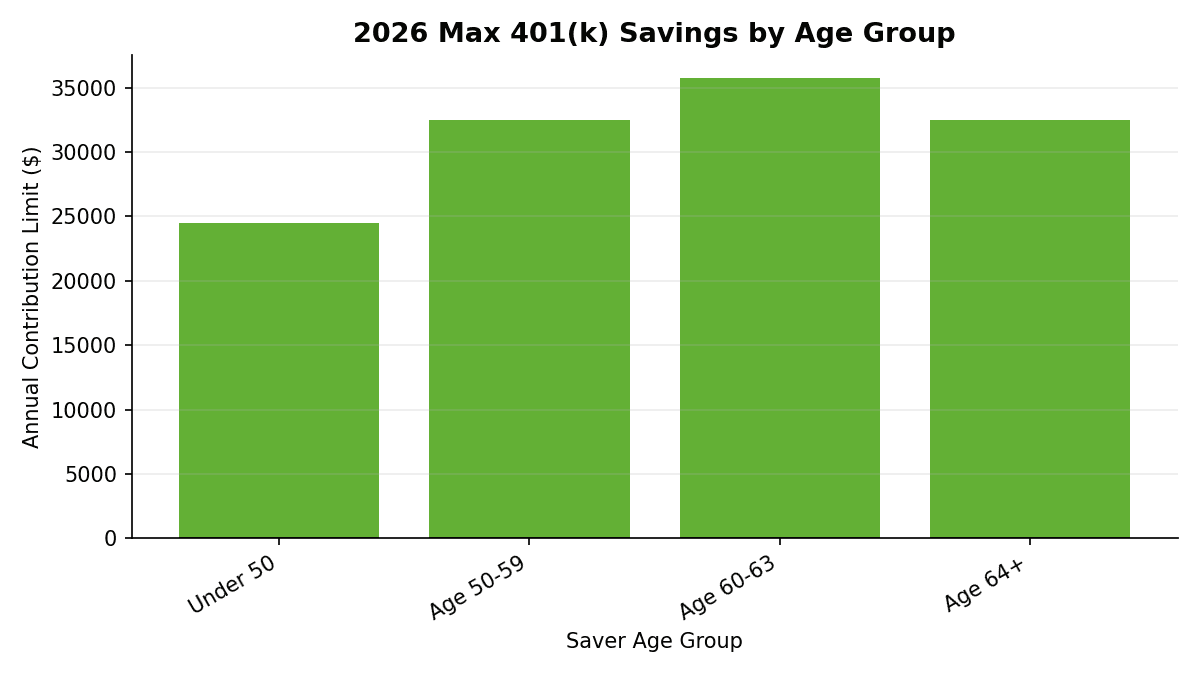
If you are still working and not yet at $300K, the contribution rules for 2026 are generous. Workers 50 and older can contribute up to $32,500 to a 401(k) this year ($24,500 base plus an $8,000 catch-up, per IRS guidance).
Workers aged 60–63 get an even bigger window: a super catch-up provision raises the total to $35,750 per year. At that savings rate, the gap between your current balance and $300K can close faster than you might think.
On the IRA side, savers 50 and older can contribute $8,600 total ($7,500 base plus a $1,100 catch-up) in 2026. Every account you maximize is a compounding engine working in your favor.
Build a Simple Retirement Income Plan
Start with a one-page income plan.
List every income source: Social Security (estimated), portfolio withdrawals at your chosen rate, any pension, any part-time income. Compare the total to your estimated monthly budget.
If there is a gap, you have options: delay retirement slightly, reduce one spending category, add a part-time income stream, or relocate. Knowing the exact gap is far less stressful than the vague fear that something is wrong.
Our retirement budget guide walks through how to build this plan step by step.
Think About the Retirement You Actually Want
A $300K retirement is not the same as a deprived retirement. It is a retirement that requires intention — knowing what you want, spending on that, and cutting what does not matter.
Retirees who report the highest satisfaction tend to be clear about how they spend their time, not just their money. More time with family, more travel, more creative pursuits — those things are available at almost any income level when you are deliberate about them.
That mindset shift is where financial planning and meaningful retirement actually meet.
The Bottom Line
Can you retire with $300K? Yes — with the right strategy, the right income mix, and the right spending plan. It is not a number that works on autopilot, but it is a number that works.
The most important moves: choose your withdrawal rate to match your retirement age, optimize your Social Security claim, keep your portfolio invested for growth, and plan proactively for healthcare costs.
Each of those decisions adds real dollars to your retirement income.
You do not need a million dollars to retire well. You need a plan that is honest about the math and built around the life you actually want.
Take action now: download a one-page retirement income worksheet, estimate your Social Security benefit at ssa.gov, and run your monthly budget against the scenarios in this guide — then you will know exactly where you stand and what your next step is.
Frequently Asked Questions
How long will $300,000 last in retirement?
At a 4% annual withdrawal rate, $300,000 generates $12,000 per year and historically lasts 30 or more years in a balanced portfolio. Withdrawing at 5% increases depletion risk, with money potentially running out in 20–25 years. The lower your withdrawal rate and the higher your portfolio’s growth, the longer your savings last.
What percentage of Americans have $300,000 in retirement savings?
According to the Federal Reserve’s 2022 Survey of Consumer Finances, the median retirement savings for families headed by someone aged 55–64 is approximately $185,000. That means $300K places you above the median for that age group in the U.S. Your challenge is optimization, not starting from scratch.
What is a safe withdrawal rate for retirement savings?
Financial planners widely consider 4% a reasonable starting point for a 30-year retirement, a benchmark derived from historical market research. Retirees who stop working before 65 often use 3–3.5% to extend the portfolio’s life. Your ideal rate depends on your age at retirement, other income sources, and how much flexibility you have in your spending.
Can I retire at 62 with $300,000 in savings?
Retiring at 62 with $300K is possible but requires other income sources, because your portfolio alone generates only $750–$1,000 per month at a safe withdrawal rate. At 62 you can begin claiming Social Security (at a reduced benefit per SSA rules), which can add $1,000–$1,400 or more per month depending on your earnings history. Combining those streams, living in a lower-cost area, and keeping expenses tight makes 62 a realistic target for many people.