

You did the hard part. You saved, planned, and made it to retirement.
Now comes the hard part… keeping what you’ve got.
Most retirement nest eggs don’t run dry from one big disaster. They bleed out slowly, from dozens of small leaks nobody ever notices.
A forgotten streaming service here. A poorly timed Social Security claim there. An investment fee that sounds tiny but compounds into tens of thousands of dollars over a decade.
None of these feel like emergencies. That’s exactly why they’re so dangerous.
The good news: every leak on this list is fixable. Most take less than an afternoon to address.
In this article, you’ll learn 10 specific ways retirees waste money without realizing it, ranked by impact, with step-by-step fixes for each one.
Because protecting your retirement doesn’t require sacrifice. It just requires knowing where to look.
1) Paying Investment Fees That Quietly Compound Against You
What’s being missed
Most retirees know they pay some fees on their investments. Few realize how much.
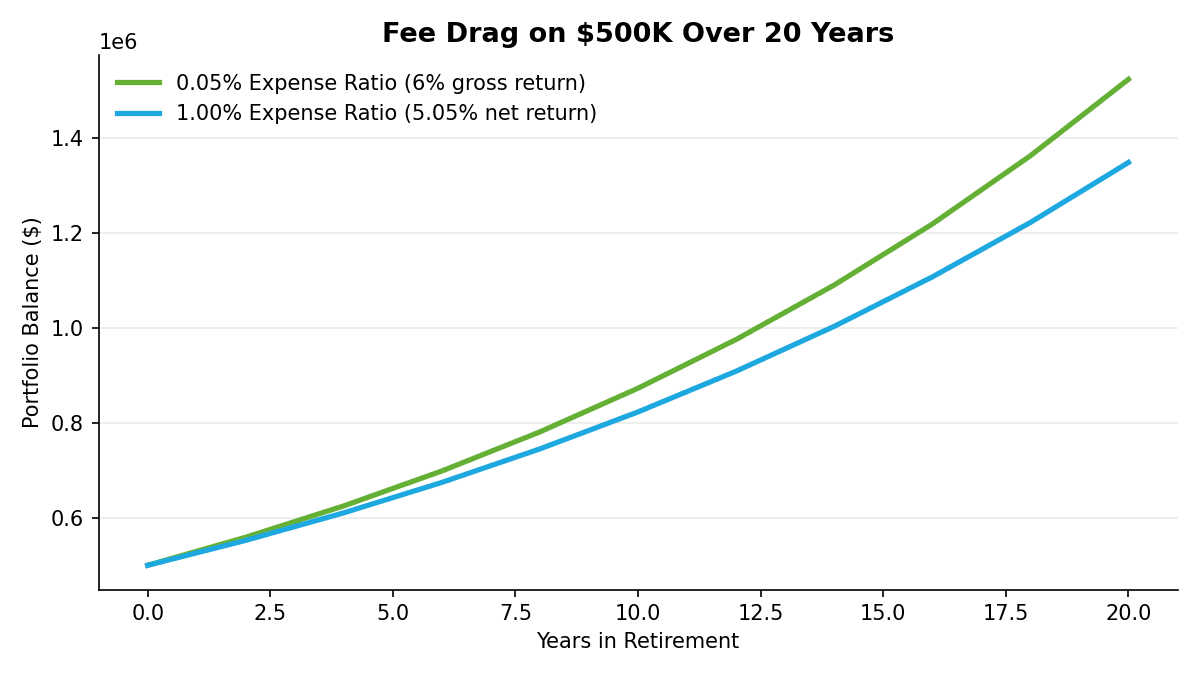
A fund with a 1% annual expense ratio versus a 0.05% index equivalent costs you nearly 20 times more each year. On a $500,000 portfolio, that gap runs roughly $4,750 annually — before you factor in the compounding growth you’re also forfeiting.
Why it matters
Investment fees don’t show up as a line item on your bank statement. They’re deducted silently from your returns. As the chart above shows, that seemingly small difference balloons to over $175,000 by year 20 on a $500,000 portfolio.
How to fix it
- Log in to each account and look up the expense ratio for every fund you hold.
- Target funds with expense ratios below 0.20%.
- Ask any advisor for a written breakdown of all fees, including advisory, fund, and trading costs.
- Switching to lower-cost index funds inside the same account often takes just a few clicks.
2) Claiming Social Security at the Wrong Time
What’s being missed
Millions of retirees claim Social Security the moment they become eligible at 62, leaving significant lifetime income on the table. Per SSA rules, your monthly benefit grows by roughly 8% for every year you delay past full retirement age, up to age 70.
Why it matters
Claiming at 62 versus 70 can mean a difference of approximately 77% in your monthly check (from 70% of your full benefit at 62 to 124% at 70, for those with a full retirement age of 67).
For someone whose full retirement age benefit is $2,000 per month, that’s the difference between $1,400 and $2,480 — every single month, for life. For married couples, the higher earner’s benefit also becomes the survivor benefit, making the timing decision even more consequential.
How to fix it
Use the SSA’s free calculator at ssa.gov to model your break-even age.
If you have other income to bridge the gap, delaying even two or three years delivers a meaningful lifetime boost. Couples should coordinate claims rather than both defaulting to early collection. Our guide on joint retirement account strategies for couples covers how to approach that coordination.
3) Ignoring Required Minimum Distribution Timing
What’s being missed
Under SECURE 2.0, RMDs now start at age 73 (rising to 75 in 2033). Many retirees miss the window between retirement and 73 when they could draw down at lower tax rates — and then get blindsided by large forced distributions later.
Why it matters
When a traditional IRA or 401(k) balance is large and untouched, the IRS-mandated withdrawals that kick in at 73 can be substantial. Those distributions count as ordinary income. A poorly timed RMD can trigger higher Medicare premiums (IRMAA surcharges) and push more of your Social Security benefit into taxable territory.
How to fix it
Consider doing Roth conversions in the years between retirement and age 73 to reduce your future taxable balance. Work with a tax professional to model how much to convert each year while staying within your current bracket. For a deeper look at how account types interact, see our breakdown of the tax implications of retirement accounts.
4) Paying Full Price When Senior Discounts Are Everywhere
What’s being missed
Restaurants, retailers, hotels, airlines, and software companies offer senior discounts that most retirees never ask about. The America the Beautiful Senior Pass, for example, costs $80 one-time for lifetime access to national parks that would otherwise run $35 per visit.
Why it matters
These savings are real and cumulative. A household that actively uses senior discounts on travel, dining, and everyday purchases frees up meaningful budget for the experiences that actually matter — the trips, the hobbies, and the time with people you love.
How to fix it
- Make it a habit to ask “Do you offer a senior discount?” before every purchase.
- AARP membership (as low as $15/year for the first year with auto-renewal, approximately $15–$16/year thereafter per aarp.org) unlocks hundreds of partner discounts, often paying for itself in a single use.
- Research your most frequent spending categories — airlines, hotel chains, and car rentals often have unpublicized rates not listed online.
5) Carrying Subscriptions and Memberships You Forgot About
What’s being missed
After retirement, spending patterns shift. Autopay doesn’t. Gym memberships, streaming services, software subscriptions, and club memberships quietly renew every month whether you use them or not.
Why it matters
At $15–$50 per month each, just four forgotten subscriptions cost $720–$2,400 per year. The psychological trap is that each one feels too small to bother canceling. That’s exactly how they add up.
How to fix it
Pull three months of credit card and bank statements and highlight every recurring charge. Cancel anything you haven’t actively chosen to use in the last 30 days. Then schedule a quarterly subscription audit — 15 minutes, four times a year — to stay ahead of the creep.
6) Underestimating Healthcare Costs and Overpaying for Coverage
What’s being missed
Many retirees enroll in the first Medicare plan they’re offered and never revisit it. Medicare Advantage and Medigap plans vary significantly in out-of-pocket exposure. The best plan at 65 is rarely still the best plan at 72.
Why it matters
Fidelity’s 2026 Retiree Health Care Cost Estimate puts average lifetime out-of-pocket healthcare costs for a 65-year-old couple retiring today at approximately $371,000 ($185,500 per individual). Dental, vision, and hearing — largely uncovered by standard Medicare — add thousands more. Choosing the wrong plan structure can mean paying dramatically more for identical care.
How to fix it
Review your Medicare plan every year during Open Enrollment (October 15 – December 7) using the Plan Finder tool at medicare.gov. If you have a Health Savings Account from a prior employer, those pre-tax dollars can cover qualified Medicare premiums. Our article on the Shoebox Strategy for tax-free medical expenses shows exactly how to stretch those dollars further.
7) Supporting Adult Children at the Expense of Your Own Security
What’s being missed
One of the most emotionally difficult money leaks in retirement is financial support for adult children or grandchildren. It’s rarely one large gift. It’s a pattern of phone bills, rent deposits, and “just this once” emergencies that gradually become expected.
Why it matters
There are no retirement loans. Every dollar redirected from your portfolio is a dollar that won’t compound over the next 15–20 years. Parents who quietly subsidize adult children often do so at the cost of their own long-term care planning — which creates a larger crisis down the road for everyone in the family.
How to fix it
Set a clear, written family gifting budget each year — an amount you can give without impacting your plan. Make it a gift, not a loan. Have honest conversations with your kids about your financial boundaries early. Our guide on preparing your budget for retirement includes strategies for building these boundaries into your plan from day one.
8) Keeping Too Much Cash Sitting in Low-Yield Accounts
What’s being missed
In a well-intentioned effort to feel safe, many retirees keep far more cash in checking or basic savings accounts than they need. Cash earning 0.01% in a traditional savings account is silently losing purchasing power every month to inflation.
Why it matters
A $100,000 cash buffer earning 0.01% annually earns $10. The same amount in a high-yield savings account or short-term Treasury ladder can earn significantly more. Keep that money working without sacrificing liquidity.
How to fix it
- Decide on a genuine cash buffer: 6–12 months of essential expenses.
- Move anything beyond that into a high-yield savings account, money market fund, or short-term CD ladder.
- Compare current rates at bankrate.com — the difference is often dramatic and the switch takes under an hour.
9) Overpaying on Housing Costs You Can Control
What’s being missed
The mortgage may be paid off, but housing still devours retirement budgets through property taxes, homeowner’s insurance, utilities, and maintenance. Most states offer property tax exemptions specifically for seniors — and most eligible homeowners never apply.
Why it matters
Overpaying across just three housing line items — insurance, taxes, and utilities — can easily cost $3,000–$6,000 per year more than necessary. Recapturing that money doesn’t just improve the math. It frees up real room in your budget for travel, hobbies, and more time with the people you care about most.
How to fix it
- Call your county assessor’s office and ask about senior property tax freeze or exemption programs in your state.
- Get competing quotes on homeowner’s insurance every two years — loyalty rarely pays.
- Ask your phone, internet, and energy providers specifically about senior or low-usage rates.
10) Never Building (or Revisiting) a Written Retirement Budget
What’s being missed
The common thread running through all nine items above is the same: no written spending plan. Without one, waste is invisible. Subscriptions auto-renew, fees go unnoticed, and spending drifts upward in early retirement when energy is high and habits haven’t yet adjusted.
Why it matters
Research consistently shows that retirees with a written budget feel more confident and report higher satisfaction — independent of account balance. A budget isn’t a restriction. It’s a tool that tells your money where to go instead of wondering where it went.
How to fix it
Start with a zero-based review once per year: list every income source, every expense category, and every automatic payment. Assign every dollar a job.
Our article on essential tips for a better retirement budget walks through this process step by step with retirement-specific guidance. Schedule it like a bill — same month, every year.
Conclusion
None of the leaks on this list are your fault. They’re products of how financial systems are designed: quiet, automatic, and easy to ignore.
But now you know where to look. Fixing even three or four of these can meaningfully extend how long your money lasts and how freely you live.
Start with the one that stings most. Run the audit. Make the call. Switch the fund.
Small moves, done consistently, build the retirement you actually planned for.
Your money worked hard to get here. Now make sure it’s working hard for you.