

Fidelity’s 2026 Retiree Health Care Cost Estimate puts the figure at $185,500 for a single 65-year-old retiree — a number that can feel paralyzing. It does not have to.
The good news is that the tax code has built some remarkably powerful tools specifically for this challenge.
Health Savings Accounts, retiree Health Reimbursement Arrangements, and a handful of related options can quietly stack up a serious medical reserve while your regular retirement accounts handle everyday living.
Most people think of an HSA as a use-it-or-lose-it spending card for copays. It is actually one of the most efficient long-term savings vehicles in the entire tax code, and it gets more useful, not less, as you approach retirement.
The catch is that eligibility rules, contribution windows, and Medicare enrollment timing all interact in ways that trip people up. Understanding the landscape now means you capture every dollar available to you before that window closes.
The key? Getting clear on which accounts you qualify for today, how each one behaves in retirement, and which providers make the most of your money.
Article Highlights
- Triple tax advantage: HSA contributions, growth, and qualified withdrawals are all tax-free, making it the only account with three layers of tax protection.
- 2026 contribution limits: The IRS sets the HSA limit at $4,400 for self-only coverage and $8,750 for family coverage, plus a $1,000 catch-up for age 55+.
- Age-65 flexibility: After turning 65, you can withdraw HSA funds for any purpose without penalty, paying only ordinary income tax on non-medical withdrawals.
- No required minimum distributions: Unlike a 401(k) or traditional IRA, an HSA carries no RMD rule, letting your balance compound on your timeline.
- Top HSA providers in 2026: Fidelity, Optum, and Lively consistently rank highly for low fees and strong investment menus, but the right fit depends on your balance and goals.
Types of Retirement Health Savings Accounts Explained
Not all retirement health savings accounts work the same way. Some you fund yourself; others come from an employer. Knowing the differences upfront saves you from choosing the wrong strategy.
Health Savings Accounts (HSAs): The Gold Standard
An HSA is a personal savings account paired with a High-Deductible Health Plan (HDHP). You own it outright, it never expires, and every dollar you do not spend this year rolls over to next year.
The account earns interest or investment returns tax-free. When you pull money out for qualified medical expenses, you pay zero taxes. That combination of pre-tax contributions, tax-free growth, and tax-free withdrawals is unique in the savings world.
For retirement planning, the most important feature is portability. The account follows you from job to job and into retirement, growing the entire time.
Retiree Health Reimbursement Arrangements (HRAs)
A retiree HRA is funded entirely by your former employer, not by you. After you separate from service, the company deposits a set amount into an account you can use to reimburse qualified medical expenses and insurance premiums.
You cannot contribute your own money, and you cannot invest the balance for growth. But the reimbursements are tax-free, and for retirees with access to a generous HRA, it can meaningfully offset Medicare premiums and out-of-pocket costs.
Not every employer offers one. Federal employees and many large-company retirees are most likely to encounter this benefit.
Other Options: FSAs, Medicare MSAs, and ABLE Accounts
A Flexible Spending Account (FSA) is employer-sponsored and generally use-it-or-lose-it within the plan year, making it a poor long-term retirement vehicle. It is worth using for current-year medical costs, but it does not build the kind of reserve an HSA can.
A Medicare Medical Savings Account (Medicare MSA) pairs with a high-deductible Medicare Advantage plan. Medicare deposits money into the account; you use it for qualifying costs. Availability is limited and enrollment rules differ from standard HSAs.
For retirees with disabilities, an ABLE account offers another tax-advantaged savings option for disability-related expenses. Contribution limits are much lower, but the accounts are worth knowing about if they apply to your situation.
| Account Type | Who Funds It | Tax Benefits | 2026 Contribution Limit | Best For |
|---|---|---|---|---|
| HSA | You (+ employer optional) | Contributions, growth, and qualified withdrawals all tax-free | $4,400 self / $8,750 family + $1,000 catch-up | Pre-retirees on an HDHP building a long-term reserve |
| Retiree HRA | Employer only | Reimbursements tax-free | Employer sets the amount | Retirees whose former employer offers the benefit |
| Medicare MSA | Medicare (via plan) | Deposits and qualified withdrawals tax-free | Plan-determined | Medicare Advantage enrollees in eligible MSA plans |
| FSA | You + employer | Pre-tax contributions | $3,400 (2026, healthcare FSA) | Current-year medical expenses only |
| ABLE Account | You + family/employer | Growth and qualified withdrawals tax-free | $20,000 (2026) | Retirees with qualifying disabilities |
Eligibility Requirements and Contribution Limits
The rules that determine who can contribute to an HSA are stricter than most people expect. Getting them right, especially around Medicare enrollment, is where a lot of pre-retirees lose money they could have kept.
HSA Eligibility: The HDHP Requirement
Per IRS Publication 969, you must be enrolled in a qualifying High-Deductible Health Plan to make HSA contributions. For 2026, a qualifying HDHP has a minimum deductible of $1,700 for self-only coverage or $3,400 for family coverage, per IRS Rev. Proc. 2025-19.
You also cannot be claimed as a dependent on someone else’s tax return, and you cannot have any disqualifying coverage, including most general-purpose FSAs run by a spouse.
One common misconception: if you enroll in Medicare Part A or Part B, even at 65, you lose HSA contribution eligibility from that month forward. The clock matters here.
2026 Contribution Limits and the Catch-Up Bonus
The IRS sets 2026 HSA limits at $4,400 for self-only HDHP coverage and $8,750 for family coverage, per IRS Rev. Proc. 2025-19. If you are 55 or older, you can add an extra $1,000 catch-up contribution on top of the standard limit.
That catch-up is per eligible individual, not per account. If both spouses are 55 or older and both are HSA-eligible, each can contribute the extra $1,000, but they must hold separate HSAs to do it.
Maxing out every eligible year between 55 and Medicare enrollment can realistically build a five-figure medical reserve before you ever touch it.
The Medicare Enrollment Timing Trap
This is the most costly mistake pre-retirees make.
When you enroll in Medicare, your HSA contribution window closes. That applies even if you sign up for Social Security benefits before 65, because SSA automatically back-dates Medicare Part A enrollment up to six months.
If you plan to delay Medicare and keep contributing to your HSA, stop Social Security benefit claims until you are ready to close the contribution window intentionally. A few months of miscalculation can create an IRS excess contribution penalty.
For federal employees navigating FEHB alongside these rules, our guide on FEHB and Medicare Part B walks through how the two interact.
Tax Advantages of Health Savings Accounts in Retirement
The triple tax advantage of an HSA is real, and it compounds in a way that no other retirement account can match. Here is how each layer works and why it matters more the longer you hold the account.
Layer One: Pre-Tax Contributions
Every dollar you contribute to an HSA reduces your taxable income for the year. If you contribute through payroll deduction, you also skip FICA taxes, which saves an additional 7.65% on those dollars that a direct contribution would not.
That immediate tax reduction means the government is effectively subsidizing your medical savings. A $4,400 contribution might only cost you $2,800 or $3,100 out of pocket depending on your tax bracket.
That is a better first-year return than almost any investment can deliver.
Layer Two: Tax-Free Growth
Inside an HSA, your balance earns interest or investment returns without generating a tax bill each year. No capital gains taxes, no dividend taxes, no year-end statements requiring you to report anything.
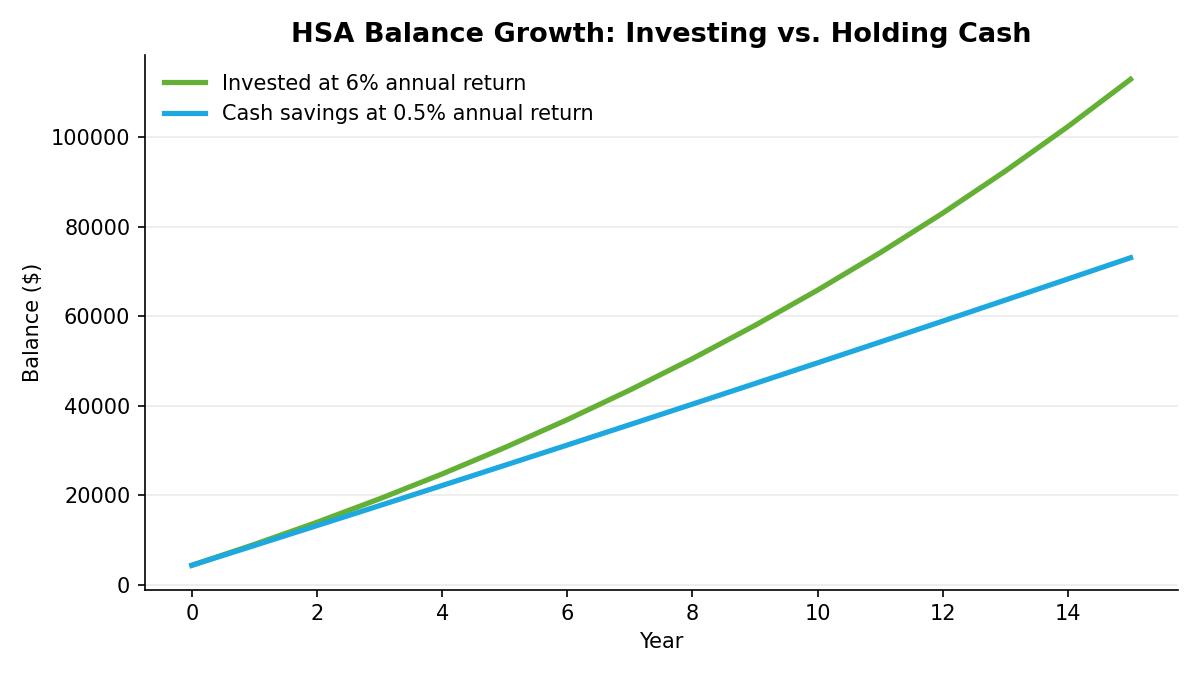
Over a 10- or 15-year accumulation window, that compounding without tax drag can add tens of thousands of dollars compared to a taxable account holding the same investments.
The chart below shows what that compounding curve looks like across a 15-year horizon.
Layer Three: Tax-Free Withdrawals (and the Age-65 Bonus)
Pull money out for qualified medical expenses at any age and you pay no federal income tax. The IRS list of qualifying expenses is broad: deductibles, copays, prescriptions, dental, vision, hearing aids, and, critically, Medicare premiums (including Part B, Part D, and Medicare Advantage premiums).
After age 65, the rules get even more flexible. You can withdraw HSA funds for any purpose, medical or not, and simply pay ordinary income tax on non-medical withdrawals. No penalty. That makes an aged-up HSA behave almost identically to a traditional IRA, with the bonus that medical withdrawals remain completely tax-free.
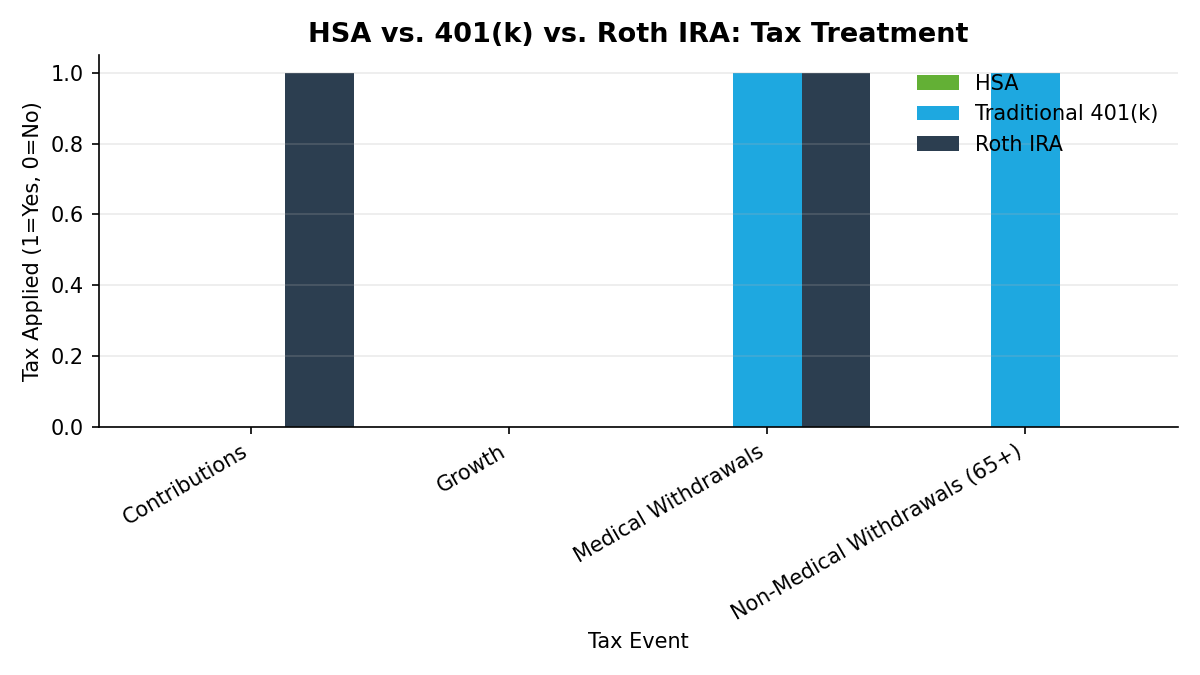
That flexibility is what makes the HSA the most versatile account in a retirement portfolio.
There is a broader benefit worth naming here. When your medical costs have their own dedicated funding source, more of your retirement income stays free for the things you actually want to do with this chapter of your life: travel, family, passion projects, and adventures you have been planning for years. That is the quiet power of building this reserve early.
HSA Investment Strategies for Long-Term Retirement Growth
Most people leave HSA dollars sitting in a low-yield savings balance. That is a missed opportunity. Investing your HSA like a retirement account is how you turn a modest annual contribution into a meaningful medical reserve.
The Pay-Out-of-Pocket Strategy
One of the most powerful HSA tactics is surprisingly simple: pay current medical bills out of your own pocket and let your HSA balance grow untouched.
The IRS does not require you to reimburse yourself in the same year as the expense. You can save receipts for years, let the account compound, and withdraw a tax-free lump sum later, backed by those documented expenses.
This turns your HSA into a stealth investment account. Every dollar that stays invested longer has more time to grow.
Choosing the Right Investment Mix
Most HSA providers offer a menu of index funds, target-date funds, and sometimes ETFs once your balance clears a minimum threshold (often $1,000 to $2,000 depending on the provider).
For balances intended as long-term retirement reserves, a diversified stock/bond mix appropriate for your timeline makes sense, similar to how you would invest a 401(k) you do not plan to touch for a decade.
For the portion you expect to need within two or three years for known medical costs, a stable money market or short-term bond fund gives you access without market timing risk.
Coordinating HSA Investing With Your Other Retirement Accounts
Think of your HSA as the account you tap first for medical costs in retirement, ahead of your IRA or 401(k). That sequencing protects tax-deferred dollars from being depleted by healthcare bills.
A practical priority order: contribute enough to your 401(k) to capture any employer match (that is free money). Then max your HSA. Then go back to the 401(k) or IRA with anything left.
The HSA earns its spot near the top of that list because no other account gives you a tax-free path specifically for medical spending, which will be one of your largest retirement costs.
Best HSA Providers and Account Features Comparison
The provider you choose shapes how your HSA performs over time. Fees, investment menus, and account minimums vary enough to matter, especially over a decade of compounding.
What to Look for in an HSA Provider
Prioritize four things: monthly maintenance fees (look for zero or low), the investment threshold (the lower the better), the investment menu (broad index funds with low expense ratios), and digital ease of use.
Some providers charge $2 to $5 per month in account fees. Over 15 years, that erodes hundreds of dollars that could have stayed invested. Fee-free options exist, so there is no reason to accept unnecessary charges.
Also check whether the provider offers a debit card for direct expense reimbursement and whether receipts can be stored digitally in the account portal.
Top Providers Worth Considering in 2026
Fidelity consistently earns top marks: no monthly fees, no minimum to invest, and a strong index fund menu. It is a strong default choice for most savers.
Optum Bank is widely used through employer-sponsored plans. Its investment options are solid, though some plans carry administrative fees depending on employer agreements. Check your specific plan before assuming the costs.
Lively and HSA Bank round out the top tier for individual (non-employer) accounts, each offering no-fee structures and investment access through partnerships with major brokerages. Confirm current fee schedules directly with each provider before opening an account, as these are updated periodically.
Employer-Sponsored vs. Individual HSAs
If your employer offers an HSA through payroll deduction, that is almost always the better starting point because payroll contributions dodge FICA taxes. Check whether the plan allows you to invest once you hit the minimum balance.
When you retire or change jobs, you can roll your balance over to any individual HSA provider without penalty. This means you are not locked in forever. A rollover to a fee-free, investment-friendly provider is straightforward and worth doing if your employer plan has high fees.
Per IRS Publication 969, direct trustee-to-trustee HSA transfers are unlimited and never count as taxable distributions. The one-per-12-month restriction applies only to indirect rollovers, where you receive the funds personally and redeposit them within 60 days.
Using HSA Funds in Retirement: Rules and Strategies
Knowing how to spend your HSA wisely is just as important as knowing how to build it. The rules around qualified expenses are broader than most people realize, especially once Medicare enters the picture.
Qualified Medical Expenses: A Broader List Than You Think
The IRS publishes a full list in Publication 502, and it covers more ground than copays and prescriptions. Long-term care insurance premiums (up to age-based IRS limits), dental work, vision correction including LASIK, hearing aids, and mental health services all qualify.
In retirement, Medicare Part B premiums, Part D premiums, and Medicare Advantage premiums are all qualified HSA expenses. This is a major advantage because most retirees pay these every month.
One notable exclusion: Medigap (Medicare Supplement) premiums do not qualify as HSA-reimbursable expenses. That distinction matters when comparing Medicare coverage strategies.
Covering Long-Term Care Costs
Long-term care is one of the largest unplanned expenses in retirement, and HSA funds can help in two ways. You can use the balance to pay directly for qualified long-term care services. You can also use it to pay premiums on a tax-qualified long-term care insurance policy, up to the IRS-set limit for your age.
The deductible LTC premium limits are updated annually and published in IRS Publication 502. Look up the current age-based limits for your bracket before deciding how much HSA capacity to reserve for this purpose.
Even a partial buffer here reduces the pressure on other retirement accounts when care costs arrive.
Coordinating HSA Withdrawals With Medicare and Social Security
Once you are on Medicare, you can no longer contribute to an HSA, but you can spend what you have built with full tax-free benefits. Using HSA funds for Medicare premiums essentially makes those premiums tax-free, something no other account can do.
If your Social Security benefit is subject to income-related Medicare premium surcharges (IRMAA), strategic HSA withdrawals for medical expenses can sometimes help manage your adjusted gross income in ways that reduce future IRMAA exposure. A tax professional familiar with retirement income can model this for your situation.
For a broader look at how Medicare fits your overall retirement health plan, our Medicare for Beginners guide is a good next read.
Common Mistakes to Avoid
A few predictable missteps cost HSA holders thousands of dollars every year. Knowing them in advance is all it takes to sidestep every one.
Spending Every Dollar Instead of Investing
Treating your HSA like a monthly spending card instead of a long-term investment account is the single most common mistake. Every dollar you spend on a $30 copay today is a dollar that cannot compound tax-free for the next 20 years.
If you can afford to pay current medical bills from regular cash flow, do it. Let the HSA grow. Keep receipts for every out-of-pocket expense you pay yourself, because you can reimburse yourself later, years later, with tax-free dollars.
That patience is the difference between a modest balance and a significant medical reserve.
Missing the Medicare Enrollment Timing Window
As covered earlier, enrolling in Medicare or Social Security before you are ready to close your HSA contribution window can trigger excess contribution penalties and require amended tax returns.
The fix is simple: plan the transition deliberately. Decide in advance when you will enroll in Medicare, stop contributions before that date, and keep records showing the month eligibility ended.
If you are a federal employee with FEHB coverage, the interaction between FEHB, Medicare, and HSA eligibility adds another layer. Our guide on FEHB health insurance in retirement covers the specifics.
Choosing a High-Fee Provider and Ignoring Investment Minimums
Paying $3 to $5 per month in maintenance fees on a $5,000 balance is the equivalent of a 0.72% to 1.2% annual drag, before you even factor in investment expenses. That matters.
Also, many providers require a $1,000 or $2,000 cash minimum before allowing any investment. If your provider holds $2,000 idle in a 0.01% savings account while the rest earns market returns, you are leaving money on the table. Choose a provider with the lowest investment threshold you can find, or negotiate the threshold by maintaining a higher overall balance.
Fidelity currently offers HSA investing with no minimum and no fees, which sets the standard worth benchmarking other providers against.
Building Your Medical Nest Egg: Next Steps
Building a retirement health savings account strategy is not about being pessimistic about your health. It is about being smart enough to protect the rest of your retirement from an expense category that will show up no matter what.
An HSA used well is a triple tax-advantaged account that grows for decades, covers Medicare premiums tax-free, and still gives you penalty-free access after 65 even for non-medical needs. No other account in the tax code does all three.
Start by confirming your HDHP eligibility and contribution room for 2026. Open or review your HSA provider. Automate contributions at the maximum you can afford, including the catch-up if you are 55 or older. Then invest the balance and let it compound.
The window to contribute closes when Medicare begins. Every month between now and then is an opportunity.
Take action now: check your HDHP enrollment status, calculate your 2026 HSA contribution room including any catch-up, and move your balance to a low-fee, investment-friendly provider if you have not already. Your future self will thank you at every Medicare premium statement.
Frequently Asked Questions
Is there an HSA specifically for retirees?
There is no separate HSA product for retirees, but the standard HSA becomes especially powerful in retirement. Once you turn 65, you can withdraw funds for any purpose without penalty and use your balance to pay Medicare premiums tax-free, a benefit no other account offers. Contribution eligibility ends when you enroll in Medicare, but spending a balance you built during your working years continues indefinitely.
Can you withdraw HSA funds penalty-free for non-medical expenses after 65?
Yes. Per IRS rules, once you reach age 65 you can take HSA distributions for any reason without the 20% penalty that applies to younger account holders. Non-medical withdrawals are simply added to your ordinary taxable income for the year, the same treatment a traditional IRA withdrawal receives. Withdrawals for qualified medical expenses remain completely tax-free at any age.
Where is the best place to open an HSA?
The best HSA provider for most people combines zero monthly fees, a low or no investment minimum, and a broad index fund menu. Fidelity currently offers all three for individual HSA accounts, making it a strong benchmark. If your employer offers an HSA through payroll deduction, start there to capture FICA savings, then evaluate rolling to a fee-free individual provider when you leave.
What are the best ways to use HSA funds in retirement?
The highest-value use is paying Medicare premiums, including Part B, Part D, and Medicare Advantage premiums, because those withdrawals are tax-free and most retirees pay them every month without thinking of them as reimbursable. Covering out-of-pocket costs for dental, vision, hearing, and long-term care services or qualified LTC insurance premiums are also strong uses. After age 65, any remaining balance can cover non-medical expenses at ordinary income tax rates, giving you a flexible backup reserve.