

After decades of federal service, you’ve earned something most Americans will never have: access to one of the most flexible employer-sponsored health systems in the country… and the right to take it with you into retirement.
FEHB, the Federal Employees Health Benefits program, covers millions of retirees and their families across the country. It offers hundreds of plan options, strong government premium support, and — unlike most private-sector retiree coverage — it never expires as long as you qualify.
If you’re within a few years of retirement, the decisions you make now about FEHB could shape your healthcare costs and choices for the next 20 or 30 years. Coordinating it correctly with Medicare alone can save thousands of dollars annually.
The rules are straightforward once you know them, and the flexibility you gain is remarkable. The key? Understanding three simple eligibility requirements before you submit your retirement paperwork and then building a smart plan from there.
Article Highlights
- 5-year coverage rule: You must have been enrolled in FEHB for the 5 years of service immediately before retirement to carry it into retirement. Prior enrollment periods can count toward that total in certain situations.
- Government pays most of the bill: The federal government pays the lesser of 72% of the weighted average premium or 75% of your chosen plan’s premium. That’s a substantial contribution which continues through retirement.
- Medicare coordination: Pairing FEHB with Medicare Part A and Part B can reduce or eliminate most out-of-pocket costs, but Part B comes with its own monthly premium.
- No annual open enrollment lock-in: Unlike many plans, FEHB lets you switch plans every year during the Federal Benefits Open Season (typically early November through early December).
- Survivor coverage available: A qualifying survivor annuity can allow your spouse or eligible family members to keep FEHB coverage after your death.
What Is FEHB and Can You Keep It in Retirement?
How FEHB Works for Active Employees
The Federal Employees Health Benefits program is the health insurance marketplace run by the U.S. Office of Personnel Management (OPM). It gives federal employees access to a wide range of private health plans — HMOs, PPOs, fee-for-service plans, and consumer-driven options — all under one umbrella.
During your working years, you pick a plan during Open Season or after a qualifying life event, and the government automatically covers the lion’s share of your premium. You never have to shop the open market or worry about being denied for pre-existing conditions.
What makes FEHB special is what happens next. It doesn’t have to end when your career does.
FEHB in Retirement: The Big Picture
If you meet the eligibility requirements (covered in the next section), your FEHB coverage continues seamlessly into retirement. Your plan doesn’t reset. Your doctors don’t disappear. Your premium support from the government continues.
This is a genuinely rare benefit.
Most private-sector workers lose employer health coverage the day they retire and must bridge to Medicare on their own — often at significant expense. As a federal retiree, you start retirement with a robust, government-backed health plan already in your corner.
For a broader look at all the federal health options available to you, see our guide to Federal Health Insurance Options for Retirees.
Who Administers FEHB in Retirement?
Once you retire, OPM takes over from your agency as the administrator of your FEHB enrollment.
Your premiums are deducted directly from your annuity payment so there’s no bill to remember and no risk of accidentally lapsing coverage.
OPM communicates plan changes, Open Season notices, and premium updates directly to annuitants. Keeping your mailing address and contact information current with OPM is one of the simplest and most important things you can do to protect your coverage.
The Three Rules for Maintaining FEHB Coverage Into Retirement
Rule 1: The 5-Year Coverage Requirement
Per OPM retirement eligibility guidance, you must have been enrolled in FEHB (or covered as a family member under FEHB) for the five years of service immediately before your retirement date.
This is the rule that trips up the most people.
Importantly, those five years don’t have to be a single unbroken stretch in every situation. OPM’s rule states that prior enrollment periods can be combined to meet the requirement — so a break in federal service doesn’t automatically reset your clock (but you need to be careful here). What does reset the clock is voluntarily dropping your FEHB enrollment while you were continuously employed and then re-enrolling later.
The good news: if you’re within five years of retirement and currently enrolled, you just need to stay enrolled. Don’t drop your FEHB coverage to save a few months of premiums. The lifetime value of carrying it into retirement is far greater.
Rule 2: Retiring on an Immediate Annuity
You must be retiring with an immediate annuity. That means your pension begins upon retirement, commencing the day after your separation from federal service. Deferred retirement (where you leave federal service but delay your pension to a later date) does not qualify you to carry FEHB into retirement.
This rule applies to both CSRS (Civil Service Retirement System) and FERS (Federal Employees Retirement System) retirees. Most employees who work to their full retirement age and leave voluntarily will meet this requirement without any extra steps.
If your situation involves a deferred retirement, talk with your HR office well before your planned departure. Your options for health coverage during the gap period are limited.
Rule 3: Retiring Under a Qualifying Retirement System
You must be retiring under a retirement system for civilian federal employees — primarily CSRS or FERS. Certain other groups, including some non-appropriated fund employees and employees of specific federal agencies, may have different rules.
Most career federal civilian employees will meet this requirement automatically.
But if you’ve had a non-traditional federal employment history — intermittent work, breaks in service, or positions under different retirement systems — it’s worth confirming your status with your agency’s HR office before you finalize your retirement date.
Meet all three rules, and your FEHB coverage carries forward for life. It’s one of the most valuable rewards of a federal career.
FEHB Costs and Government Contributions During Retirement
How Much Does FEHB Cost in Retirement?
Here’s the headline: the government’s premium contribution doesn’t shrink when you retire.
OPM pays the lesser of 72% of the program-wide weighted average premium or 75% of your chosen plan’s total premium — the same formula as during your working years.
In practice, enrollees in lower-cost plans receive the full 75% contribution, while those in higher-cost plans receive the 72% weighted-average cap which may represent a smaller share of that particular plan’s total cost.
Per OPM’s 2026 premium tables, the weighted average total monthly premium for Self Only coverage is approximately $977.28, with the government contributing up to $703.65 and the average enrollee share running about $273.63 per month.
Actual enrollee shares vary widely by plan. Lower-cost options can run under $150 per month, while higher-cost plans can exceed $400 per month.
Your exact premium depends on which plan and coverage tier (Self Only, Self Plus One, or Self and Family) you choose. The key difference from your working years: premiums are now deducted from your monthly annuity check rather than your paycheck — but the math is essentially the same.
![Grouped bar chart showing illustrative monthly FEHB premium splits between government and retiree contributions across three coverage tiers: Self Only, Self Plus One, and Self and Family. The government share is approximately 72% in each tier. Note: Exact 2026 premiums vary by plan — use OPM's comparison tool for current figures. [VERIFY: 2026 FEHB average premium figures by tier for annuitants to replace illustrative values]](https://heroretirement.com/wp-content/uploads/2026/07/chart1-9.png)
That steady, government-subsidized premium is worth more than the number alone suggests.
When your biggest healthcare cost is predictable and mostly covered, it frees up real room in your monthly budget for the travel, family time, and experiences that make retirement meaningful.
Tax Treatment of FEHB Premiums in Retirement
During your working years, FEHB premiums were deducted pre-tax through the Federal Flexible Benefits Plan (known as the premium conversion benefit). In retirement, that automatic pre-tax treatment no longer applies. Your premiums are paid from after-tax annuity income.
This is a subtle but real change.
If you’re eligible for an HSA-qualified High Deductible Health Plan (HDHP), contributing to a Health Savings Account while you’re still working can help offset this. For a deep dive on how HSAs can serve you into retirement, see our guide on Retirement Health Savings Accounts (HSAs): A Dual Benefit.
Consult a tax professional about whether FEHB premiums may be deductible as a medical expense on your individual return, since that depends on your overall medical costs and adjusted gross income.
What Happens to Premiums Over Time?
FEHB premiums adjust every year, and historically they have increased over time — though the government’s proportional contribution increases alongside yours, so you’re never absorbing the full impact alone.
During Open Season each fall, you can switch to a lower-premium plan if your current one has become too expensive or if your healthcare needs have changed.
This annual flexibility is one of FEHB’s greatest strengths: you’re never locked in forever.
Building a modest buffer in your retirement budget for annual premium increases is a smart planning move. Even small annual increases compound over a 20- or 25-year retirement.
How FEHB Works Alongside Medicare
Medicare Part A: Likely Free and Worth Having
Most federal retirees are eligible for Medicare Part A (hospital insurance) at age 65 at no premium cost, as long as you or your spouse paid Medicare taxes for at least 10 years.
Medicare tax coverage for federal workers depends on hire date and retirement system: new federal employees hired after December 31, 1983 have been subject to Medicare taxes since that date, while existing CSRS employees hired before 1984 became subject to Medicare taxes starting January 1, 1986 under OBRA 1986.
Long-tenure CSRS employees hired well before 1983 may have fewer than 40 quarters of Medicare-covered earnings and should verify their status via their Social Security statement at ssa.gov.
Enrolling in Part A costs you nothing and adds a second layer of hospital coverage on top of FEHB. When FEHB and Medicare Part A work together, Medicare typically pays first for hospital stays, and FEHB picks up much of the remaining cost. The combination can dramatically reduce your hospital out-of-pocket exposure.
Enrolling in Part A is generally a straightforward yes for most federal retirees.
Medicare Part B: The Bigger Decision
Medicare Part B (outpatient/medical coverage) comes with a monthly premium — $202.90 for most beneficiaries in 2026, with higher amounts for higher-income enrollees under IRMAA surcharges. (That’s up from $185.00 in 2025, per CMS.)
Because FEHB already provides robust outpatient coverage, the Part B decision is genuinely a calculation, not an automatic yes. Many federal retirees with comprehensive FEHB plans find that adding Part B reduces their out-of-pocket costs enough to justify the premium. Others — particularly those in lower-cost FEHB plans with good outpatient benefits — find the math doesn’t favor enrollment until later.
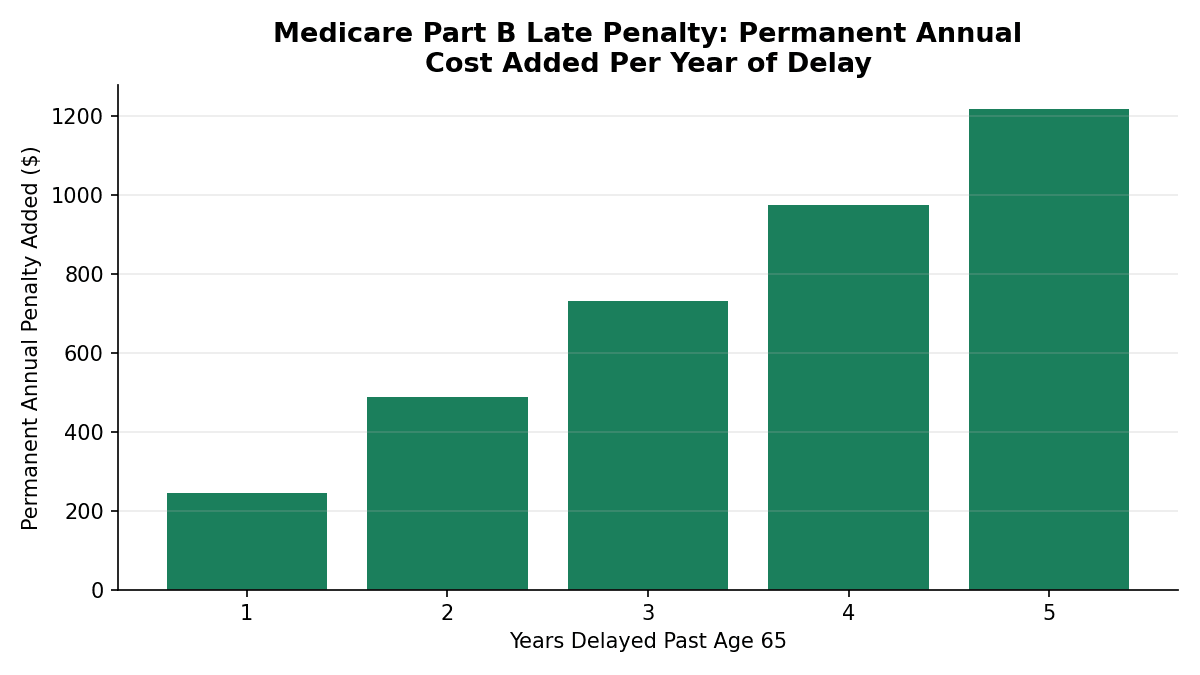
The catch: if you delay Part B enrollment past your Initial Enrollment Period and later want to enroll, you may face a 10% late enrollment penalty per year of delay. That penalty is permanent and adds up quickly. Weigh this carefully before deciding to skip Part B.
How Coordination of Benefits Actually Works
When you have both FEHB and Medicare, the two programs coordinate using a set of rules that determine which pays first (the “primary” payer) and which pays second (the “secondary” payer).
For most retirees, Medicare pays primary and FEHB pays secondary.
In practice, this coordination can reduce your out-of-pocket costs to near zero for many services. Medicare covers its share, and FEHB covers most or all of what’s left. Some FEHB plans even waive their normal cost-sharing (like deductibles and copays) entirely when Medicare is primary.
Review the specific coordination rules for any plan you’re considering. The FEHB plan brochure — available on OPM.gov — has a dedicated section on Medicare coordination that spells out exactly what you’d owe in common scenarios.
Choosing the Right FEHB Plan as a Retiree
How Your Needs Change at Retirement
The plan that was perfect during your working years may not be the best fit in retirement. Your healthcare use often shifts — more routine and specialist visits, potentially more prescription medications, and a greater focus on long-term care considerations.
Start by listing your current doctors, any specialists you see regularly, and all prescriptions you take. Then check each plan you’re considering for network inclusion and formulary coverage. A plan with a slightly higher premium that covers your existing providers and medications can easily be the lower-cost option once you run the real numbers.
Retirement is also a great time to think about your overall wellness picture.
Staying physically active, eating well, and managing stress all reduce your long-term healthcare costs — and your FEHB plan may offer wellness incentives that support those habits. Our Stay Active: Exercise Routines for the Retired Hero resource is a great place to start building that foundation.
Plan Types: HMO vs. PPO vs. HDHP
FEHB offers three main plan structures, each with a different cost and flexibility tradeoff.
HMOs typically offer lower premiums and copays but require you to stay within a defined network and get referrals for specialists. They work well if you live in their service area and your preferred doctors participate.
PPOs cost more but let you see any provider, in or out of network — valuable if you travel frequently or want to see specialists without referrals. HDHPs (High Deductible Health Plans) pair lower premiums with higher deductibles and HSA eligibility, which can be a strong value for retirees who are relatively healthy and have savings to cover the deductible.
For retirees who are also enrolled in Medicare, the plan type often matters less than coordination benefits. Many HDHPs and PPOs have strong Medicare wraparound provisions worth exploring.
Where to Compare Plans
OPM’s FEHB Plan Comparison Tool at opm.gov lets you filter plans by zip code, plan type, and coverage tier. It shows premiums side by side and links directly to each plan’s brochure.
The FEHB Plan Finder tool also allows you to enter your specific prescriptions and see estimated annual drug costs by plan. This is a critical step for retirees who take multiple medications. Don’t skip it. Drug cost differences between plans can run into thousands of dollars per year.
Many FEHB plans also publish a separate Summary of Benefits for Medicare-eligible enrollees, which details exactly how the plan works alongside Medicare. Look for this document when comparing finalists.
FEHB Beyond Age 65: Life Changes and Survivor Coverage
How FEHB Changes After 65
Turning 65 doesn’t change your FEHB eligibility — your coverage continues uninterrupted.
What changes is how the coverage interacts with Medicare, as described in the previous section. If you’re already enrolled in FEHB and you turn 65, nothing about your FEHB enrollment needs to change.
Some retirees choose to switch to a lower-cost or lower-coverage FEHB plan at 65 because Medicare is now handling a larger share of the claims. This can be a smart cost-cutting move. But be sure to verify that the new plan still coordinates well with Medicare before making the switch during Open Season.
Planning for longevity is one of the most important parts of a well-designed retirement.
Protecting your physical health over the long run — through good healthcare coverage, regular screenings, and healthy habits — sets the stage for a retirement that stays vibrant for decades.
Our guide on Anti-Aging and Longevity For Your Retirement is worth a read.
Covering a Spouse or Dependents
FEHB allows you to cover a spouse and eligible dependents under Self Plus One or Self and Family enrollment options. Your spouse doesn’t need to have been a federal employee. They simply need to qualify as a covered family member under OPM rules.
If your spouse is not yet Medicare-eligible, FEHB can be their primary coverage — a significant benefit compared to buying individual marketplace insurance. Once your spouse turns 65 and enrolls in Medicare, the same coordination rules that apply to you will apply to them.
Dependents (generally children up to age 26) can also be covered under Self and Family enrollment, though this tier comes with a higher premium. Review whether the added cost makes sense compared to other coverage options for younger family members.
Survivor Coverage After the Retiree’s Death
If you elect a survivor annuity for your spouse at retirement, your surviving spouse can continue FEHB coverage after your death (as long as the survivor annuity is large enough to cover the premium deduction). This is one of the most important decisions you’ll make at retirement, and reversing it later is generally not possible.
If you do not elect a survivor annuity, FEHB coverage ends at your death.
Your spouse would then need to find alternative coverage — typically Medicare (if eligible) or a marketplace plan. The lifetime healthcare cost implications of this decision can be substantial.
Work through this decision carefully with your spouse and, if possible, a financial planner who specializes in federal benefits before you finalize your retirement paperwork.
Common Mistakes to Avoid When Retiring With FEHB
Dropping Coverage Before You Hit 5 Years
The most costly FEHB retirement mistake is also the most preventable: voluntarily dropping your FEHB enrollment (even briefly) while you’re continuously employed and within the five years before your planned retirement date. Some employees let coverage lapse to save a few months of premiums, not realizing it resets their eligibility clock entirely.
If you’re approaching five years of continuous enrollment and thinking about any coverage change, talk to your HR office first. The premium you’d save in a short gap is almost certainly worth far less than the lifetime value of carrying FEHB into retirement.
Stay enrolled. Mark your five-year anniversary on your calendar. Protect your clock.
Missing the Medicare Part B Enrollment Window
Many federal retirees delay Medicare Part B enrollment because FEHB feels sufficient — and it often is, in the short term.
But missing your Initial Enrollment Period (the seven-month window around your 65th birthday) without a qualifying special enrollment period means you’ll face that permanent 10% per-year late penalty when you eventually do enroll.
The financially smart move is to make an intentional decision about Part B — run the numbers, weigh the premium against your likely usage and FEHB plan costs — rather than letting the deadline slip by default. A passive “I’ll figure it out later” approach is where the costly mistakes happen.
If you’re still working past 65, different rules may apply. Confirm your specific situation with the Social Security Administration well before you turn 65.
Forgetting to Update Your Plan During Open Season
Auto-renewing the same FEHB plan year after year feels easy…
But plans change. Premiums shift. Networks change. Formularies get updated. A plan that was the best value three years ago may no longer be competitive.
Make it a habit to spend 30 minutes each fall during Open Season (typically early November through early December) reviewing your current plan and comparing it to two or three alternatives. The OPM comparison tool makes this much faster than it used to be.
This annual check-in is especially important in the first few years of retirement, when your healthcare needs and budget are still adjusting. Small changes in plan selection can add up to real savings over a long retirement.
FEHB Enrollment Timeline and Retirement Checklist
12 to 18 Months Before Retirement
Start by confirming your five-year FEHB eligibility with your HR office. Don’t assume, verify. Pull your Official Personnel Folder (OPF) or check your enrollment records to confirm your continuous enrollment history.
This is also the right time to start researching your Medicare Part B decision. Request your Social Security earnings record to confirm your Medicare tax history, especially if you’re a CSRS employee. If there are any gaps or questions, it’s far easier to resolve them now than in the weeks before you retire.
Begin a rough list of your current doctors, specialists, and prescriptions. You’ll use this list to evaluate FEHB plans as you get closer.
3 to 6 Months Before Retirement
Request a retirement estimate from OPM or your agency’s HR office. This estimate will show your projected annuity amount and can help you model what your FEHB premium deduction will look like against your monthly income.
During this window, use OPM’s plan comparison tool to narrow down two or three FEHB plan candidates. Run the prescription drug cost estimator for each. Review the Medicare coordination section in each plan’s brochure.
If you’re planning to elect a survivor annuity, discuss the financial tradeoffs with your spouse now — before the paperwork is in front of you with a deadline.
At Retirement and After
When you submit your retirement application, your FEHB enrollment transfers automatically to OPM.
You don’t need to re-enroll. But you should confirm with OPM within 60–90 days that your coverage has transitioned correctly and that premium deductions are appearing on your annuity statement.
If you turn 65 after retiring, enroll in Medicare Part A (and make your Part B decision) through the Social Security Administration online at ssa.gov/benefits/medicare or at your local SSA office.
Your FEHB coverage continues independently; Medicare enrollment is a separate action.
Then set a reminder for every November. Open Season is your annual opportunity to optimize your coverage, and it’s well worth the hour it takes.
FEHB is one of the most powerful benefits of a federal career. And it doesn’t have to end the day you stop working.
Meet the three eligibility rules, make a thoughtful decision about Medicare, and use Open Season every year to keep your plan tuned to your life. Done right, your health coverage in retirement can be comprehensive, predictable, and genuinely affordable.
The foundation you build now — with the right plan, the right Medicare strategy, and a survivor coverage decision you feel good about — pays dividends for decades.
Combine solid coverage with the healthy habits that keep you actually using it less, and you’ve built a retirement that works on every level.
Take action now: log in to opm.gov, confirm your FEHB enrollment history, and schedule 30 minutes this Open Season to compare your current plan against two alternatives — your future self will thank you.
Frequently Asked Questions
What are the three rules to keeping FEHB in retirement?
To carry FEHB into retirement, you must meet three requirements set by OPM: you must have been enrolled in FEHB for the five years of service immediately before your retirement date (prior enrollment periods can count in certain situations, such as breaks in federal service), you must retire on an immediate annuity (your pension commencing the day after your separation from federal service), and you must retire under a qualifying federal civilian retirement system such as CSRS or FERS. All three conditions must be met — missing any one of them ends your eligibility to continue FEHB as a retiree.
Is it worth keeping FEHB in retirement?
For most federal retirees, yes — the government pays the lesser of 72% of the weighted average premium or 75% of your chosen plan’s premium in retirement, making it one of the most heavily subsidized health coverage options available to any retiree in the country. The combination of that subsidy, the flexibility to switch plans annually, and the ability to coordinate with Medicare to reduce out-of-pocket costs makes FEHB difficult to beat on value.
Do you have to enroll in Medicare if you have FEHB?
No. Enrolling in Medicare is not required if you have FEHB. However, Medicare Part A is typically free for those who qualify and adds a useful second layer of hospital coverage, so most retirees choose to enroll. The Part B decision is more nuanced because it carries a monthly premium ($202.90 in 2026 for most beneficiaries), and delaying it past your Initial Enrollment Period can trigger a permanent late-enrollment penalty.
Can you lose FEHB coverage in retirement?
Yes, in a few specific situations. If you voluntarily drop your FEHB enrollment during your five-year pre-retirement window while continuously employed, or retire without meeting all three eligibility requirements, you lose the right to carry FEHB into retirement — and cannot re-enroll later. After retirement, coverage is generally very stable as long as premiums are deducted from your annuity and you maintain a qualifying survivor annuity if you want coverage to continue for a spouse after your death.