
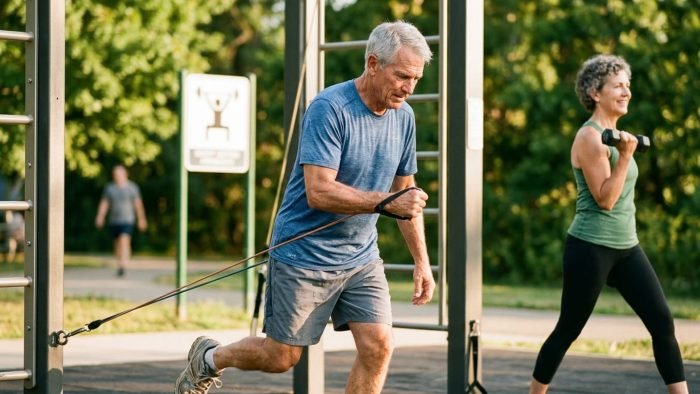
You spent decades pushing your body to its limits.
Maybe it was military service, first responder work, competitive athletics, or a physically demanding career that defined your identity for 20, 30, even 40 years.
Now you’re retired, and the mission has changed. The alarm clock doesn’t scream at 05:00 anymore. Nobody’s counting on you to run a six-minute mile. But your body still craves movement, and your mind still needs the discipline that physical training provides.
The challenge is that the routines that served you at 30 can wreck you at 60.
Staying active as a retiree means building exercise routines that honor your history while protecting your future. This isn’t about recapturing your glory days. It’s about writing a new chapter where you’re still strong, still capable, and still showing up for yourself every single day.
The retired hero doesn’t stop training: they just train smarter.
Article Highlights:
- Staying active as a retiree requires a shift in mindset from peak performance to sustainable, long-term fitness that respects your body’s history.
- Exercise routines for every former hero should include low-impact strength training, mobility work, cardiovascular conditioning, and mental resilience practices.
- Nutrition, sleep, and community are just as critical as the workouts themselves, especially for aging athletes managing old injuries and chronic inflammation.
- Building accountability through a new fitness community can replace the camaraderie you lost when you left your career behind.
The Transition from Combat to Civilian Fitness
The hardest part of retirement fitness isn’t the physical work. It’s the psychological shift.
For years, your training had external purpose: pass the PT test, make the team, survive the shift, protect your crew.
Without that external motivator, many retirees drift into inactivity.
According to the CDC, only 28% of adults aged 55 and older meet both aerobic and muscle-strengthening guidelines. That number should alarm you, because the consequences of sedentary retirement are severe: accelerated muscle loss, cognitive decline, increased fall risk, and a significantly higher chance of chronic disease.
Assessing Long-Term Wear and Tear
Before you design any training program, you need an honest inventory of what your body has been through.
This isn’t weakness: it’s intelligence.
Start with a comprehensive physical that includes joint imaging if you have chronic pain, a cardiovascular stress test, and bloodwork that covers inflammatory markers like C-reactive protein and homocysteine.
Most former athletes and service members carry specific damage patterns.
Knees and lower backs take the worst of it for infantry and law enforcement. Shoulders and cervical spines suffer in contact sports and tactical professions. A 2019 study in the Journal of Athletic Training found that 60% of retired professional athletes reported chronic pain in at least one joint, with many managing two or three problem areas simultaneously.
Write down every injury, surgery, and persistent ache.
This list becomes the foundation of your training program, not something you ignore and push through. Your physical therapist or sports medicine doctor should review it before you touch a barbell.
Redefining Purpose Beyond the Mission
The identity crisis of retirement is real, and it hits physical fitness hard.
Research from the Harvard Study of Adult Development shows that retirees who maintain a sense of purpose live longer and report higher life satisfaction. Your workout needs a “why” that goes beyond aesthetics.
Some retirees train to keep up with grandchildren.
Others prepare for hiking trips, charity events, or simply the ability to live independently into their 80s and 90s. At Hero Retirement, we anchor this in the Health pillar of the HERO framework: your physical capacity directly determines how much enjoyment, opportunity, and financial independence you can actually experience.
Pick a concrete goal. “Stay healthy” is too vague. “Hike Glacier National Park next summer” or “carry my own groceries at 85” gives your training direction and urgency.
Low-Impact Strength Training for Longevity
Muscle mass declines roughly 3-8% per decade after age 30, and the rate accelerates after 60. This process, called sarcopenia, is the single biggest threat to your independence as you age.
The good news: resistance training can slow and even reverse it at any age.
A landmark study published in PLOS Medicine followed over 80,000 adults and found that strength training was associated with a 23% reduction in all-cause mortality.
Prioritizing Compound Movements
Forget the bicep curl machines.
Your training time is limited and your recovery is slower than it used to be, so every exercise needs to deliver maximum return.
Compound movements – exercises that work multiple joints and muscle groups simultaneously – are your best investment.
Focus on these movement patterns:
- Squat variations (goblet squats, box squats, leg press if knees are compromised)
- Hip hinge patterns (trap bar deadlifts, Romanian deadlifts, kettlebell swings)
- Horizontal push and pull (push-ups, dumbbell rows, cable rows)
- Vertical push and pull (landmine press, lat pulldowns, face pulls)
- Loaded carries (farmer’s walks, suitcase carries)
Three sessions per week is plenty. Keep the rep ranges moderate, between 8-12 reps, and leave 2-3 reps in reserve on every set.
You’re not training for a powerlifting meet. You’re training for the next 30 years.
Resistance Bands and Bodyweight Mastery
Not every workout needs to happen in a gym.
Resistance bands are one of the most underrated tools for retirees because they provide variable resistance that’s easier on joints than free weights, and they’re portable enough to travel with you.
A quality set of loop bands and a door anchor can replicate about 80% of what a full gym offers.
Band pull-aparts, banded squats, pallof presses, and banded hip thrusts are all excellent choices for maintaining strength without heavy spinal loading.
Bodyweight training deserves respect too.
If you can perform 10 clean push-ups, 5 pull-ups, a 60-second plank, and a full bodyweight squat to depth, you’re ahead of most people your age. These benchmarks are worth chasing if you haven’t hit them yet.
Restoring Mobility and Joint Health
Strength without mobility is like horsepower without steering.
You might be strong enough to lift heavy objects, but if you can’t reach overhead without pain or squat below parallel, your functional capacity is limited.
Mobility work isn’t optional for former heroes: it’s the thing that keeps you in the game.
Yoga and Dynamic Stretching for Flexibility
Yoga has a branding problem among former military and athletes. It looks soft. It’s not.
A well-designed yoga practice challenges your balance, grip strength, core stability, and mental focus while systematically opening up the tight areas that decades of hard use have locked down.
Start with 15-20 minutes of dynamic stretching before every training session.
This means movement-based stretches like leg swings, arm circles, thoracic rotations, and walking lunges: not static holds. Save the longer holds for dedicated mobility sessions or post-workout cool-downs.
If a full yoga class feels like too much, try following along with a 20-minute video focused on hip openers and thoracic spine mobility. These two areas are almost universally restricted in retirees who spent careers in body armor, patrol cars, or hunched over desks.
Corrective Exercises for Old Injuries
Every former hero has a collection of injuries that never fully healed.
Maybe your left shoulder clicks when you raise your arm. Maybe your right knee swells after stairs. These aren’t reasons to stop training: they’re reasons to train specifically.
Corrective exercise targets the muscle imbalances and movement dysfunctions that old injuries create. A physical therapist can identify your specific patterns, but common protocols include:
- Rotator cuff strengthening with light bands for shoulder injuries
- Single-leg balance work and terminal knee extensions for knee issues
- McGill’s Big Three (curl-up, side plank, bird dog) for chronic low back pain
- Ankle mobility drills for anyone with a history of sprains
Spend 10 minutes on corrective work before your main training session. Yes, it’s boring. But it’s also the difference between training consistently for years and being sidelined by a preventable flare-up.
Sustainable Cardiovascular Conditioning
Your heart doesn’t care about your ego.
It needs consistent, moderate-intensity work to stay healthy, and the research is unambiguous: cardiovascular fitness is the single strongest predictor of longevity.
A 2022 study in the British Journal of Sports Medicine found that high cardiorespiratory fitness was associated with the greatest reduction in mortality risk, even more than not smoking.
The Benefits of Rucking and Zone 2 Training
Rucking, walking with a weighted pack, is one of the best cardiovascular exercises for retirees with a military or tactical background.
It’s familiar, it’s low-impact compared to running, and it builds both aerobic capacity and lower body strength simultaneously. Start with 20-30 pounds and a 30-minute walk. Build from there.
Zone 2 training is the backbone of any sustainable cardio program.
This means working at an intensity where you can hold a conversation but feel like you’re putting in effort: roughly 60-70% of your max heart rate. For most retirees, that’s a brisk walk, an easy bike ride, or a light rowing session.
Aim for 150-200 minutes of Zone 2 work per week.
That’s the sweet spot where you get significant cardiovascular benefit without the recovery cost that high-intensity work demands. You can split it into daily 30-minute sessions or longer weekend outings.
Swimming for High-Intensity, Zero-Impact Cardio
If your joints are beat up enough that even rucking causes problems, swimming is your answer.
Water supports your body weight while providing resistance in every direction, making it both joint-friendly and surprisingly demanding on your cardiovascular system.
Swimming laps isn’t the only option.
Water aerobics classes, pool walking, and aqua jogging all deliver excellent cardiovascular training with virtually zero impact. Many VA facilities and community centers offer pool access at reduced rates for retirees.
For those who want intensity, swimming intervals are brutal in the best way.
Try 4-6 rounds of 50-meter sprints with 30 seconds rest. Your heart rate will spike, your muscles will burn, and your joints will thank you the next morning.
Mental Resilience and Mindfulness in Motion
Physical training is only half the equation.
The mental health benefits of exercise are well-documented, but retirees face specific psychological challenges that deserve attention.
Social isolation, loss of identity, and the absence of structured daily routines can lead to depression and anxiety, even in people who never struggled with mental health during their careers.
Exercise itself is a form of mindfulness when you approach it with intention. Counting reps, focusing on breathing, feeling the ground beneath your feet during a ruck: these are meditative practices disguised as physical training.
A 2020 meta-analysis in the British Journal of Sports Medicine found that exercise was 1.5 times more effective than counseling or medication for reducing symptoms of depression.
Consider adding explicit mindfulness practices to your routine.
Five minutes of box breathing before a workout. A 10-minute walking meditation on rest days. Journaling about your training progress and how you feel physically and emotionally.
These small habits compound over time and build the kind of mental resilience that served you in your career but now needs a new outlet.
Nutrition and Recovery Protocols for Aging Athletes
You can’t out-train a bad diet, and this becomes more true with every passing year.
Your metabolism slows, your recovery takes longer, and your body becomes less tolerant of inflammatory foods.
Treating nutrition and recovery as seriously as your training sessions is non-negotiable.
Anti-Inflammatory Diet Essentials
Chronic inflammation is the silent driver behind most age-related diseases: heart disease, diabetes, Alzheimer’s, and many cancers. Your diet is your primary weapon against it.
The basics aren’t complicated:
- Prioritize whole foods: vegetables, fruits, lean proteins, healthy fats, and whole grains
- Eat fatty fish (salmon, sardines, mackerel) at least twice per week for omega-3 fatty acids
- Reduce processed sugar, refined carbohydrates, and seed oils
- Include anti-inflammatory spices like turmeric, ginger, and garlic regularly
- Aim for 1.0-1.2 grams of protein per pound of lean body mass daily to support muscle maintenance
That protein target surprises most people.
The RDA of 0.36 grams per pound is woefully inadequate for anyone doing resistance training, especially older adults. Research from the International Society of Sports Nutrition consistently supports higher protein intake for muscle preservation in aging populations.
Optimizing Sleep for Physical Repair
Sleep is when your body actually rebuilds itself.
Growth hormone release, muscle protein synthesis, and neural repair all peak during deep sleep. Yet the National Sleep Foundation reports that 44% of older adults experience insomnia symptoms at least a few nights per week.
Protect your sleep like it’s a mission-critical asset.
Keep your bedroom cool, between 65-68 degrees. Stop screen exposure 60 minutes before bed. Maintain consistent sleep and wake times, even on weekends. Limit caffeine after noon. If you’re training hard and sleeping poorly, you’re essentially tearing your body down without giving it the chance to rebuild.
Consider tracking your sleep with a wearable device.
Seeing the data can motivate changes that subjective feelings alone won’t. Aim for 7-8 hours of total sleep with at least 1.5 hours of deep sleep per night.
Building a New Community and Accountability Network
The hardest thing about retirement isn’t the money or the health.
It’s the loneliness. AARP reports that one in three adults over 45 is chronically lonely, and that number spikes after retirement when the built-in social structure of work disappears. Exercise is one of the most effective ways to rebuild community, but you have to be intentional about it.
Join a gym with a culture, not just equipment.
CrossFit affiliates, martial arts schools, rowing clubs, and hiking groups all provide the kind of shared suffering and mutual accountability that former heroes thrive on. The camaraderie of pushing through a hard workout alongside other people scratches the same itch that your career once did.
Find a training partner or a small group that meets consistently.
Research from the Society of Behavioral Medicine shows that people who exercise with others are 95% more likely to complete a fitness program than those who train alone. That’s not a small difference: it’s the difference between a New Year’s resolution and a lifestyle.
If in-person options are limited, online communities focused on veteran fitness, masters athletics, or retiree wellness can fill the gap. The key is consistent connection with people who understand what you’ve been through and where you’re headed.
Your career may be over, but your body still has decades of potential.
Every former hero deserves exercise routines that respect their past while building toward a strong, independent, and fulfilling future. Start where you are, train with purpose, and surround yourself with people who push you to keep showing up.
The mission has changed, but the discipline that made you who you are hasn’t gone anywhere.
Frequently Asked Questions
How often should a retiree strength train per week?
Three sessions per week is the sweet spot for most retirees. This frequency allows adequate recovery between sessions while providing enough stimulus to maintain and build muscle mass. Each session should last 45-60 minutes and focus on compound movements that train multiple muscle groups simultaneously.
Is it safe to start a new exercise program after 60?
Yes, but start with a medical clearance from your doctor, especially if you have a history of injuries, heart conditions, or have been sedentary for an extended period. Begin with lighter weights and lower intensity than you think you need. Progress gradually over weeks and months rather than days.
What’s the best exercise for retirees with bad knees?
Swimming and cycling are excellent low-impact options that build cardiovascular fitness without stressing the knees. For strength training, focus on exercises that reduce knee shear force: leg presses, box squats to a comfortable depth, and terminal knee extensions with a resistance band. Avoid deep lunges and jumping movements until cleared by a physical therapist.
How much protein do older adults actually need?
The standard RDA of 0.36 grams per pound of body weight is insufficient for active older adults. Research supports 1.0-1.2 grams per pound of lean body mass for retirees engaged in regular resistance training. Spread protein intake across 3-4 meals per day, with 30-40 grams per meal, to maximize muscle protein synthesis.