

You spent a career serving the public. That career came with one of the best health insurance programs in the country: the Federal Employees Health Benefits program, or FEHB. Now that retirement and Medicare eligibility are arriving at the same time, you may be wondering whether you need both.
Here’s the short answer…
For most federal retirees, combining FEHB with Medicare Part B creates a coverage partnership that dramatically reduces what you pay out of pocket. Neither program alone is as powerful as the two working together.
The coordination rules aren’t complicated once you see them laid out. Medicare pays its share first, FEHB picks up much of what’s left, and your wallet often stays closed entirely for covered services.
You don’t need to memorize policy documents or decode government acronyms to make a smart decision. You just need a clear picture of how the pieces fit.
The key? Understanding which plan leads, which plan follows, and where the real savings show up.
Article Highlights
- Medicare pays first: Once you enroll in Part B, Medicare becomes the primary payer for outpatient care, with FEHB stepping in as secondary coverage.
- 2026 Part B standard premium: The standard Medicare Part B monthly premium is $202.90 per person — worth comparing against the out-of-pocket savings the combination can produce.
- Late-enrollment penalty: Missing your Part B enrollment window can add a 10% permanent premium surcharge for every 12-month period you delay.
- Zero patient balance: Many federal retirees with both FEHB and Medicare Part B end up paying $0 in coinsurance on covered outpatient services.
- Plan type matters: High-deductible FEHB plans often coordinate most generously with Medicare Part B, potentially making the $2,000+ annual savings case for enrolling in Part B.
How FEHB and Medicare Part B Work Together
Think of FEHB and Medicare Part B as two teammates with defined roles. When both are active, they don’t trip over each other — they hand off costs in a specific order that leaves very little for you to pay.
If you want a broader look at all your health insurance options as a federal retiree, start with our guide to Federal Health Insurance Options for Retirees before diving into the coordination details below.
The Basic Coordination Rule
When you are enrolled in both programs, Medicare Part B is the primary payer for covered outpatient services. It pays its portion of the bill first. FEHB then functions as the secondary payer, covering some or all of the remaining cost.
This layered approach is the foundation of the whole system.
The provider submits the claim to Medicare, Medicare processes it, and the remaining balance is forwarded automatically to your FEHB plan. No extra paperwork on your end.
What “Outpatient” Actually Means Here
Medicare Part B covers outpatient medical services: doctor visits, lab tests, durable medical equipment, preventive screenings, and outpatient surgeries. Part A covers hospital stays, and FEHB coordinates with that separately.
This guide focuses specifically on Part B coordination because that’s where most retirees face the most frequent costs. Specialist visits, imaging, chemotherapy administered in a clinic — these are all Part B territory.
What Changes When You Turn 65 and Enroll in Medicare
Your FEHB coverage doesn’t disappear when Medicare kicks in. You keep your FEHB card, your FEHB provider network, and your FEHB prescription drug benefits. What changes is the billing order.
Before Medicare, your FEHB plan was primary. After you enroll in Part B, Medicare moves to the front of the line for outpatient services. Many retirees find this shift invisible in day-to-day care — they see the same doctors and fill the same prescriptions — but the financial math shifts significantly in their favor.
Primary and Secondary Payer Coordination Explained
The phrase “primary and secondary payer” sounds like insurance jargon, but the concept is simple. It’s just an agreed-upon order for who pays what portion of any given bill. Understanding that order helps you predict your actual costs before a medical event, not after.
How a Typical Claim Flows
Here’s a practical sequence:
You visit a specialist. The office submits the claim to Medicare first. Medicare applies your Part B deductible ($283 for 2026, per CMS.gov) if it hasn’t been met, then pays 80% of the Medicare-approved amount.
The remaining 20% — normally called coinsurance — goes to your FEHB plan. Many FEHB plans pay that entire 20%, leaving you with a $0 balance for that visit.
The Crossover Claim Process
Most Medicare-participating providers are set up for automatic crossover claims. Medicare sends the claim data directly to your FEHB insurer once it finishes processing. You typically don’t need to file a separate claim with FEHB.
The system isn’t perfect (crossovers occasionally fail) so it’s worth keeping your Medicare Explanation of Benefits until you see your FEHB Explanation of Benefits confirm the secondary payment.
When FEHB Is the Only Payer
If you have FEHB but have not enrolled in Part B, your FEHB plan acts as the sole payer. It covers services according to its own schedule, with no Medicare backstop.
This is still solid coverage.
But it means you absorb the deductibles, copays, and coinsurance that Medicare Part B would otherwise have handled first. That trade-off is the core financial question in the Part B enrollment decision.
Cost-Sharing Coverage: What FEHB Covers When Medicare Is Primary
This is where the real money lives. The table below gives you a snapshot of how costs split across common outpatient scenarios. The exact amounts depend on your specific FEHB plan, but the structure applies broadly.
| Service or Cost Type | Medicare Part B Responsibility | FEHB Responsibility | Your Responsibility |
|---|---|---|---|
| Annual Part B Deductible | You pay this first before Medicare pays | Many plans waive or reimburse this deductible | $0 to full deductible depending on plan |
| Doctor Visit (in-network) | Pays 80% of approved amount | Pays remaining 20% coinsurance | $0 in most cases |
| Specialist Visit | Pays 80% of approved amount | Pays remaining 20% coinsurance | $0 in most cases |
| Outpatient Lab Tests | Pays 100% of approved amount for many preventive labs | No additional cost-sharing required | $0 |
| Durable Medical Equipment | Pays 80% of approved amount | Pays remaining 20% coinsurance | $0 in most cases |
| Mental Health Outpatient | Pays 80% of approved amount | Pays remaining 20% coinsurance | $0 in most cases |
Plan-Level Differences in Secondary Coverage
Not every FEHB plan coordinates identically.
Some plans — particularly high-deductible options like GEHA’s High Deductible Health Plan — are specifically designed to work alongside Medicare and will waive cost-sharing almost entirely for Medicare-covered services.
Other plans, including some HMOs, may apply their own copay even when Medicare has already paid 80%. Reading your specific FEHB plan brochure’s “Coordination of Benefits” section (usually Section 9) tells you exactly what your plan does in each scenario.
Prescription Drug Coverage: A Separate Conversation
Medicare Part B covers drugs administered in a clinical setting (i.e. infusions and injections given at a doctor’s office).
It does not cover the prescriptions you fill at a pharmacy. That’s Medicare Part D territory.
Your FEHB plan almost certainly includes pharmacy benefits that are comparable to or better than standalone Part D plans. That’s one reason most financial planners suggest federal retirees skip Part D and keep their FEHB drug coverage instead. Check your plan’s formulary to confirm your medications are covered.
Services FEHB May Not Cover Even With Medicare Coordination
There are limits worth knowing.
If Medicare doesn’t cover a service — because it deems it not medically necessary or it’s excluded — FEHB typically won’t cover it as secondary either. It can only pay costs that were part of a covered Medicare claim.
Dental, routine vision, and hearing aids are common examples: most standard FEHB plans and traditional Medicare both exclude them.
You’d need a separate dental or vision plan, or an FEHB plan that specifically adds those benefits.
Do You Need Medicare Part B if You Have FEHB?
This is the question federal retirees ask most often, and the honest answer is: it depends on your health, your FEHB plan, and your finances. But the math increasingly favors enrolling.
Here’s how to think through it…
The Case for Enrolling in Part B
If you visit doctors frequently, manage a chronic condition, or anticipate significant outpatient care, the 80/20 Medicare split dramatically lowers your bills. The Part B premium you pay buys you a backstop that most FEHB plans then amplify into near-zero patient cost.
Over a year with moderate medical use, the savings on coinsurance alone often exceed the annual Part B premium cost. High users of specialist care tend to see the strongest financial case for enrollment.
The Case for Skipping Part B
If you are in excellent health, rarely see a doctor, and carry a low-premium FEHB plan, you may pay more in Part B premiums than you recover in cost-sharing savings in any given year. Some retirees — particularly those with higher incomes who pay IRMAA surcharges on their Part B premium — find the math less compelling.
This is a legitimate choice.
FEHB alone is comprehensive coverage. The risk is that your health situation can change, and enrolling in Part B later carries a permanent penalty.
The Late-Enrollment Penalty You Can’t Undo
Per Medicare’s enrollment rules, if you don’t enroll in Part B when you’re first eligible and don’t have a qualifying exception, you face a 10% premium penalty for every 12-month period you delayed.
That surcharge is permanent. It stays with you for as long as you have Part B.
Federal retirees who use FEHB as their primary coverage during active employment are generally protected from this penalty during that time, but the clock starts ticking at retirement if you don’t enroll within your Special Enrollment Period. Missing that window is one of the costliest mistakes in this entire process.
FEHB Premium vs. Medicare Part B Premium: The Full Cost Picture
To decide whether the combination makes financial sense, you need to see both premiums side by side and then weigh them against what you’d spend in cost-sharing without Part B.
The numbers often tell a clearer story than any general advice can.
The savings from coordinated coverage don’t just protect your budget. They free up money for the things that make retirement worth living: travel with grandchildren, pursuing a hobby you’ve put off for decades, or investing in an active lifestyle that keeps you feeling strong.
Good health coverage is the foundation everything else is built on.
For ideas on staying physically vibrant in retirement, see our guide on staying active with exercise routines for retirees.
What You Pay for Each Program
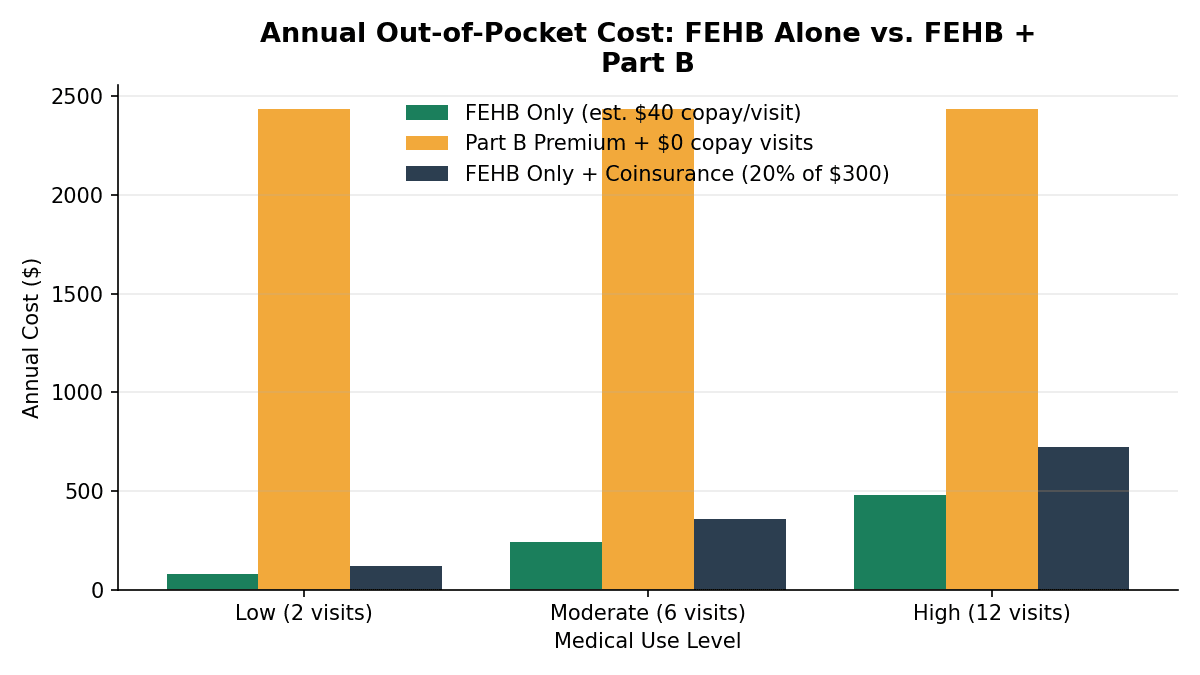
In 2026, the standard Medicare Part B premium is $202.90 per month per person. If your income exceeds certain thresholds, you pay an Income-Related Monthly Adjustment Amount (IRMAA) on top of that.
Your FEHB premium depends on the plan you choose and your annuity status. OPM pays a portion of FEHB premiums even in retirement, which keeps your out-of-pocket premium lower than it would be for a private retiree buying individual coverage.
The Break-Even Calculation
A simple way to evaluate the decision: estimate your annual out-of-pocket costs under FEHB alone (without Part B), then compare that to your annual Part B premium plus your expected out-of-pocket costs with both.
If the difference exceeds your annual Part B premium, Part B is paying for itself. For a single retiree paying the standard $202.90/month ($2,434.80/year), it takes roughly three to four specialist visits per year to break even in many FEHB plan scenarios — a threshold most retirees exceed.
High-Income Retirees and IRMAA
If your modified adjusted gross income exceeds $109,000 as a single filer (or $218,000 for married couples filing jointly), your Part B premium rises above the standard rate — from $202.90 to $284.10 per month at those initial thresholds, per CMS.gov’s 2026 premium tables.
This doesn’t change the coordination mechanics — Medicare still pays 80% first regardless — but it changes the premium math.
Higher-income retirees should run the numbers carefully before assuming Part B is automatically a win.
Real Scenarios: What the Combination Looks Like in Practice
Abstract percentages only tell you so much. These concrete scenarios show how FEHB and Medicare Part B interact across situations that federal retirees commonly face. Numbers use standard Medicare rates; your FEHB plan may perform even better.
Scenario 1: Routine Specialist Care
A retiree sees a cardiologist four times a year. The Medicare-approved amount per visit is $300. Medicare pays 80% ($240). The FEHB plan pays the remaining 20% ($60). Patient cost: $0 per visit.
Without Part B, the retiree’s FEHB plan might cover the visit under its own schedule — say, a $40 copay per specialist visit — totaling $160 for the year. Part B in this example saves $160 in copays, plus protects against any plan-level deductibles.
Scenario 2: Outpatient Surgery
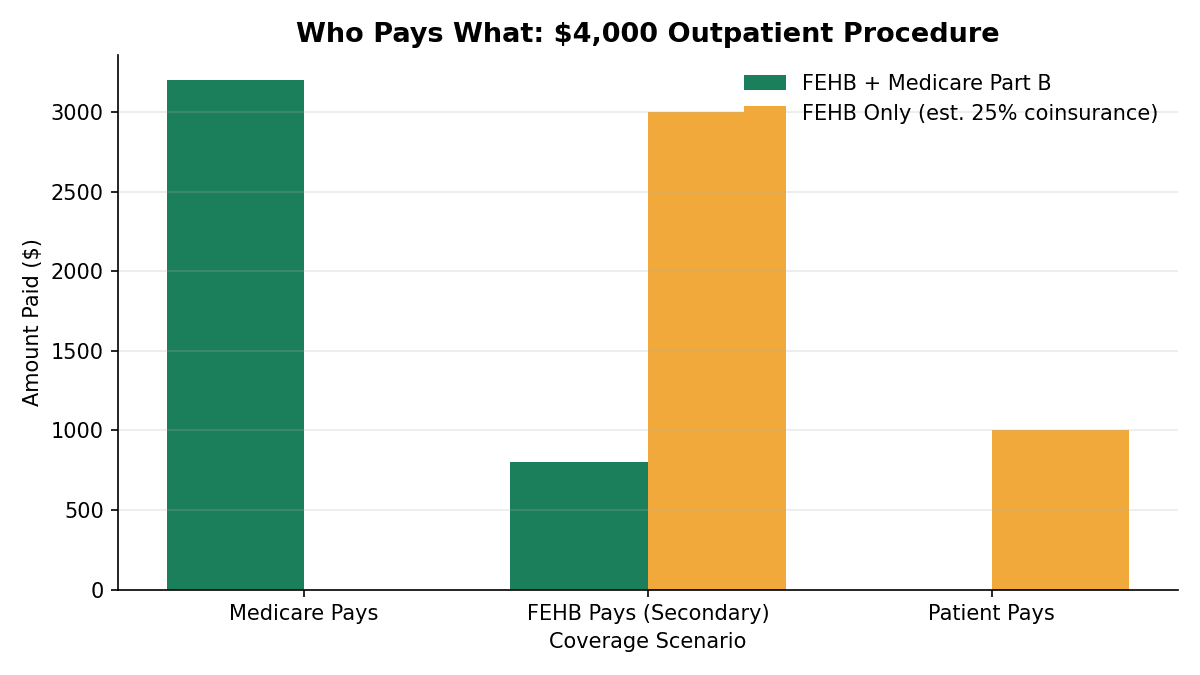
A retiree has an outpatient knee procedure with a $4,000 Medicare-approved facility fee. Medicare pays 80% ($3,200). FEHB pays the remaining $800. Patient cost: $0.
Without Part B, the FEHB plan would apply its own outpatient surgery cost-sharing — potentially 20–30% coinsurance after a deductible, meaning $800 to $1,200 or more out of pocket. One procedure like this can pay for several years of Part B premiums.
Scenario 3: High-Deductible FEHB Plan Holder
Some retirees choose a high-deductible FEHB plan specifically because it pairs well with Medicare.
When Medicare is primary, the FEHB high-deductible plan’s own deductible rarely applies to Medicare-covered services. The plan treats Medicare’s payment as satisfying cost-sharing requirements.
The result: lower FEHB premiums and near-zero out-of-pocket costs for covered outpatient care.
This is one of the more powerful combinations available to federal retirees.
If you’re using or considering an HDHP, see our related resource on Retirement Health Savings Accounts (HSAs): A Dual Benefit for how HSA strategy intersects with this approach.
Common Mistakes Federal Retirees Make with FEHB and Medicare
The FEHB-Medicare coordination system is generous…
But only if you navigate it correctly.
A few predictable missteps can cost thousands of dollars or limit your options permanently. Here’s what to watch for.
Mistake 1: Missing the Part B Enrollment Window
The most expensive mistake on this list.
When you retire from federal service, you have an 8-month Special Enrollment Period to sign up for Part B without penalty. Miss that window, and the next opportunity is the General Enrollment Period (January 1 through March 31 each year). Coverage then begins the first day of the month after you enroll — so signing up in January means coverage starts February 1 — and a permanent premium penalty applies.
Set a calendar reminder before your last day of work. This deadline is not flexible.
Mistake 2: Dropping FEHB to Save on Premiums
Some retirees think Medicare Advantage can replace FEHB and save money on premiums.
That may work for some people, but it carries a significant risk: once you voluntarily drop FEHB coverage, you generally cannot re-enroll.
If your Medicare Advantage plan changes, gets discontinued, or doesn’t cover a new medication, you have no FEHB safety net to return to. FEHB is a benefit earned over a career. Most financial guidance strongly advises keeping it. The OPM healthcare guidance page outlines your FEHB rights in retirement and is worth bookmarking.
Mistake 3: Seeing Out-of-Network Providers Without Checking Coverage
Medicare pays based on its approved amounts for Medicare-participating providers.
If your doctor doesn’t accept Medicare assignment, Medicare’s payment may be limited or unavailable and your FEHB plan’s secondary coverage follows suit.
Confirming that your providers accept Medicare — not just your FEHB plan — protects you from unexpected bills. This is especially relevant when you’re seeing a new specialist or receiving care while traveling.
Mistake 4: Not Reviewing Your FEHB Plan Annually During Open Season
Your health needs in retirement change over time.
A plan that coordinated beautifully with Medicare at 65 may not be the best fit at 72. OPM’s annual Open Season (typically mid-November through mid-December) lets you switch FEHB plans without penalty.
Review your plan’s coordination-of-benefits section each year.
Staying sharp on your coverage options is one of the most valuable habits you can build in retirement — and staying cognitively engaged with your finances is itself a form of healthy aging worth prioritizing.
For more on keeping your mind sharp, see our guide on Maintaining Cognitive Health in Seniors.
Putting It All Together
FEHB and Medicare Part B are two of the most powerful coverage tools available to any American retiree.
Used together correctly, they form a safety net that can absorb the vast majority of outpatient medical costs — leaving your savings intact and your mind at ease.
The decision to enroll in Part B isn’t all-or-nothing thinking. It’s a calculation based on your health, your plan, and your income.
Most federal retirees who run the numbers find that the combination pays for itself. And the protection it provides — especially against large, unexpected medical events — is hard to put a price on.
Review your FEHB plan’s coordination-of-benefits section. Confirm your doctors accept Medicare assignment. Mark your enrollment window on the calendar. These three steps take an afternoon and can save you thousands over the years ahead.
Take action now: Use OPM’s FEHB Plan Comparison Tool and Medicare’s Plan Finder together this Open Season to identify the combination that minimizes your out-of-pocket costs for 2026 and beyond.
Frequently Asked Questions
Do I need Medicare Part B if I have Federal Blue Cross Blue Shield or another FEHB plan?
You are not legally required to enroll in Part B if you have FEHB, but most federal retirees benefit financially from having both. When Medicare is primary, FEHB typically covers the remaining 20% coinsurance, often leaving you with a $0 balance on covered outpatient visits. Skipping Part B means your FEHB plan handles all cost-sharing alone, which can add up quickly if you have regular medical appointments.
Will I face a penalty if I don’t enroll in Medicare Part B while I have FEHB coverage?
If you are still actively employed and covered by FEHB through your job, you are generally protected from the late-enrollment penalty during that period. Once you retire, you have an 8-month Special Enrollment Period to sign up for Part B penalty-free. Missing that window results in a permanent 10% premium surcharge for every 12-month period you delayed enrollment.
Can I have both FEHB and Medicare Advantage instead of Original Medicare Part B?
Technically yes — you can enroll in a Medicare Advantage plan while keeping FEHB, and some retirees do. However, most benefits guidance cautions against dropping FEHB entirely in favor of Medicare Advantage, because once you voluntarily cancel FEHB you generally cannot re-enroll. Having both can also create coordination complexity, since Medicare Advantage plans have their own networks and rules that differ from Original Medicare.
What percentage of federal retirees enroll in Medicare Part B?
Enrollment rates have historically been high among federal retirees because the financial case for combining FEHB with Part B is strong. OPM and CMS periodically publish data on federal retiree Medicare participation that can give you the most current figure.