

You’ve spent your entire career contributing to Social Security. Every paycheck, every year, without fail.
So it’s worth making sure you actually collect what you’re owed.
Yet the average retiree makes at least one claiming decision that quietly shrinks their check. Sometimes by hundreds of dollars a month. For life.
These aren’t exotic tax traps or obscure loopholes. They’re everyday mistakes made by people who simply didn’t have the right information at the right time.
The good news: most of them are avoidable. Some are even fixable after the fact.
In this article, you’ll learn 9 Social Security mistakes that shrink your check — and exactly what to do instead.
Because the money is already yours. Let’s make sure you keep it.
1) Claiming Benefits Before Your Full Retirement Age
What’s being missed
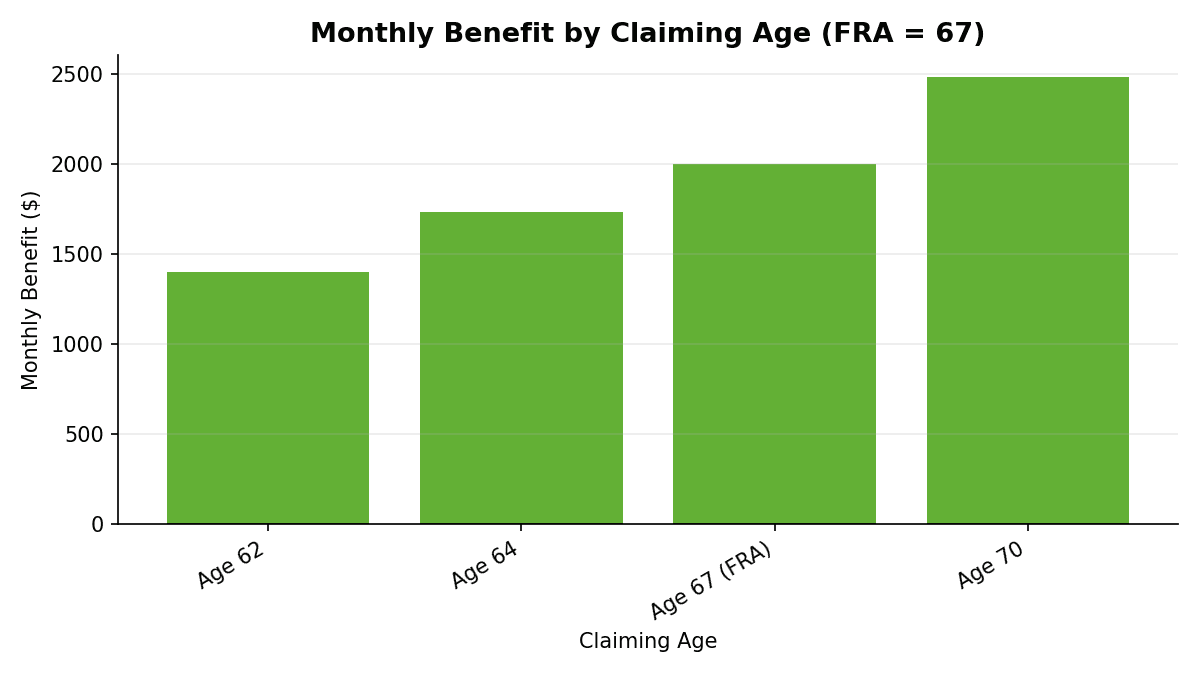
Per SSA rules, your Full Retirement Age (FRA) is the point where you receive 100% of your earned benefit. For anyone born in 1960 or later, that’s age 67. Claiming at 62 — the earliest possible age — permanently reduces your benefit by up to 30%.
Why it matters
That reduction isn’t temporary. On a $2,000/month benefit, a 30% cut means $600 less every single month. Over a 20-year retirement, that’s more than $144,000 gone.
How to fix it
- Run your numbers at SSA.gov’s benefit estimator
- Know your exact FRA before filing anything
- Even waiting one or two years past 62 grows your check meaningfully
2) Ignoring How COLA Compounds on a Reduced Benefit
What’s being missed
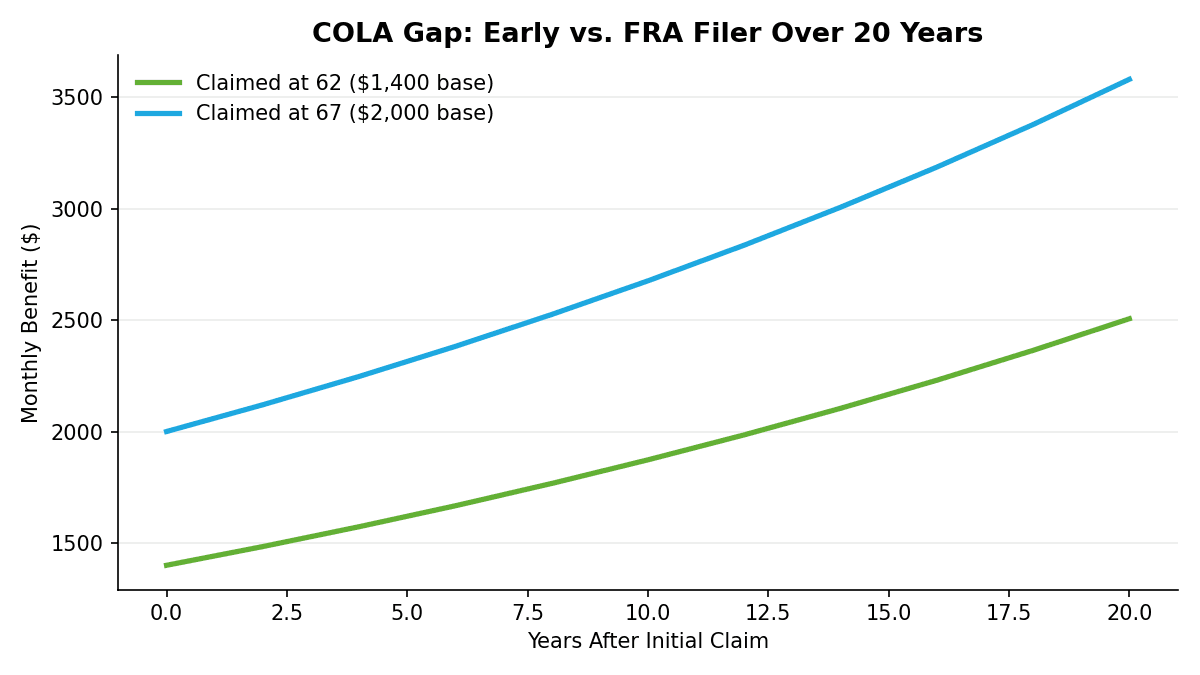
Cost-of-Living Adjustments (COLAs) are calculated as a percentage of your current benefit. Lock in a lower base by claiming early, and every future COLA increase is applied to that smaller number. The gap widens every single year.
Why it matters
Two people with identical earnings records: one claims at 62 with a $1,400 benefit, the other waits until 67 for a $2,000 benefit. The 2026 COLA is 2.8% (announced October 2025). At that rate, the early filer gains about $39/month. The FRA filer gains about $56/month. That roughly $17 gap compounds across every future adjustment for the rest of their lives.
How to fix it
Think of your FRA benefit as your COLA base. Protecting it by delaying even a year or two gives every future cost-of-living raise more purchasing power. It’s one of the most overlooked advantages of patience in Social Security planning.
3) Miscalculating Your Full Retirement Age
What’s being missed
Many people assume FRA is 65. That was true for decades, but Congress changed it. Born between 1943 and 1954: FRA is 66. Born 1955–1959: it rises in two-month increments. Born 1960 or later: FRA is 67.
Why it matters
Filing based on a miscalculated FRA means you might think you’re filing “on time” when you’re actually filing early — and locking in a permanent reduction without realizing it.
Even a six-month error can cost you thousands over a long retirement.
How to fix it
Log into your My Social Security account at ssa.gov. You’ll see your exact FRA and your projected benefit at every claiming age. Takes about ten minutes and removes the guesswork entirely.
4) Missing Delayed Retirement Credits
What’s being missed
Every month you delay past your FRA, your benefit grows by roughly two-thirds of one percent. That adds up to 8% per year between FRA and age 70. These Delayed Retirement Credits stop accruing at 70, so that’s your deadline.
Why it matters
Waiting from 67 to 70 grows a $2,000 FRA benefit to roughly $2,480/month. That’s a permanent 24% increase.
Delaying also increases the survivor benefit a widowed spouse eventually receives, because credits accrued by the deceased worker carry into that survivor benefit calculation. Note that these credits do not boost the spousal benefit while both spouses are alive; the spousal benefit is always based on 50% of the worker’s primary insurance amount, regardless of how long the worker delays.
How to fix it
If you’re in good health and have income to bridge the gap (savings, a pension, part-time work), consider treating ages 67–70 as your earning window for Social Security. The guaranteed 8% annual growth is hard to match anywhere else.
See The $1,000 a Month Rule for Retirement for ideas on building income while you wait.
5) Not Coordinating Spousal and Survivor Benefits
What’s being missed
A spouse can claim a benefit worth up to 50% of their partner’s FRA benefit, even with little or no earnings history of their own. If the higher-earning spouse dies first, the surviving spouse steps up to that person’s full benefit. These rules interact in powerful ways most couples never optimize.
Why it matters
When the higher earner claims early and locks in a reduced benefit, they’re shrinking their own check and the survivor benefit their spouse may depend on for decades. This is one of the most consequential mistakes a couple can make.
Getting this right isn’t just a numbers exercise.
A larger survivor benefit means the spouse left behind has more financial security and more freedom — more room in the budget for travel, for time with grandchildren, for the life they planned together.
How to fix it
Treat this as a household decision, not an individual one.
The higher earner delaying to 70 often produces the best lifetime outcome for both partners. Our guide on Joint Retirement Accounts covers related coordination strategies for couples.
6) Triggering the Earnings Test Penalty
What’s being missed
If you claim before your FRA and keep working, the SSA applies an earnings test.
The 2026 annual exempt amount is $24,480 for those who won’t reach FRA during the year. Above that threshold, the SSA temporarily withholds $1 in benefits for every $2 you earn over the limit. In the year you reach FRA, a higher threshold of $65,160 applies, with $1 withheld per $3 earned above it.
Why it matters
Benefits withheld due to the earnings test are eventually returned once you reach FRA — but the timing disruption can create real cash-flow problems in the meantime. Many people are caught off guard expecting both a paycheck and a full benefit.
How to fix it
If you plan to keep working substantially before FRA, strongly consider delaying your claim until you reach FRA or stop working. The earnings test disappears completely at FRA. A financial planner can model the specific breakeven for your situation.
7) Overlooking the Tax Bite on Benefits
What’s being missed
Up to 85% of your Social Security benefit can be subject to federal income tax, depending on your combined income (adjusted gross income plus nontaxable interest plus half your Social Security). Many retirees are surprised to learn their benefit is taxable at all.
Why it matters
If your combined income exceeds $34,000 as a single filer (or $44,000 married filing jointly), up to 85% of your benefit is taxable. A $2,400/month benefit partially taxed at 22% means real money leaving your pocket every year. Some states add their own tax on top.
How to fix it
Strategic Roth conversions in the years before you claim can reduce your taxable income in retirement, keeping more of your benefit out of the IRS’s reach. Coordinating IRA and 401(k) withdrawals around your claiming age is a powerful lever. For a creative tax strategy, read The Shoebox Strategy to Pay Medical Expenses Tax-Free.
8) Forgetting About the Deemed Filing Rules
What’s being missed
Before 2016, married individuals could file for their own benefit and delay it while collecting a spousal benefit in the meantime. That loophole is closed. Today, deemed filing rules mean that when you apply for any Social Security benefit, you’re automatically applying for all benefits you’re eligible for at once.
Why it matters
If you’re eligible for both a personal and a spousal benefit, the SSA pays only the higher amount. You don’t stack them. Planning based on the old “file and suspend” strategy can leave you with a permanently smaller check than you expected.
How to fix it
Get current. SSA.gov and the official Social Security & Medicare publication (Publication 05-10035) outline exactly how deemed filing works today. If you’ve read any claiming strategy guide written before 2016, review it against current rules before acting.
9) Never Checking Your Earnings Record for Errors
What’s being missed
Your benefit is calculated using your 35 highest-earning years. If any year of wages was reported incorrectly — or if a former employer failed to file properly — your benefit will be lower than it should be. Errors are more common than most people expect, especially for those who changed jobs frequently or worked for small businesses.
Why it matters
A single missing year of high earnings can reduce your monthly benefit permanently. The longer you wait to catch it, the harder it becomes to track down old W-2s and pay stubs for correction. This is worth checking now, while records are still accessible.
How to fix it
- Log into My Social Security at ssa.gov and download your full earnings history
- Compare it against your old tax returns or W-2s year by year
- Contact the SSA directly with documentation if you spot a discrepancy
Catching one missing year of earnings can add real money to your benefit for life. This kind of diligence fits naturally into a broader retirement budget review — see 7 Ways to Prepare Your Budget for Retirement for the full picture.
Conclusion
Social Security is one of the most reliable income streams you’ll have in retirement. It’s inflation-adjusted, guaranteed by the federal government, and lasts as long as you live.
That makes every dollar of it worth protecting.
The mistakes in this article aren’t signs that you’ve failed at planning. They’re simply gaps that most people don’t know to look for. Until now.
Start with the easy wins: check your earnings record, confirm your actual FRA, and run your benefit estimates at ssa.gov. From there, build a claiming strategy around your health, your spouse’s situation, and your other income sources.
The best Social Security decision you’ll ever make is an informed one.