

You spent decades planning for retirement. Now it’s time to plan something a little more fun: the open road.
A retirement road trip isn’t just a vacation. It’s a chance to move at your own pace, stop wherever you want, and rediscover a country (or a corner of it) you’ve never had enough time to explore.
The challenge is choosing where to go…
There are hundreds of beautiful routes out there, and every travel site seems to list them all equally.
This article does something different: it ranks the 7 best retirement road trip ideas using a clear, weighted scoring system so you can quickly find the route that fits your style, budget, and energy level.
The key? Matching the right route to the right season and the right traveler.
Article Highlights
- The #1 ranked route offers world-class scenery AND the easiest accessibility for senior travelers, and it’s completely free to drive.
- Learn which months to travel each route to avoid crowds, extreme weather, and peak-season prices.
- A side-by-side comparison table covers all 7 routes on cost, length, crowds, and Senior Pass value so you can choose at a glance.
- The America the Beautiful Senior Pass ($80, lifetime) delivers exceptional value on at least four of these routes — here’s exactly where it pays off most.
- A quick-start planning checklist at the end makes your first retirement road trip feel effortless rather than overwhelming.
How We Ranked These Routes
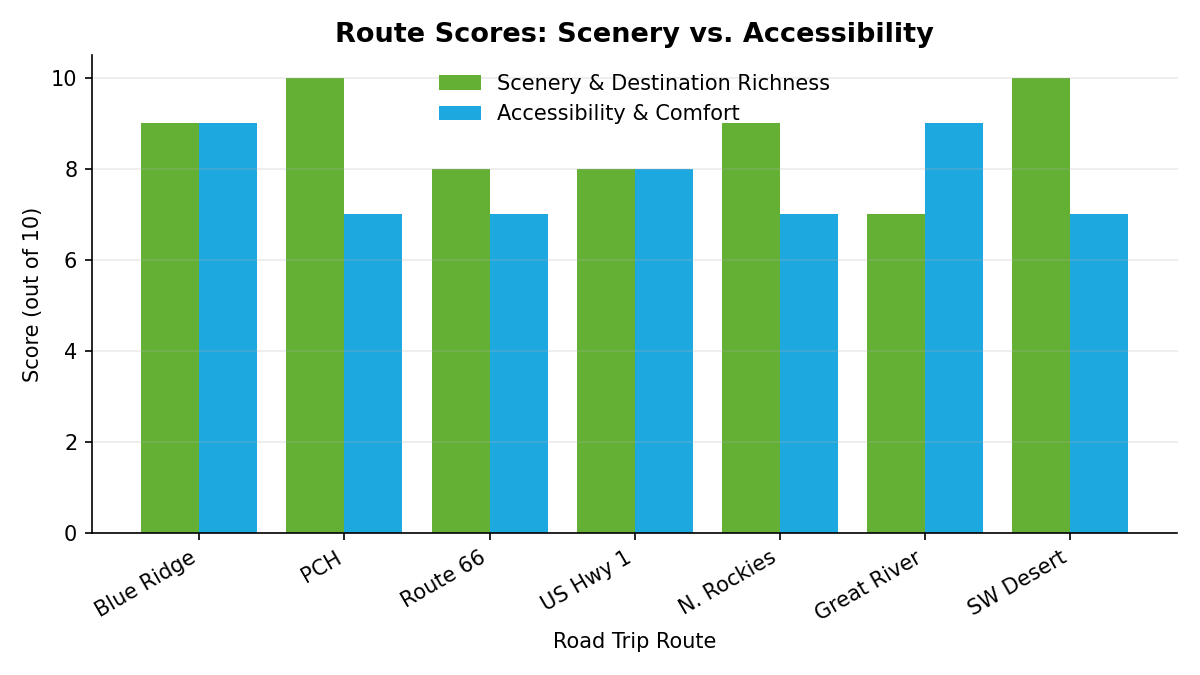
Every route was evaluated on four criteria, each scored 1–10.
- Discovery (scenery and destination richness): variety of landscapes, iconic stops, and photography moments.
- Accessibility and comfort: road quality, year-round access, rest stop availability, nearby medical facilities, and ease of navigation for travelers who may have mobility considerations.
- Value (budget friendliness): average daily costs including fuel, lodging, and food, plus availability of senior discounts.
- Experiences: opportunities to meet people, explore new communities, and come home feeling genuinely refreshed — because staying curious and socially engaged on the road is one of the most powerful things you can do for your overall health in retirement.
Routes were not ranked by sheer popularity.
Popularity sometimes works against you: the most famous road is often the most congested. Where a lesser-known route scores as well or better, it gets the credit it deserves.
#1: Blue Ridge Parkway (Virginia & North Carolina)
The Blue Ridge Parkway stretches 469 miles through the Southern Appalachians and is widely regarded as one of the most beautiful drives in the world.
There are no commercial trucks, no traffic lights, and a 45 mph speed limit that practically forces you to slow down and look around.
That’s not a frustration. That’s the point.
For retirees, this route earns the top spot because it combines jaw-dropping scenery with genuinely easy driving. Pull-offs and overlooks appear every few miles, so you can stretch, breathe mountain air, and take photos without hunting for a parking spot.
Towns like Asheville, NC and Charlottesville, VA sit just off the Parkway and offer excellent restaurants, walkable downtowns, and strong medical infrastructure.
Best months: May, September, and October. Spring wildflowers and fall foliage are both spectacular.
Summer is busy but manageable. Avoid January through March if you want reliable road conditions above 4,000 feet.
Budget-wise, the Parkway itself is free. An America the Beautiful Senior Pass, available through the National Park Service for a one-time fee of $80 for U.S. citizens or permanent residents age 62 and older, covers entrance to all connected NPS sites along the route.
| Category | What You Get on the Blue Ridge Parkway |
|---|---|
| Accessibility & Comfort | Frequent pull-offs, short paved nature walks, and clean mountain air make daily movement easy and low-impact. |
| Experiences | Endless overlooks, charming mountain towns, live music in Asheville, and some of the best fall color in the eastern U.S. |
| Value | The Parkway is free to drive; the $80 Senior Pass pays for itself quickly if you visit two or more NPS sites. |
| Discovery | Gateway to Appalachian culture, craft breweries, art studios, and pottery traditions unique to this region. |
#2: Pacific Coast Highway (California)
Highway 1 along the California coast is the road trip that launched a thousand bucket lists.
Running roughly 460–500 miles from San Francisco to Los Angeles (or in reverse), it offers ocean cliffs, redwood groves, sea otters at Big Sur, and a string of towns that each feel like their own distinct world.
It ranks #2 rather than #1 because certain stretches require careful planning.
Some sections near Big Sur have historically closed after landslides, so checking Caltrans road conditions before you go — and again at time of travel — is essential.
Visit quickmap.dot.ca.gov for the most current status. The drive also demands more concentration than the Blue Ridge Parkway: narrow lanes, steep cliffs, and coastal fog can make portions genuinely demanding. Plan shorter daily driving legs, ideally 150 miles or less, to keep it relaxed.
The payoff is extraordinary. Carmel-by-the-Sea, Morro Bay, and Santa Barbara offer world-class dining and easy walkability. If you’re thinking about what it might look like to live near a route this beautiful, our guide to the cheapest and happiest states covers California alongside more affordable coastal alternatives.
| Category | What You Get on Highway 1 |
|---|---|
| Accessibility & Comfort | Coastal towns offer excellent walking terrain; ocean air and natural beauty support stress reduction and mental clarity. |
| Experiences | Among the most visually dramatic drives on earth, with outstanding food and wine stops throughout. |
| Value | Lodging costs are higher than most routes; booking 60–90 days ahead and choosing shoulder-season dates saves significantly. |
| Discovery | Exposure to world-class art, culinary scenes, and diverse communities from San Francisco to greater Los Angeles. |
#3: Route 66 (Chicago to Santa Monica)
No list of retirement road trip ideas is complete without Route 66.
The 2,400-mile “Mother Road” from Chicago to Santa Monica is as much a history lesson as a drive. Roadside diners, neon signs, ghost towns, Cadillac Ranch, and the Painted Desert all appear on this route. It’s the kind of trip that feels like stepping into an American time capsule.
Route 66 scores slightly lower than the top two on accessibility because the sheer length and some rough rural stretches require more planning.
But that’s also part of its charm: you don’t have to drive the whole thing.
Many retirees focus on the Oklahoma through New Mexico stretch, which packs the most iconic imagery into the fewest miles. Flagstaff, AZ makes an especially comfortable home base for several nights.
Budget travelers will appreciate that Route 66 is cheap by road trip standards: small-town motels and diners are affordable, and the attractions (drive-in theaters, retro museums) cost very little.
The America the Beautiful Senior Pass again covers Grand Canyon National Park, which sits approximately 58–60 miles north of Williams, AZ via AZ-64 — a natural add-on to any Route 66 trip.
| Category | What You Get on Route 66 |
|---|---|
| Accessibility & Comfort | Flat terrain through the Southwest is easy driving; desert air suits those with respiratory sensitivities to humidity. |
| Experiences | Pure nostalgia and Americana, with unique stops that simply don’t exist anywhere else in the world. |
| Value | One of the most budget-friendly long routes in the U.S.; small-town pricing keeps daily costs manageable. |
| Discovery | Native American cultural sites, roadside folk art, and living history you won’t find on any interstate. |
#4: US Highway 1 — Florida to Maine (East Coast Drive)
US Highway 1 runs the length of the East Coast, but the magic is in choosing your segment.
A popular retirement version starts in St. Augustine, FL (the oldest continuously occupied European-established settlement in the continental United States) and travels north through the Outer Banks of NC, Virginia’s colonial heartland, Philadelphia, New York City’s outer boroughs, and coastal New England, ending in Bar Harbor, ME.
This route ranks #4 because urban traffic in mid-Atlantic cities can be stressful, and navigating through or around metro areas takes planning.
The reward is unmatched variety: no other route on this list lets you eat stone crab in Florida, tour Revolutionary War sites in Virginia, and watch lobster boats in Maine on the same trip.
A reasonable pacing is 6 to 8 weeks if you want to savor it.
Accessibility is good throughout: US-1 is a well-maintained federal highway with abundant services. If any particular city on the route appeals to you as a potential home base, our article on safest cities to retire in 2026 covers several East Coast options in depth.
| Category | What You Get on US Highway 1 |
|---|---|
| Accessibility & Comfort | Coastal towns offer flat, walkable boardwalks and beaches; medical facilities are plentiful along the entire corridor. |
| Experiences | Extraordinary variety: beaches, cities, history, foliage, and fresh seafood at every latitude. |
| Value | Costs vary widely; New England summers are expensive, but the Carolinas and mid-Atlantic offer excellent value. |
| Discovery | American history is literally the landscape here, from colonial forts to Ellis Island to Plymouth Rock. |
#5: Going-to-the-Sun Road & Northern Rockies Loop (Montana & Idaho)
Going-to-the-Sun Road inside Glacier National Park is only 50 miles long, but those 50 miles are among the most breathtaking in North America.
Pair it with a loop through the Flathead Valley, Coeur d’Alene, ID, and the Bitterroot Valley, and you have a complete 10–14 day itinerary through some of the least-crowded spectacular scenery in the country.
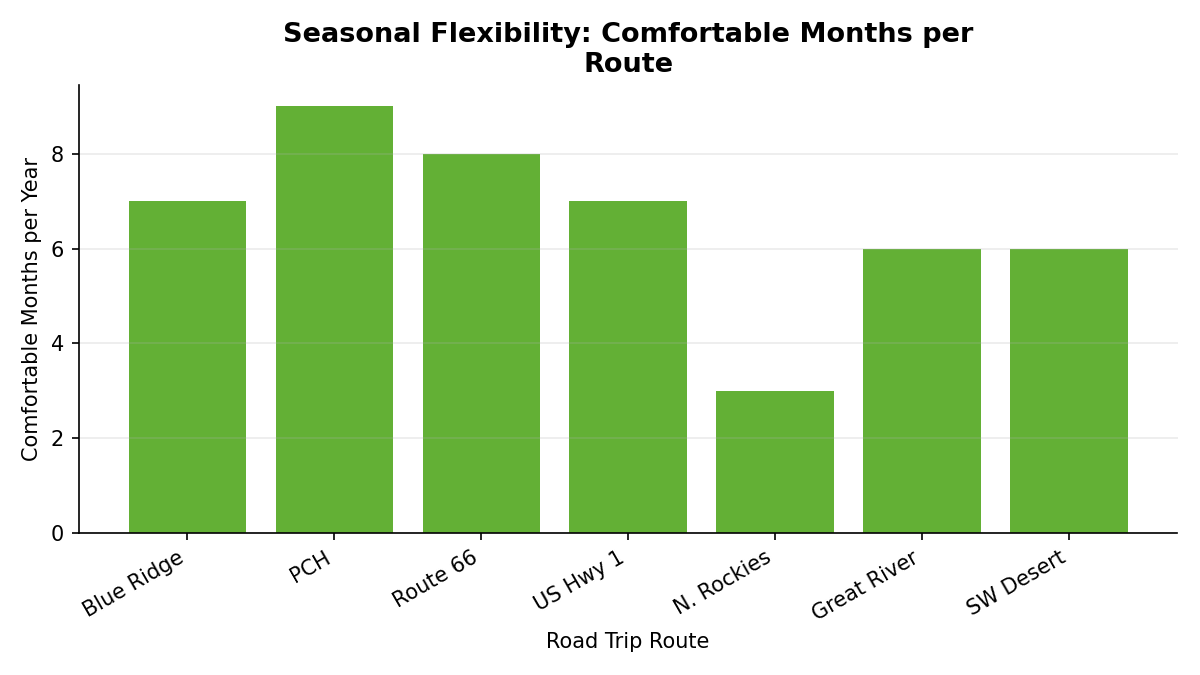
This route ranks #5 primarily because of its narrow seasonal window: Going-to-the-Sun Road typically opens in late June and closes in late October to early November, depending on snowpack.
Check NPS Glacier current conditions for actual opening and closure dates before you plan.
Vehicle size restrictions also apply inside the park (generally no vehicles wider than 8 feet or longer than 21 feet), which matters if you’re considering an RV. Within that window, though, wildlife viewing — grizzly bears, mountain goats, bald eagles — is extraordinary.
The Northern Rockies are genuinely less crowded than Yellowstone or the Grand Canyon. If you want the majesty of the American West without the summer gridlock of more famous parks, this loop delivers exactly that.
| Category | What You Get on the Northern Rockies Loop |
|---|---|
| Accessibility & Comfort | Dramatic scenery and wildlife watching encourage daily outdoor time; cooler temperatures are comfortable for those who struggle with heat. |
| Experiences | Some of the most untouched wilderness in the lower 48, with a genuine sense of solitude that’s increasingly rare. |
| Value | Montana and Idaho are significantly cheaper for lodging and dining than California or Colorado equivalents. |
| Discovery | Small towns like Whitefish, MT offer growing arts and dining scenes alongside authentic Western character. |
#6: Great River Road (Minnesota to Louisiana along the Mississippi)
The Great River Road is a designated National Scenic Byway that traces the Mississippi River for roughly 3,000 miles from Lake Itasca, MN to the Gulf of Mexico.
Most retirees choose a segment: the Upper Mississippi through Minnesota, Wisconsin, and Iowa offers bluffs and river towns; the Lower Mississippi through Memphis, TN and Natchez, MS delivers blues music, antebellum history, and Southern food.
This route ranks #6 because it lacks the concentrated “wow moments” per mile of the top five, but it more than compensates with cultural richness and affordability.
It’s consistently one of the most budget-friendly routes on this list as well, with small river towns offering genuinely warm hospitality and very low costs.
The route pairs beautifully with a slower, immersive travel style.
If you’re curious about how road trips and new experiences connect to staying socially engaged in retirement, our article on building social connections in retirement explores that topic well.
| Category | What You Get on the Great River Road |
|---|---|
| Accessibility & Comfort | Flat terrain throughout; river towns are easy to navigate on foot, and the pace naturally encourages rest and reflection. |
| Experiences | Living American music history, from Chicago blues to New Orleans jazz, with excellent food at every stop. |
| Value | Among the cheapest routes on this list: Midwest and Southern lodging and dining costs are hard to beat. |
| Discovery | Deep immersion in American history, music, and regional culture that most travelers rush past on interstates. |
#7: Southwest Desert Loop (Arizona, Utah, Nevada, New Mexico)
A Southwest Desert Loop connecting the Grand Canyon, Zion, Bryce Canyon, Arches, and Santa Fe is arguably the greatest concentration of natural wonders in the United States.
Four national parks, red rock formations, ancient cliff dwellings, and the art galleries of Santa Fe — all within a 2,500-mile loop from Las Vegas or Phoenix.
It ranks #7 because summer heat is a genuine consideration.
Temperatures in canyon country regularly exceed 100°F from June through August, and some trails inside the parks are genuinely dangerous in that heat even for fit travelers. The solution is simple: go in April–May or September–October. Spring and fall transform this route into the most visually spectacular trip on this entire list.
The America the Beautiful Senior Pass shines brightest here: the Grand Canyon, Zion, Bryce Canyon, and Arches each charge entrance fees that add up quickly without it. With the pass, you cover all four for free. That alone makes the $80 one-time cost one of the best deals in American travel.
| Category | What You Get on the Southwest Desert Loop |
|---|---|
| Accessibility & Comfort | Avoid summer; shoulder-season temperatures are ideal for outdoor activity, and the parks offer wheelchair-accessible viewpoints throughout. |
| Experiences | Unmatched geological drama; the color and scale of these landscapes is unlike anything else in North America. |
| Value | The Senior Pass delivers exceptional value on this route; lodging inside popular parks books 6+ months ahead, so plan early. |
| Discovery | Native American history and living culture (Navajo Nation, Puebloan sites) add layers most road trips simply don’t offer. |
All 7 Routes at a Glance
Use this table to compare routes quickly before diving into the details. Cost ratings reflect average daily out-of-pocket costs for two travelers including lodging, fuel, and food (excluding airfare to the starting point). Daily cost figures should be confirmed against current AAA, GasBuddy, or travel aggregator data before travel — fuel costs fluctuate, so base estimates on a midsize SUV at current national average prices.
| Route | Length | Best Season | Access | Crowds | Senior Pass Value |
|---|---|---|---|---|---|
| Blue Ridge Parkway | 469 mi | May, Sep–Oct | Excellent | Moderate | High |
| Pacific Coast Highway | 460–500 mi (SF to LA) | Sep–Oct, Apr–May | Good | High | Moderate |
| Route 66 | 2,400 mi (full) | Apr–May, Sep–Oct | Good | Low–Moderate | High |
| US Highway 1 (East Coast) | ~1,500 mi featured seg. | May–Jun, Sep | Excellent | Moderate–High | Moderate |
| Northern Rockies Loop | ~800 mi | Jul–Oct only | Good (size limits apply) | Low | High |
| Great River Road | ~3,000 mi (full) | May–Oct | Excellent | Low | Low |
| Southwest Desert Loop | ~2,500 mi | Apr–May, Sep–Oct | Good (heat caveat) | High at parks | Excellent |
Quick-Start Planning Checklist
- Pick your route and segment — you don’t have to drive the whole thing.
- Buy the America the Beautiful Senior Pass at store.usgs.gov if you don’t already have one.
- Check seasonal road conditions for your chosen route before booking anything.
- Book your first two nights only — leave the rest flexible so you can linger where you love it.
- Pack a 2-week buffer supply of any prescription medications.
- Add a roadside assistance membership (AAA or equivalent) for peace of mind.
- Research one medical facility per major stretch of your route — a quick search ahead of time is all it takes.
- Set a daily driving cap of 300 miles or fewer and schedule your driving for morning hours.
Your Road, Your Rules
The best retirement road trip is the one you actually take.
It doesn’t have to be perfect. It doesn’t have to be long. Even a long weekend on a stretch of the Blue Ridge Parkway can reset your sense of what retirement feels like.
If you’re not sure where to start with the logistics, our guide on how to navigate retirement for a smooth transition touches on the mindset shifts that make big adventures easier to actually launch.
Pick the route that made you lean forward while you were reading.
Get the Senior Pass if you don’t have one. Book the first two nights and leave the rest flexible. The open road is genuinely one of the great gifts of having time that belongs entirely to you. Go use it.
Frequently Asked Questions
What is the best trip to take to celebrate retirement?
A road trip that matches your personal style is hard to beat as a retirement celebration. If you love scenery and easy driving, the Blue Ridge Parkway is an ideal first choice: it’s free, accessible, and feels immediately special. If you’ve always dreamed of crossing the country, a partial Route 66 drive from Oklahoma to California is a genuinely memorable way to mark a new chapter.
How long should a retirement road trip last?
There’s no single right answer, but most retirees find that 10 to 14 days is a sweet spot for a first road trip. It’s long enough to settle into a travel rhythm and see meaningful stretches of a route, but short enough to stay comfortable and not exhaust yourself. Once you’ve done one trip, many people find themselves extending future journeys to 3–4 weeks.
What is the safest way to road trip as a senior?
A few practices make a big difference. Keep daily driving to 300 miles or fewer — shorter legs mean less fatigue. Schedule your driving for morning hours when alertness is highest. Research medical facilities in advance along your route (most hospital locator tools are free online). If you take prescription medications, carry a 2-week buffer supply. And don’t underestimate the value of a quality roadside assistance membership for peace of mind.
Is an RV or hotels better for retirement road trips?
Both work well, and the right choice depends on your style. Hotels give you flexibility to change plans without worrying about hookups or parking. RVs eliminate lodging costs and let you camp in stunning locations, but add vehicle complexity and planning. Many retirees start with hotels for their first road trip and explore RV or van life later once they know what they enjoy. Our article on 7 best hobbies for retirees touches on how travel communities (including RV clubs) can become a social world of their own.
What is the America the Beautiful Senior Pass and how do I get it?
The America the Beautiful Senior Pass is a lifetime pass to federally managed lands including national parks, forests, and recreation areas. Per National Park Service guidelines, it’s available to U.S. citizens or permanent residents age 62 or older for a one-time fee of $80 (or $20 for an annual version). You can purchase it online at store.usgs.gov or in person at any participating federal recreation site. On a Southwest Desert Loop or a Blue Ridge Parkway trip, it pays for itself at the very first park entrance.
What are the best road trip routes for seniors with mobility considerations?
The Blue Ridge Parkway and the US Highway 1 East Coast route both score highest for accessibility. The Parkway’s pull-offs are designed for easy vehicle access, and many overlooks are paved and flat. All seven national parks mentioned in this article have accessibility programs and offer detailed guides on their websites. Calling ahead to confirm specific trail or facility details is always worthwhile.