
![[REVIEW] Cheapest and Happiest States for Retirees: A Complete Guide for 2026](https://heroretirement.com/wp-content/uploads/elementor/thumbs/feature-13-rrdycqpcg0aepose4s2whs6uohw3kdlswk50l16usk.png "[REVIEW] Cheapest and Happiest States for Retirees: A Complete Guide for 2026")
You’ve done the work. You’ve saved, planned, and now you’re asking one of retirement’s best questions: where should I actually live?
The internet will hand you two separate lists. One ranks the cheapest states. Another ranks the happiest states. The problem is they rarely overlap, and nobody explains why, or what to do about it.
The cheapest states often carry real trade-offs: thinner healthcare networks, fewer cultural amenities, or climates that push you indoors for months. The happiest states can carry price tags that quietly drain a fixed income.
But there’s a middle ground…
A handful of states genuinely deliver both: lower costs and higher day-to-day satisfaction. You just need to know where to look and what to weigh.
The key? Treat this as a personal decision framework, not a ranking contest. Let’s build yours.
Article Highlights
- West Virginia leads on affordability: annual retirement costs are among the lowest of any state, with housing well below the national median. West Virginia’s overall cost-of-living index sits at approximately 83 (national average = 100), meaning a retired couple may spend meaningfully less than peers in most other states.
- South Dakota has no state income tax: retirees there keep more of every Social Security dollar and pension payment.
- Mississippi’s annual cost advantage: housing costs run roughly 33% below the national average, per U.S. Census data.
- 3 states score well on both dimensions: Tennessee, Missouri, and Nebraska consistently appear on both low-cost and high-wellbeing rankings.
- Healthcare access gaps are real: the happiest states for retirees tend to score measurably higher on senior healthcare access than the cheapest states, according to annual reports such as the United Health Foundation’s America’s Health Rankings Senior Report.
The Cheapest States for Retirees in 2026
Affordability in retirement isn’t just about a low sticker price on a house.
It’s the full picture: housing, groceries, transportation, utilities, and, critically, healthcare. These states consistently rank at the bottom of cost-of-living indices, which means your dollars stretch further every single month.
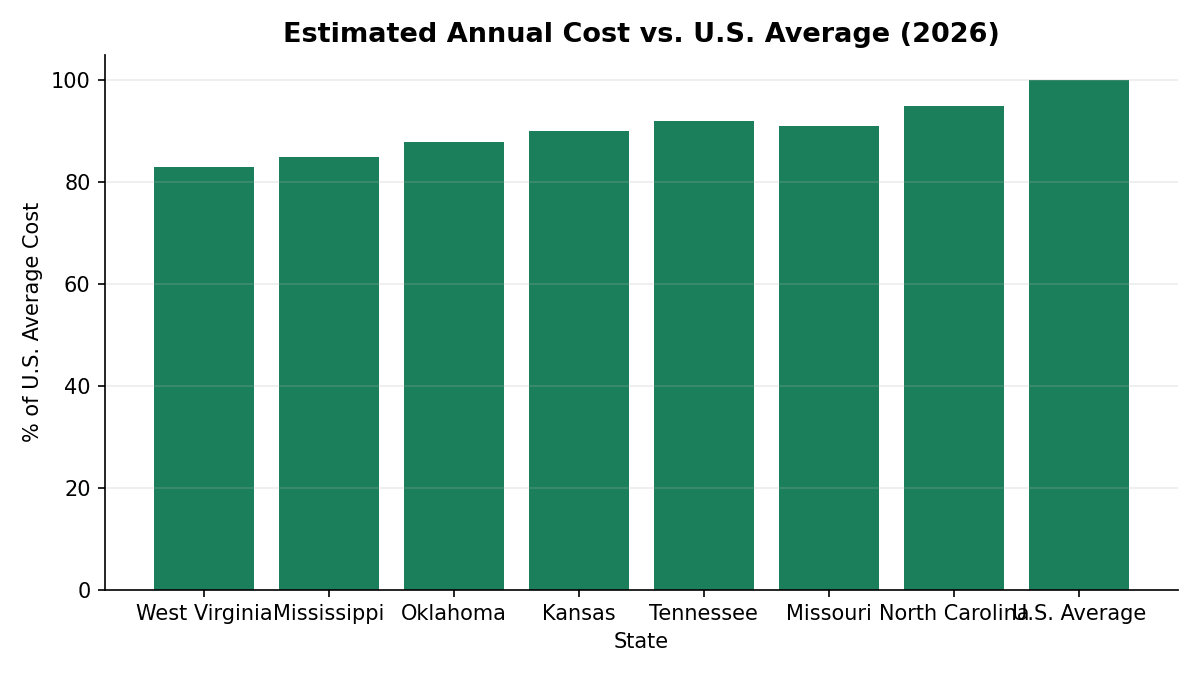
West Virginia, Mississippi, and Oklahoma: The Affordability Frontrunners
West Virginia regularly tops national cost-of-living rankings as the most affordable state in the country. Housing is the biggest driver: median home prices run well below $200,000 in most markets.
Mississippi follows closely, with grocery and utility costs that rank among the nation’s lowest. Oklahoma rounds out the top tier, offering flat terrain, warm weather, and a cost base that supports a comfortable retirement on a modest fixed income.
The trade-off in all three states is healthcare infrastructure. Rural areas can mean longer drives to specialists, so factor that into your personal math.
Kansas and Arkansas: Underrated Budget Picks
Kansas offers something its neighbors don’t always match: mid-sized cities like Wichita and Lawrence with genuine cultural amenities, university towns, and solid medical centers, all within a low-cost framework.
Arkansas has seen a quiet surge of interest from retirees drawn to the Ozarks region, where natural beauty and low property taxes combine.
Both Kansas and Arkansas exempt Social Security benefits from state income tax in 2026.
Kansas enacted a full exemption with no income cap starting Tax Year 2024 under Senate Bill 1. Arkansas also exempts Social Security from state income tax, but it is not a no-income-tax state: pensions and 401(k) withdrawals above a $6,000-per-person exemption are still subject to state income tax at rates up to 3.7% in 2026.
If a significant portion of your retirement income comes from a pension or IRA withdrawals, Arkansas’s tax picture is notably different from states like South Dakota or Tennessee that impose no income tax at all. Know your income mix before assuming either state is fully tax-free for you.
What “Cheapest” Actually Costs You
The honest version of this conversation includes the hidden costs in very low-cost states. Older housing stock can mean higher maintenance. Sparse public transit means a second car. Limited local healthcare means travel expenses for care.
None of these are dealbreakers, but they belong in your budget model.
A state that looks $400 per month cheaper on paper might net out to $150 cheaper once you account for reality. That’s still a win. Just go in with clear eyes.
The Happiest States for Retirees: What the Research Actually Measures
“Happiness” is a loaded word.
In retirement research, it typically gets measured through a combination of senior wellbeing surveys, depression rates among adults 65+, healthcare access scores, social engagement data, and life expectancy. When you layer those metrics together, a different set of states rises to the top.
How Happiness Rankings Are Built
Organizations like Gallup, WalletHub, and the CDC’s Behavioral Risk Factor Surveillance System produce annual wellbeing and senior health indices. They pull from behavioral health surveys, Medicare data, and state-level social service reports.
The metrics that move the needle most for retirees: access to primary care, rates of social isolation, availability of recreational infrastructure, and climate satisfaction.
No single list is definitive, but the states that appear repeatedly across multiple indices are worth your attention.
States That Consistently Score High on Senior Wellbeing
New Jersey, Connecticut, and Maryland tend to rank at the top of senior wellbeing lists, driven by dense healthcare networks, strong social infrastructure, and high rates of community engagement among older adults.
South Dakota surprises many people: it combines no state income tax, low crime, and above-average senior wellbeing scores.
Minnesota and Colorado also earn consistent marks for outdoor access, cultural vitality, and quality senior care networks.
The catch: several of these states carry above-average living costs, especially in metro areas.
Social Connection Is the Happiness Variable Most People Miss
Research consistently shows that social isolation is one of the strongest predictors of poor health and low life satisfaction in retirement. A state’s happiness score is partially a proxy for how easy it is to stay connected.
States with strong community infrastructure, including active senior centers, walkable neighborhoods, volunteer networks, and continuing education programs, tend to produce happier retirees regardless of cost tier.
Before you choose a state, ask: does this place make it easy to build a social life from scratch?
That question often matters more than the tax rate. For ideas on staying socially active wherever you land, see our guide to 7 best hobbies for retirees to stay social.
States That Offer Both Affordability and Happiness
This is the gap most retirement guides leave open.
Here are the states that credibly appear on both dimensions: not perfect tens on either list, but genuine contenders across both. Think of these as your best starting shortlist.
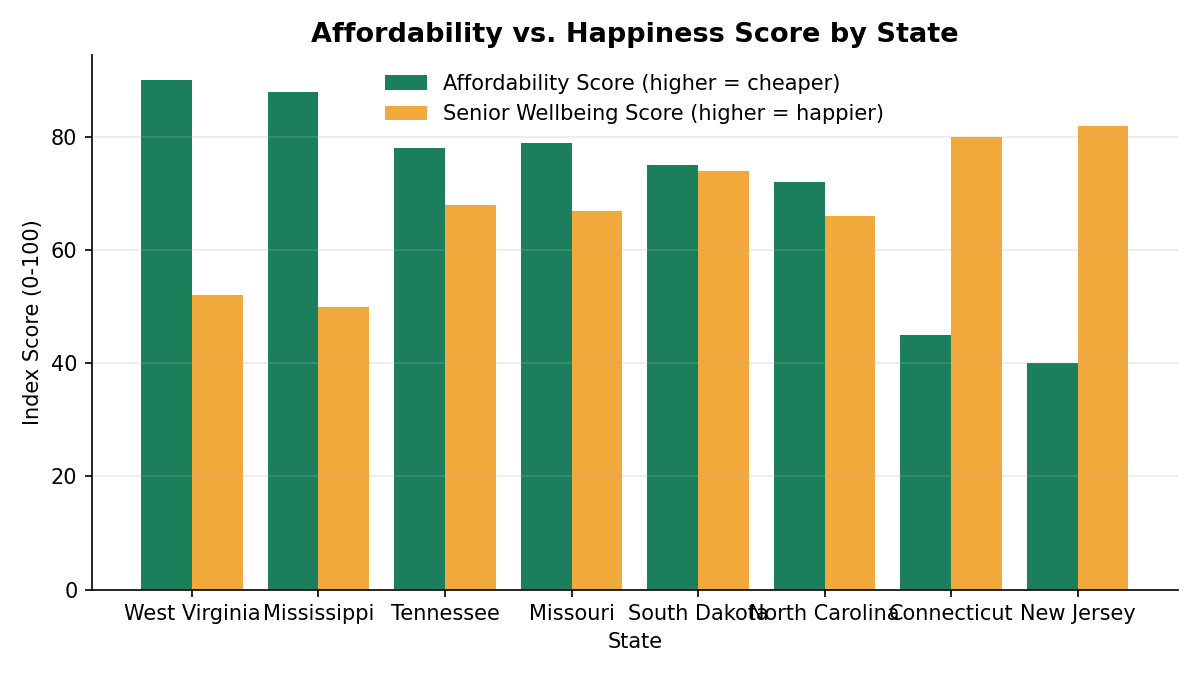
The Sweet Spot Comparison Table
Use this table as a starting point, not a final verdict.
Costs are approximate annual figures for a single retiree based on composite cost-of-living index data. Your actual number depends on housing choice, healthcare needs, and lifestyle.
| State | Est. Annual Cost (Single Retiree) | Relative Happiness Rank | Key Benefit | Best For |
|---|---|---|---|---|
| Tennessee | ~$46,000–$52,000 | Above average | No state income tax, mild climate | Budget-conscious with active lifestyle |
| Missouri | ~$40,000–$46,000 | Above average | Low housing + strong mid-size cities | Urban amenities at rural prices |
| Nebraska | ~$43,000–$52,000 | Above average | Low crime, strong senior healthcare | Safety-focused retirees |
| South Dakota | ~$46,000–$52,000 | High | Zero income tax, low cost | Maximizing take-home income |
| North Carolina | ~$48,000–$55,000 | Above average | Climate diversity, growing retiree communities | Outdoor enthusiasts |
These five states show up repeatedly in analyses that weigh both dimensions simultaneously, which is exactly the comparison most top pages skip.
Tennessee: The Most Discussed Sweet Spot
Tennessee earns its reputation. There is no state income tax on wages or retirement income, housing costs sit roughly 15-20% below the national median, and cities like Chattanooga, Knoxville, and Nashville offer genuine cultural depth.
The climate is mild by Midwest standards. Healthcare infrastructure in the major metros is strong. The tradeoff: Tennessee’s rural areas have thinner medical networks, and some smaller cities score lower on senior social programming. Choose your specific city carefully, not just the state.
North Carolina: Growing Fast for Good Reasons
North Carolina has become one of the most popular retirement destinations in the country, and the numbers back the enthusiasm. The western mountains offer cooler summers; the coast offers mild winters.
Asheville, Wilmington, and the Research Triangle each attract a different retiree profile. Costs are rising in some markets as demand increases, so locking in sooner rather than later may work in your favor.
Healthcare is a genuine strength: the state hosts major medical systems and teaching hospitals within reach of most mid-size cities.
Comparing Cost of Living vs. Quality of Life Across Regions
Where you retire isn’t just a financial decision. It’s a climate decision, a family proximity decision, and a daily-life decision. Regional patterns help you narrow the map before you dive into individual states.
The South: Low Costs, Climate Wins, Healthcare Gaps
The South offers the most affordable retirement real estate in the country, and the warm climate is a genuine quality-of-life plus for many retirees. The region’s weakness is healthcare access outside major metro areas.
If you’re healthy and mobile today, this may not feel urgent — but it’s worth projecting forward 10 to 15 years. States like Tennessee, the Carolinas, and parts of Georgia offer the best of the South’s cost advantage with stronger healthcare infrastructure than the deep rural areas of Mississippi or West Virginia.
The Midwest: Underappreciated Value
The Midwest is chronically underrated in retirement conversations. States like Missouri, Nebraska, Iowa, and Kansas offer low crime rates, affordable housing, strong community infrastructure, and four-season climates that suit people who actually like distinct seasons.
The region doesn’t carry the marketing glamour of Florida or the Southwest, but retirees who move there tend to express high satisfaction with the cost-to-quality ratio. Mid-size cities, think Columbia MO, Lincoln NE, or Des Moines IA, punch well above their weight on amenities.
The Northeast and West Coast: High Cost, High Amenity
The Northeast and West Coast states that top happiness rankings come with premium price tags. If you own significant home equity in these regions, a move within the region may still make financial sense, trading a $900,000 suburb for a $500,000 coastal town, for instance.
But if you’re relocating from a lower-cost state to a high-cost one, run your numbers carefully. The amenity premium is real, but so is the financial drag over a 20-to-30-year retirement. For a broader view on living well in retirement regardless of location, see our piece on empower your retirement: 7 strategies for a fulfilling life.
Essential Factors Beyond Cost: Taxes, Healthcare, and Safety
Two states with identical cost-of-living scores can feel completely different to retire in once you factor in taxes, healthcare quality, and personal safety. These three layers deserve their own analysis before you commit.
State Tax Rules That Directly Affect Retirement Income
Per state tax authority rules reviewed alongside IRS guidance on retirement income, Social Security benefits, pensions, and 401(k) withdrawals are taxed differently in every state. Some states tax none of your retirement income. Others tax all of it at the same rate as wages.
As of 2026, nine states have no income tax at all: Alaska, Florida, Nevada, New Hampshire, South Dakota, Tennessee, Texas, Washington, and Wyoming.
Every retiree income source passes through those states without state income tax.
(Note: Washington taxes capital gains above a threshold, which won’t affect most retirees’ ordinary income. New Hampshire fully eliminated its interest and dividends tax effective January 1, 2025. Washington also passed legislation in March 2026 imposing a 9.9% tax on household income above $1 million effective 2028, which will not affect ordinary retirees but is worth noting for high-income households planning ahead.)
States that exempt Social Security but tax pensions offer a partial advantage that depends on your specific income mix.
Know your income sources before you assume any state is “tax-free” for you personally.
Healthcare Access: The Factor That Compounds Over Time
A great tax situation means very little if you’re driving 90 minutes for a specialist appointment at 72.
When evaluating states, look at: hospital quality ratings from the Centers for Medicare and Medicaid Services Care Compare tool, the ratio of primary care physicians per 100,000 residents, and Medicare Advantage plan availability and premiums in that specific county.
Rural areas in even the most affordable states can have thin coverage. Urban cores in mid-tier states often have excellent systems. This is a city-level decision as much as a state-level one.
For a broader look at what it means to stay physically well in retirement, the healthy hero’s guide to thriving in retirement is worth a read.
Safety and Community: What the Data Shows
Safety in retirement means more than low crime rates. It includes walkability, weather-related risk, natural disaster exposure, and the quality of local emergency services.
The Midwest and upper South generally score well on all four.
The Gulf Coast states carry hurricane exposure. Parts of California carry wildfire and earthquake risk. These aren’t reasons to avoid a state, but they do belong in your insurance cost projections and your long-term planning. For a deeper dive on evaluating safety holistically, see our guide on the safest cities to retire in 2026.
How to Prioritize: Building Your Personal Decision Framework
There is no universally correct answer to where you should retire.
But there is a right answer for you, and it comes from getting clear on your priorities before you start comparing ZIP codes. Here’s a framework that works.
Step 1: Define Your Non-Negotiables
Start with a short list of absolute requirements. Proximity to family often tops this list, and for good reason. A lower-cost state 1,500 miles from your grandchildren may look great on a spreadsheet and feel hollow in practice.
Other common non-negotiables: a specific climate type, proximity to a major airport, access to a particular type of specialist care, or a minimum population threshold for cultural activity.
Write these down first. They immediately eliminate large portions of the map and save you hours of research on states that were never real candidates.
This is where the financial decision and the life decision converge.
A retirement that fills your days with meaningful activity, time outdoors, time with people you love, time doing things that light you up, is the real goal. The right state gives you more room in the budget for travel, more access to activities that keep you moving, and more opportunities to build the kind of days you actually want.
That’s the real prize here, not just a lower tax bill.
Step 2: Score Each State Against Your Priorities
Once you have your non-negotiables, build a simple weighted scorecard. Assign each factor (cost, healthcare access, climate, proximity to family, cultural amenities, tax treatment) a weight based on how much it matters to you.
Score your top four or five candidate states against each factor.
The state with the highest weighted score isn’t automatically the winner, but this process consistently reveals blind spots and forces honest trade-off conversations. Many retirees find that their “obvious” first choice drops several positions once proximity to family gets its proper weight.
Step 3: Test Before You Commit
Before selling your home and moving, spend 30 to 90 days in your top candidate.
Rent an Airbnb or furnished apartment. Visit the grocery store, the local park, the nearest medical center. Drive the roads on a Tuesday. Meet your potential neighbors.
This kind of test run catches dealbreakers that no ranking system can surface.
Programs like Tulsa Remote in Oklahoma and similar community-based initiatives in several Midwest and Southern cities offer structured introductions to local life for people considering a move. It’s worth checking what’s available in your top candidate city before you commit.
Common Mistakes to Avoid When Choosing a Retirement State
The biggest relocation regrets share a pattern.
They’re almost never about picking the wrong state on paper. They’re about skipping a step in the decision process. Here are the mistakes worth avoiding.
Optimizing Only for Taxes
Tax-free states are genuinely attractive. But a retiree who moves to a no-income-tax state and finds themselves isolated, bored, or far from family often ends up spending more on travel, entertainment, and emotional compensations than they saved on taxes.
The tax math matters. It just doesn’t matter as much as your daily quality of life over a 20-year horizon. Run both calculations before you decide.
Underestimating the Social Reset
Moving to a new state in retirement means rebuilding your social network from zero.
That’s harder in your 60s and 70s than it was in your 30s, not because you’re less capable, but because the natural on-ramps aren’t there anymore: no new job, no school pickup lines, no neighborhood block parties with young families.
States and cities with strong retiree communities, active senior programming, and a culture of community engagement make this reset significantly easier. Weight this factor heavily, especially if you’re moving away from long-established roots.
See our guide on building social connections in retirement for practical strategies wherever you land.
Forgetting That Your Needs Will Change
The state that’s perfect at 62 may not be perfect at 78.
A remote mountain cabin with great hiking suits an active early retiree. A decade later, you may want walkability, proximity to medical care, and easy access to family.
When evaluating states, ask: does this place work for the full arc of my retirement, not just the first exciting chapter?
States with strong aging-in-place infrastructure, including good home health aide availability, senior transportation programs, and accessible housing stock, offer more flexibility as your needs evolve.
Choosing Where to Retire: The Bottom Line
Choosing where to retire is one of the most powerful financial and lifestyle decisions you’ll make.
The states that win on both affordability and happiness aren’t secrets. They’re Tennessee, Missouri, Nebraska, South Dakota, and North Carolina, among others.
But the right answer for you depends on what you weight most: taxes, climate, proximity to family, healthcare access, or the ease of building a social life from scratch.
Don’t chase the top of someone else’s ranking.
Build your own scorecard, test your top candidates in person, and choose the place that supports the full life you’re building, not just the budget version of it.
Frequently Asked Questions
What is the cheapest and safest state to retire in?
Nebraska and Missouri consistently rank well on both cost and safety metrics, offering low housing costs, low crime rates, and solid healthcare infrastructure in their mid-size cities. Nebraska in particular earns high marks in senior wellbeing surveys alongside its affordability. Safety in retirement also includes factors like natural disaster risk and emergency service quality, not just crime, so evaluate at the city level, not just the state.
Where can I retire on $800 a month?
Retiring on $800 per month in the United States is extremely difficult even in the lowest-cost states. Even in the most affordable states, such as Mississippi and West Virginia, which carry overall cost-of-living indices in the low-to-mid 80s compared to a national average of 100, a single retiree typically needs $1,500 to $2,200 or more per month depending on housing situation, healthcare costs, and lifestyle. Retirees seeking that level of affordability increasingly look at international destinations: countries in Central America, Southeast Asia, and Eastern Europe where $800 to $1,200 per month can support a comfortable lifestyle.
What are the five best states to retire in financially?
States that consistently rank highest on financial criteria for retirees include South Dakota, Tennessee, Wyoming, Florida, and Missouri, largely because they combine no or low state income tax with below-average or average cost of living. The right pick among these depends on your specific income mix, since tax advantages vary based on whether your income comes from Social Security, a pension, or investment withdrawals. Healthcare costs and access should also factor into your total financial picture.
Which state is best for retirees who want both low cost and high quality of life?
Tennessee is the most frequently cited answer to this question, offering no state income tax, housing costs below the national median, and genuine cultural amenities in cities like Chattanooga, Knoxville, and Nashville. North Carolina is a strong alternative, particularly for retirees who value climate variety and proximity to both mountains and coast. Both states perform above average on senior wellbeing indices while staying meaningfully below the cost of the traditional top-ranked happiness states.