
Retirement hands you something most people spend 40 years dreaming about: time.
The question is: what do you do with it?
Research consistently links active, engaged retirees with sharper minds, stronger bodies, and longer lives. But the benefits go well beyond the physical.
The right hobby gives you a reason to get up in the morning, a community to belong to, and a skill to keep building. That’s a powerful combination.
It also checks three of the four HERO foundational pillars in our Hero Retirement philosophy: Health, Enjoyment and Opportunity.
Most retirement hobby articles hand you the same recycled list with zero guidance on how to actually begin, what things cost, or how much time each pursuit realistically demands.
This one is different.
In this article, you’ll learn 10 of the best hobbies for retirees to stay active — ranked across fitness levels, budgets, and time commitments, with practical first steps you can take this week.
Because the best chapter of your life doesn’t write itself. Let’s give it a great opening line.
![Bar chart comparing approximate calories burned per hour for seven popular retirement hobbies, ranging from about 180 calories for Yoga/Tai Chi to 450 for cycling, based on standard MET values for a 150-pound adult. [VERIFY: all MET-based calorie figures against ACE or peer-reviewed exercise science source before publishing]](https://heroretirement.com/wp-content/uploads/2026/08/chart1-7.png)
1) Walking (With a Twist)
Why it works
Walking is the most accessible form of exercise on the planet — and it delivers serious results.
The CDC recommends 150 minutes of moderate aerobic activity per week for adults, and a daily walk habit gets you there with room to spare. The “twist” is intentionality: picking new routes, joining a walking group, or using an app like AllTrails to explore local trails transforms a simple stroll into an adventure worth anticipating.
What it costs
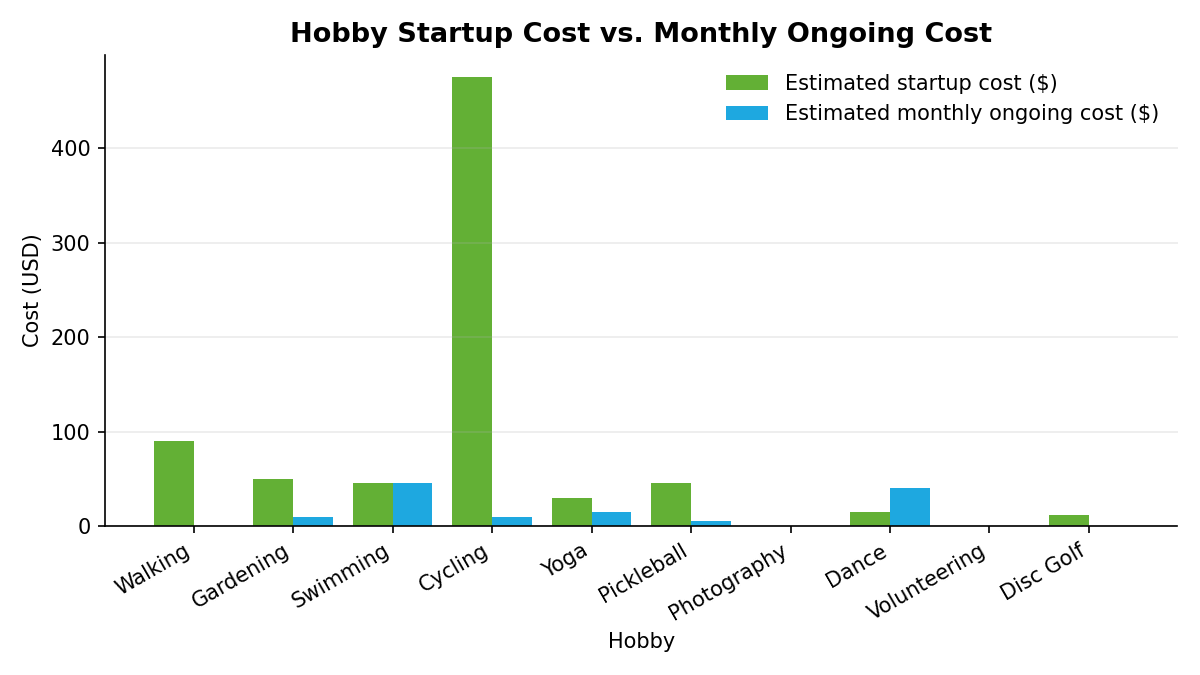
Essentially zero. A decent pair of supportive shoes ($60–$120) is the only real investment. Parks, neighborhoods, and trails are free.
How to start today
- Download a free step-tracking app (Apple Health, Google Fit, or Pacer).
- Set a modest daily goal of 5,000 to 7,000 steps.
- Find one new route this weekend, then search “walking clubs near me” to add a social layer immediately.
2) Gardening
Why it works
Gardening is deceptively physical.
Digging, planting, weeding, and hauling soil engages your core, arms, and legs in ways a gym machine never quite replicates. Research also links regular gardening to reduced stress and improved mood. And at the end of a session, you have something beautiful — or edible — to show for it.
What it costs
A starter kit of basic tools runs $30–$70. Seeds are cheap. Many cities offer community garden plots for under $50 a year, so you don’t even need a yard.
How to start today
- Pick one container — a single pot on a balcony counts.
- Choose a beginner-friendly plant (basil or mint are nearly foolproof).
- Visit your local garden center this week and let curiosity do the rest.
3) Swimming and Water Aerobics
Why it works
Water can support up to 90% of your body weight when you’re submerged to the neck.
Waist-deep water supports approximately 50% of your body weight; chest-deep water supports approximately 70–75% — still dramatically reducing joint stress during a typical water aerobics class.
You get a full cardiovascular and strength workout with almost none of the impact. Water aerobics classes also tend to be genuinely fun, which matters more than people admit.
What it costs
A YMCA or community pool membership typically runs $30–$60 per month, often less for seniors. Many offer free trial classes. Swimwear and water shoes are the only gear you need.
How to start today
- Call your nearest YMCA or community recreation center and ask specifically about senior aquatics programs.
- Most have morning classes designed for beginners. Show up once. That’s all.
4) Cycling (Road, Trail, or E-Bike)
Why it works
Cycling builds cardiovascular fitness and lower-body strength while being far gentler on knees than running.
E-bikes have been a game-changer: they let you cover more distance, tackle hills, and keep up with younger riders without overexerting. You’re still pedaling. The motor just takes the edge off.
What it costs
A reliable entry-level bike starts around $350–$600. Quality e-bikes begin around $1,200–$2,000, which sounds steep until you factor in what you’d spend on a gym membership over the same period. Helmets ($40–$80) are non-negotiable.
How to start today
- Visit a local bike shop (not a big-box store) and ask to test ride a few options.
- Many shops rent bikes by the day or week — try before you commit.
- Look up your city’s trail map online before you go.
5) Yoga and Tai Chi
Why it works
Balance is one of the most underrated physical skills, and one of the first to slip as we age.
Yoga and Tai Chi both build balance, flexibility, and core strength simultaneously. Tai Chi in particular has a strong body of evidence behind it: the CDC’s STEADI initiative lists it as an evidence-based fall-prevention program, and research confirms its effectiveness for balance in older adults.
These aren’t just “gentle” options. They’re smart ones. For a broader look at thriving in retirement through movement and mindset, that guide is worth bookmarking.
What it costs
YouTube offers hundreds of free beginner videos. In-person classes typically run $10–$20 per drop-in session. A yoga mat costs $20–$40 and lasts for years.
How to start today
- Search “Tai Chi for beginners” or “chair yoga for seniors” on YouTube and do a 15-minute session today. No equipment required.
- Many community centers offer free or subsidized classes — worth a quick phone call.
6) Pickleball
Why it works
Pickleball is the fastest-growing sport in the United States, and retirees are leading the charge.
According to the SFIA 2026 Topline Participation Report, 24.3 million Americans played pickleball in 2025, a 22.8% year-over-year increase, making it the fastest-growing sport in the country for five consecutive years.
The court is smaller, the ball moves slower, and the learning curve is short — most beginners are rallying within their first session. If you want more ideas for staying social while staying active, this list of best hobbies for retirees to stay social pairs well with this one.
What it costs
A beginner paddle runs $30–$60. Most public courts are free to use. Many recreation centers offer free intro clinics, so your first session can cost you nothing.
How to start today
- Visit usapickleball.org to find courts near you.
- Look for “open play” sessions — anyone can show up and join.
- Bring a friend or go solo. Either way, you’ll leave with new ones.
7) Photography
Why it works
Photography gets you moving in a way that never feels like exercise.
Chasing the right light means early morning walks. Hunting for interesting subjects means exploring neighborhoods, parks, and cities with fresh eyes. It also sharpens your attention to detail and gives you a creative outlet with a built-in archive of your life.
What it costs
The smartphone in your pocket is already a capable camera. If you want to go deeper, a solid entry-level mirrorless camera runs $500–$800. Free editing apps like Snapseed or Lightroom Mobile eliminate any software cost.
How to start today
- Pick a theme for this week (“doors,” “morning light,” “reflections”) and photograph it daily using only your phone.
- Join a free online photography community like Flickr for instant feedback and encouragement.
8) Dance Classes
Why it works
Dance is a rare triple threat: it builds cardiovascular fitness, balance, and coordination while demanding enough mental focus to keep your brain genuinely engaged.
Research published in the New England Journal of Medicine found that dancing was associated with a reduced risk of cognitive decline in older adults. Unlike most workouts, people actually look forward to it. It’s also one of the best ways to build social connections in retirement without it feeling like an agenda.
What it costs
Group classes at local studios typically run $10–$20 per session. Many community centers offer free or low-cost ballroom, line dancing, or salsa nights. Shoes matter more than outfit — a smooth-soled pair costs $30–$60.
How to start today
- Search for beginner ballroom or line dancing classes in your area this week.
- Most studios offer a free first class. Show up. That’s the whole plan.
9) Volunteering as a Physical Practice
Why it works
Volunteering rarely appears on hobby lists, but it should.
Habitat for Humanity builds, trail maintenance crews, community garden projects, and animal shelter walking programs all involve consistent physical activity. More importantly, the sense of purpose and connection you build through volunteering pays dividends a solo gym routine simply cannot.
This is also where staying physically active connects to something deeper.
The volunteers who report the highest satisfaction aren’t just moving their bodies. They’re building friendships, learning new skills, and finding meaning in their extra time — doing something that matters to them and to their community. That combination is genuinely hard to beat, and it costs nothing but a few hours a week.
What it costs
Free. Many organizations provide any specialized gear or training required. Some even cover travel costs for volunteers on longer projects.
How to start today
- Visit VolunteerMatch.org and filter by physical or outdoor opportunities.
- Commit to one session. The second one books itself.
10) Learning a New Sport (Pickleball’s Quieter Cousins)
Why it works
Beyond pickleball, several lower-profile sports are quietly perfect for retirees: bocce ball, lawn bowling, disc golf, and archery all offer light-to-moderate physical activity in an outdoor social setting.
Each has a short learning curve and a welcoming beginner community. The novelty of learning something brand new also carries its own cognitive benefit — your brain lights up when it’s figuring something out.
What it costs
Disc golf is largely free (courses are public parks; a starter disc costs $10–$15). Bocce sets run $25–$50. Lawn bowling clubs often provide equipment and charge modest annual dues. Archery ranges typically offer equipment rentals for $15–$25 per session.
How to start today
- Pick whichever sounds most interesting and search for a local club or public course this week.
- Disc golf in particular has exploded in popularity — there’s a very good chance there’s a free course within 10 miles of you right now.
Conclusion
You don’t need to overhaul your entire life to stay active in retirement. You just need one good starting point.
Pick the hobby from this list that made you think “I could actually do that” and take one small step toward it this week. Book the class. Download the app. Call the rec center. Buy the disc.
The research on active, engaged retirees is remarkably consistent: the people who thrive aren’t the ones who planned perfectly. They’re the ones who stayed curious and kept moving.
If you want to go deeper on building a retirement that fires on all cylinders, our guide on empowering your retirement is a great next read.
The best hobby for your retirement is the one you actually start.