
![[REVIEW] Best Countries to Retire in 2026: 7 Destinations Ranked for the Life You Actually Want](https://heroretirement.com/wp-content/uploads/elementor/thumbs/feature-rrdycrn6mubp1ar0zahj29yb9vrgs2pj8osi2b5gmc.png "[REVIEW] Best Countries to Retire in 2026: 7 Destinations Ranked for the Life You Actually Want")
Retirement abroad used to mean giving things up…
Settle for cheaper healthcare, trade safety for savings, accept a smaller life in exchange for a lower cost of living.
That trade-off is no longer the story.
In 2026, a growing list of countries actively courts retirees — with streamlined visa programs, high-quality medical care, and costs that can make your savings last decades longer.
Some of these destinations offer permanent residency on Social Security income alone. Others deliver healthcare that rivals the U.S. at a fraction of the price. Several give you both.
The key? Knowing which destination actually fits your version of a great retirement, not just which one tops a generic ranking.
Article Highlights
- 7 top retirement destinations ranked using a transparent, four-factor methodology covering costs, healthcare, visa access, and lifestyle.
- Side-by-side comparison of monthly costs, healthcare quality, and visa programs for every country on the list.
- Honest assessment of fit — what each country genuinely delivers and who it’s actually right for.
- Key visa requirements and income thresholds for 2026, including which programs Social Security income qualifies for.
- Tax and practical considerations for Americans retiring abroad, including a note on cross-border filing obligations.
How We Ranked These Countries
Every destination on this list was evaluated across four weighted criteria, chosen because they reflect what actually shapes day-to-day retirement life.
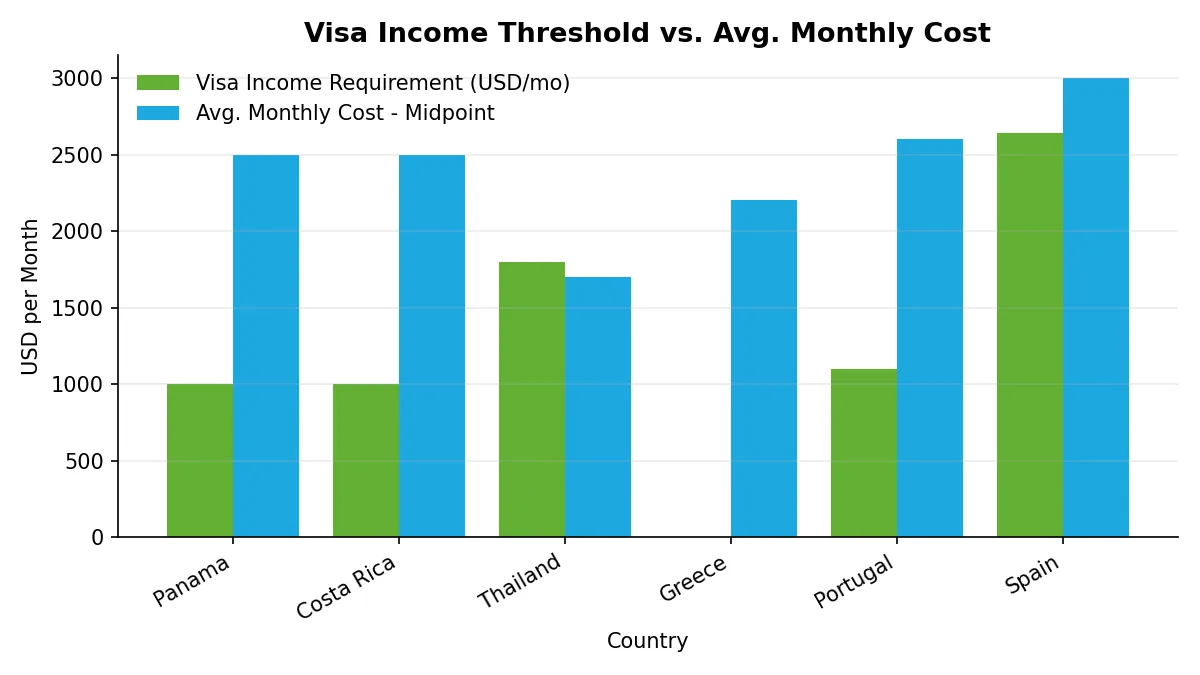
Affordability (30%): Average monthly cost for a comfortable two-person lifestyle, including rent, groceries, utilities, and dining out. Lower cost relative to the U.S. scores higher.
Healthcare access (25%): A combination of system quality and practical access for expats — including private insurance availability and English-speaking providers.
Visa and residency friendliness (25%): How straightforward it is for Americans to obtain legal long-term residency, including income thresholds, processing timelines, and path to permanent residency.
Lifestyle fit (20%): Climate, safety, English prevalence, expat community size, internet reliability, and cultural openness to foreign retirees.
No ranking system is perfect, and the right country for you depends on factors no index can capture. Use this list as a starting point, not a final answer.
#1 Portugal: The Gold Standard for American Retirees
Portugal has topped expat retirement rankings for years, and in 2026 it earns our first place.
The combination of mild Atlantic climate, world-class food, low crime, and a well-regarded national health system is hard to beat. Lisbon and Porto buzz with culture, while the Algarve coast offers a quieter, beach-focused pace of life.
Monthly costs for a comfortable lifestyle typically run $2,200 to $3,000 for a couple outside Lisbon’s city center.
The D7 Passive Income Visa (also known as the Portugal Retirement Visa) allows retirees to live legally in Portugal on passive income — including pensions and investment income — with a minimum requirement of €920/month in 2026, indexed to Portugal’s minimum wage.
It has a five-year path to permanent residency. Portugal’s National Health Service (SNS) provides baseline coverage, and private supplemental insurance is widely available and affordable.
Portugal does have a learning curve. Bureaucracy can move slowly, and Lisbon’s popularity has pushed rents higher than they were five years ago. But the expat infrastructure — English-speaking advisors, established American communities, direct flights from major U.S. cities — makes the transition more manageable than almost anywhere else on this list.
| Portugal: At a Glance | |
|---|---|
| Healthcare | Strong national health system; affordable private supplements; mild climate supports an active lifestyle. |
| Lifestyle | Rich culture, excellent cuisine, welcoming locals, and coastline that rivals anywhere in Europe. |
| Financial fit | Costs meaningfully below comparable U.S. living; pension and Social Security income can cover day-to-day expenses for many retirees, depending on benefit level. |
| Long-term upside | Five-year path to EU permanent residency; favorable estate and tax planning options worth exploring with a cross-border advisor. |
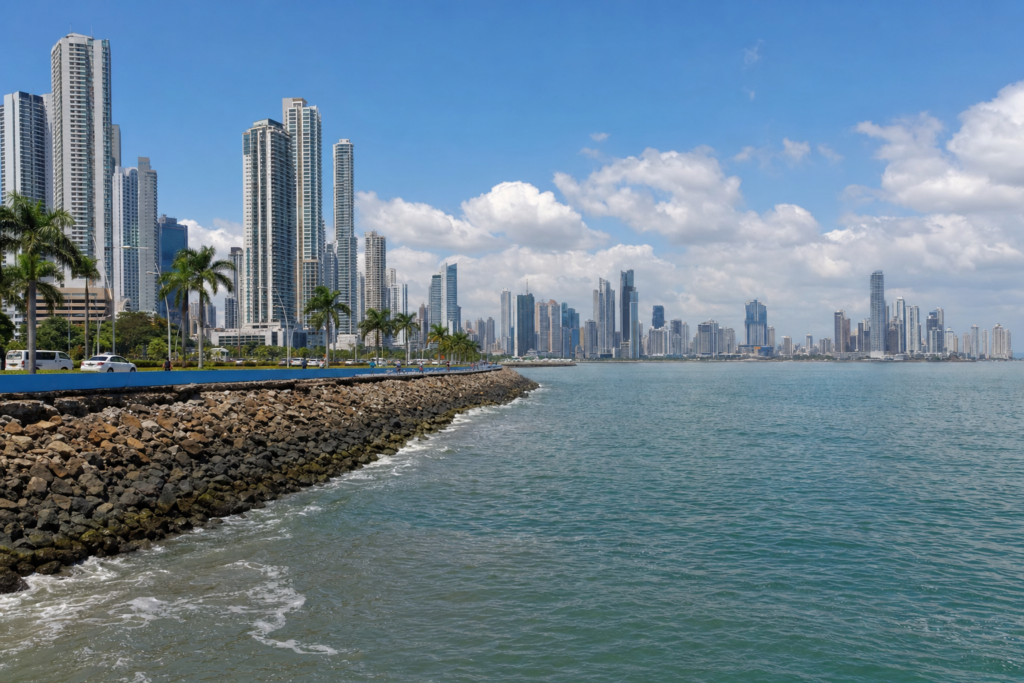
#2 Panama: The Smartest Visa Deal in the Western Hemisphere
No country on earth rolls out the welcome mat for retirees quite like Panama.
The Pensionado Visa — one of the most generous retirement visa programs globally — grants permanent residency to anyone receiving at least $1,000/month in pension income. That includes Social Security.
Once approved, you receive discounts on restaurant meals (25%), hotel stays (50% weekdays / 30% weekends), hospital bills (15%), medical consultations (20%), and prescription medicines (up to 20%).
Panama also uses the U.S. dollar, which eliminates currency risk entirely.
Monthly costs for a couple in Panama City run roughly $2,000 to $3,000, and world-class private hospitals like Hospital Punta Pacífica (affiliated with Johns Hopkins) make healthcare access genuinely excellent.
Panama has a tropical climate year-round, which is paradise for some and too humid for others. The country also sits outside the Atlantic hurricane belt, reducing natural disaster risk compared to much of the Caribbean.
The trade-off is that Panama City is a modern, fast-paced urban environment, not a sleepy beach town.
If you want laid-back coastal living, Bocas del Toro or Coronado offer alternatives, though with less medical infrastructure.
| Panama: At a Glance | |
|---|---|
| Healthcare | Top-tier private hospitals in Panama City; Pensionado discounts on medical services; outside major hurricane risk zones. |
| Lifestyle | Vibrant expat community, easy U.S. flights, Pacific and Caribbean coastlines both accessible. |
| Financial fit | Dollar-denominated economy, no currency risk; generous Pensionado discounts stretch every dollar further. |
| Long-term upside | Permanent residency achievable on Social Security income alone — one of the lowest thresholds in the world. |
#3 Greece: Europe’s Most Underrated Retirement Destination
Greece keeps appearing near the top of international retirement rankings, and the reason is simple: it delivers a European lifestyle at a cost that leaves room to actually enjoy it.
The Golden Visa program remains active for retirees who invest in real estate. As of 2026, the minimum investment is €800,000 in high-demand zones (Athens, Thessaloniki, Mykonos, Santorini, and islands with a population over 3,100) or €400,000 in most other regions. A €250,000 threshold applies only to commercial-to-residential conversion.
A separate Passive Income Visa also offers a route for those living on foreign income without a large property investment.
Monthly living costs outside Athens average $1,800 to $2,600 for a couple.
Healthcare is a mixed story: the public system (ESY) has faced budget pressure, but private care is excellent and affordable by U.S. standards. Many expats carry private insurance for around $150 to $300/month and access care that rivals any Western country.
The real draw is the lifestyle. Warm Mediterranean climate nine months of the year, fresh food at every meal, a pace of life that genuinely slows down. Dozens of islands offer very different personalities — Crete for amenities and community, Corfu for lush greenery, Paros for quieter beauty.
If you’ve been waiting to feel like you’re truly living, Greece delivers.
| Greece: At a Glance | |
|---|---|
| Healthcare | Private healthcare is affordable and high-quality; Mediterranean diet and outdoor living support long-term wellness. |
| Lifestyle | Island life, ancient history, extraordinary food culture, and a social pace that puts relationships first. |
| Financial fit | Lower costs than much of Western Europe; real estate values offer potential upside in popular island markets. |
| Long-term upside | EU residency via Golden Visa or Passive Income Visa; Schengen Zone access for travel across 27 countries. |
#4 Mexico: The Practical Favorite for Americans Who Want Proximity
Mexico earns its place on this list for one reason above all others: convenience.
No long flights, easy access to U.S. healthcare when you need it, and a cultural familiarity that makes the transition gentler. The Temporary Resident Visa (renewable up to four years) and Permanent Resident Visa (available after four years, or immediately with sufficient income or assets) are among the most accessible programs for Americans.
Monthly costs vary widely by location. San Miguel de Allende and Puerto Vallarta run $1,800 to $2,800 for a couple; smaller cities like Mérida can come in significantly lower.
Private healthcare is excellent in major expat hubs — many U.S. retirees maintain a U.S. insurance plan for complex care while using Mexican private clinics for routine needs at a fraction of the cost.
Safety deserves an honest mention.
Certain regions carry real risk, and the U.S. State Department travel advisories should be part of your research. But established expat communities in cities like San Miguel, Oaxaca, and the Lake Chapala area have decades of American residents living comfortably.
Choosing the right city matters enormously. For a deeper look at what makes a retirement location truly safe, our guide on what safety really means for retirees goes beyond crime statistics.
| Mexico: At a Glance | |
|---|---|
| Healthcare | Excellent private care in expat hubs; proximity to U.S. border for complex procedures; active outdoor lifestyle in many regions. |
| Lifestyle | Rich culture, world-class food, warm climate, and established American social communities. |
| Financial fit | One of the most cost-effective options for Americans, especially outside major tourist centers. |
| Long-term upside | Straightforward visa pathway, no long flights from the U.S., and a massive existing expat network to tap into. |

#5 Spain: High Quality of Life With a Smoother Learning Curve
Spain’s Non-Lucrative Visa (NLV) is designed almost perfectly for retirees: it requires proof of sufficient passive income but no employment, no property purchase, and no major investment.
The exact income threshold is tied to Spain’s IPREM index and updated periodically — confirm the current figure with the Spanish consulate before applying. Approval timelines have improved, and the five-year path to permanent residency is well-established.
Monthly living costs for a couple in Valencia or Seville run roughly $2,500 to $3,500, higher in Madrid or Barcelona.
Healthcare is a genuine strength: Spain consistently ranks among the top 10 globally for healthcare quality, and access to the public system after legal residency means costs stay manageable. Private insurance as a supplement is inexpensive.
Spain’s variety is underappreciated.
Beach living on the Costa del Sol, city energy in Seville, cool mountains in the north — the country can fit a wide range of retirement personalities. English is less universal than in Portugal, which is worth factoring in. But Spanish is one of the world’s most learnable languages, and picking it up adds richness rather than stress.
| Spain: At a Glance | |
|---|---|
| Healthcare | Top-10 global healthcare system; Mediterranean lifestyle; excellent climate across most regions. |
| Lifestyle | Fiesta culture, tapas, flamenco — daily life here has genuine warmth and celebration built in. |
| Financial fit | Costs below northern Europe; strong value for those seeking a high standard of living within a tighter budget than Paris or Amsterdam. |
| Long-term upside | Non-Lucrative Visa is one of Europe’s most retiree-friendly entry points; Schengen access included. |
#6 Thailand: The Best Value for Money, Anywhere in the World
For pure cost-effectiveness, Thailand is in a class by itself.
A couple can live comfortably — private apartment, daily dining out, domestic travel — for $1,400 to $2,000/month in Chiang Mai, less than many Americans spend on rent alone. Bangkok and coastal resort areas like Hua Hin and Koh Samui run higher, but still far below comparable Western options.
The Thailand Retirement Visa (Non-Immigrant OA) requires either 800,000 Thai Baht in a Thai bank account or proof of pension income of at least 65,000 Baht/month. It’s renewable annually. Thailand does not offer a direct path to permanent residency, which is the main practical limitation. Most retirees handle annual renewals without issue, but it requires planning.
Healthcare is Thailand’s best-kept secret.
International hospitals in Bangkok and Chiang Mai — Bumrungrad, Bangkok Hospital — are genuinely world-class, with English-speaking staff and costs that run well below U.S. prices for the same procedures.
Climate is tropical and hot year-round in most regions, which is perfect for some and uncomfortable for others. The cultural experience is rich, the food extraordinary, and the expat community large and welcoming.
| Thailand: At a Glance | |
|---|---|
| Healthcare | World-class international hospitals at a fraction of U.S. costs; wellness culture; warm climate year-round. |
| Lifestyle | Extraordinary food, Buddhist temples, beaches, and one of the world’s most vibrant expat social scenes. |
| Financial fit | Lowest monthly costs on this list; healthcare savings alone can offset travel costs for annual U.S. visits. |
| Long-term upside | Annual renewable visa is straightforward; digital infrastructure strong in major cities for staying connected. |

#7 Costa Rica: “Pura Vida” Is More Than a Slogan
Costa Rica’s Pensionado Visa requires just $1,000/month in provable pension income — Social Security qualifies — and grants permanent residency quickly relative to most countries.
The country has a long track record with American retirees, a mature expat services industry, and genuine political stability. It’s not the cheapest option, but it delivers strong value across every category.
Monthly costs for a couple in the Central Valley (San José area) or popular expat towns like Tamarindo or Arenal run $2,000 to $3,000.
The public healthcare system (Caja) becomes available to legal residents and is solid for routine care; private hospitals fill the gap for specialty needs. On December 1, 1948, Junta President José Figueres Ferrer publicly declared the army abolished — a prohibition later enshrined in Article 12 of the 1949 Constitution — a point of pride that reflects a broader political culture of stability.
Nature is the headline. Rainforests, volcanoes, two coastlines, and biodiversity that draws visitors from around the world. If an active outdoor retirement — hiking, surfing, birding, wildlife — is part of your vision, Costa Rica may be the best fit on this entire list.
Pura vida isn’t just a greeting. It’s a genuine cultural orientation toward a simpler, fuller life.
| Costa Rica: At a Glance | |
|---|---|
| Healthcare | Solid public healthcare system for legal residents; excellent private care in major centers; outdoor lifestyle built into daily life. |
| Lifestyle | Nature access unlike anywhere else; relaxed culture; strong community of American expats to connect with. |
| Financial fit | Pensionado discounts on services and activities; costs manageable on mid-range U.S. retirement income. |
| Long-term upside | Fast permanent residency on Social Security income; stable democracy with decades of expat-friendly policy. |
Best Countries to Retire in 2026: Side-by-Side Comparison
All cost figures are estimated monthly totals for a couple living comfortably. Verify against current data before making decisions. Healthcare ratings are approximate relative rankings based on system quality and expat access.
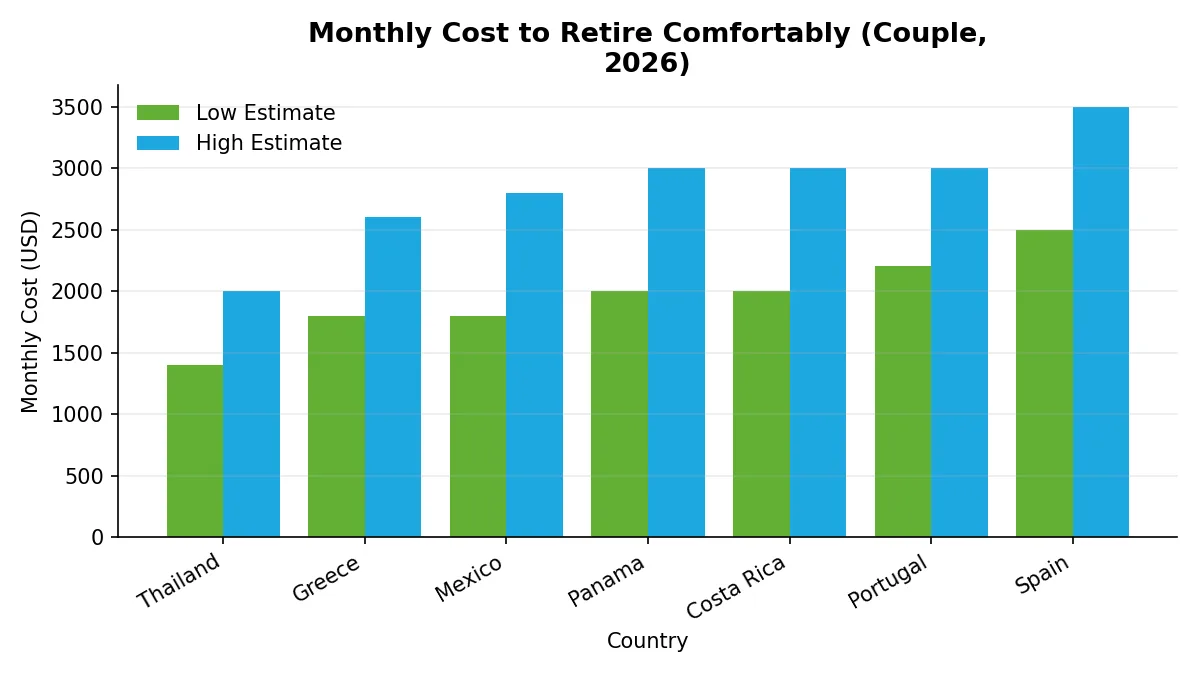
| Country | Avg. Monthly Cost (Couple) | Healthcare Quality | Visa Type | Income Threshold | Residency Path | Best For |
|---|---|---|---|---|---|---|
| Portugal | $2,200–$3,000 | Excellent | D7 Passive Income Visa | €920/mo | 5 years to PR | Culture lovers, EU access seekers |
| Panama | $2,000–$3,000 | Very Good (private) | Pensionado Visa | $1,000/mo pension | Immediate PR | Dollar users, visa simplicity |
| Greece | $1,800–$2,600 | Very Good (private) | Golden Visa / Passive Income Visa | Varies by route | 5 years to PR | Island lifestyle, EU Schengen access |
| Mexico | $1,800–$2,800 | Good (private hubs) | Temporary/Permanent Resident Visa | Confirm with consulate | 4 years to PR | Proximity to U.S., cultural richness |
| Spain | $2,500–$3,500 | Excellent | Non-Lucrative Visa | Confirm with consulate | 5 years to PR | High quality of life, regional variety |
| Thailand | $1,400–$2,000 | Excellent (international hospitals) | Non-Immigrant OA (Retirement) | 800,000 THB in bank or 65,000 THB/mo income | No direct PR path | Maximum value, healthcare savings |
| Costa Rica | $2,000–$3,000 | Good | Pensionado Visa | $1,000/mo pension | Fast PR | Nature, outdoor lifestyle, stability |
So Which Country Is Actually Right for You?
The best country to retire in isn’t the one that tops the most lists. It’s the one that fits the life you want to build.
- If you want European culture and a clear path to EU residency, Portugal or Spain are your strongest bets.
- If low monthly costs are the priority and you’re comfortable with annual visa renewals, Thailand delivers value nothing else on this list can match.
- If you want permanent residency on Social Security alone and no currency risk, Panama is a remarkably practical answer.
- If proximity to the U.S. and a rich cultural environment matter most, Mexico has decades of evidence that it works.
- If nature and political stability are your benchmarks, Costa Rica earns its spot.
- And if you want the European lifestyle without the Western European price tag, Greece keeps outperforming expectations.
Here’s something worth sitting with…
Many retirees who move abroad report that the physical environment — fresh food, walkable towns, warm weather, and access to outdoor activities every single day — quietly transforms their health in ways they didn’t expect. Better sleep, more movement, lower stress, and access to affordable preventive care all add up over time.
That’s not a minor side benefit. It may be the most compelling argument for taking international retirement seriously, beyond the numbers alone.
Remember the four pillars of HERO retirement: Health, Enjoyment, Returns, and Opportunity. Where you decide to settle down for your golden years should tick each one of those boxes.
A few practical steps before you book anything: visit first (ideally for 30 to 90 days), connect with expat forums and communities in your target country, and consult a cross-border tax advisor who understands FBAR and FATCA reporting requirements for Americans abroad.
Our guide on navigating the retirement transition is a solid starting point for thinking through the full picture.
And if you’re still weighing domestic options alongside international ones, our complete guide to the cheapest and happiest U.S. states for retirees covers that ground thoroughly.
The world is genuinely open to you. The question is where you want to spend the years you’ve earned.
Frequently Asked Questions
Which country is considered the best for Americans to retire in?
Portugal consistently ranks at or near the top for American retirees in 2026, combining a straightforward passive income visa, excellent private healthcare, low crime, a warm climate, and a large established expat community. Panama is a strong alternative for those who prioritize ease of permanent residency and no currency risk.
Where is the cheapest and safest country to retire?
Thailand offers the lowest monthly costs on this list — typically $1,400 to $2,000/month for a couple — combined with world-class international hospitals and a low violent crime rate in major expat areas. For those who want the lowest costs within a stable, established expat framework, Mexico’s Mérida or Lake Chapala regions also deliver strong value with lower risk profiles than border regions.
What is the safest country for Americans to retire?
Safety is multidimensional. Portugal, Costa Rica, and Spain consistently score well on global peace indexes. Panama and Greece also have strong safety records in expat-popular areas. Mexico and Thailand require more careful city and neighborhood selection. For a deeper look at how to evaluate safety beyond crime statistics, see our guide on what truly makes a retirement location safe.
How much does it cost to retire in Greece or Portugal?
A couple can live comfortably in Greece for approximately $1,800 to $2,600/month outside Athens, and in Portugal for approximately $2,200 to $3,000/month outside Lisbon. Both figures include rent, food, utilities, and leisure. Major city centers push costs higher.
What are the easiest retirement visa programs to qualify for?
Panama’s Pensionado Visa and Costa Rica’s Pensionado Visa both require just $1,000/month in pension income, and Social Security qualifies for both. They are among the lowest income thresholds of any retirement visa program globally, and both grant permanent residency relatively quickly. For a full comparison, see our dedicated guide on which countries offer the best retirement visas.
Do Americans have to pay U.S. taxes if they retire abroad?
Yes. The U.S. taxes citizens on worldwide income regardless of where they live. Americans retiring abroad must continue filing U.S. tax returns and may need to file FBAR reports for foreign bank accounts. Many countries have tax treaties with the U.S. that can reduce double taxation. A cross-border tax advisor familiar with expat situations is worth the cost before you relocate. This article is educational; consult a qualified tax professional for guidance specific to your situation.