

You already know protein builds muscle. What you might not know is that after 60, your body becomes less efficient at turning dietary protein into new muscle tissue — a process researchers call anabolic resistance.
That means the protein target that worked in your 40s probably isn’t enough anymore.
The good news: a handful of readily available, affordable foods can close that gap completely. You don’t need a complicated diet overhaul or expensive supplements to stay strong, mobile, and independent.
For a broader look at how nutrition fits into a thriving retirement, see our guide on Fueling Your Retirement: Nutrition for the Golden Years.
The key? Knowing which foods give you the most protein per bite, per dollar, and per digestive challenge — and building your meals around them.
Article Highlights
- Seniors need significantly more protein per pound of body weight than younger adults and most fall short without realizing it.
- Not all proteins are equal: bioavailability, ease of eating, cost, and digestibility all matter more after 60.
- Both animal and plant proteins earn top spots in our rankings (you have more good options than you think).
- Budget-friendly picks like eggs, canned fish, and lentils deliver serious protein without straining a fixed income.
- A simple comparison table lets you match the right protein source to your lifestyle and dietary needs.
How We Ranked These Protein Foods
We scored each food on five criteria that matter specifically to adults over 60. Raw protein content per serving matters, but it’s only the starting point.
Our five criteria:
(1) Protein per serving: grams of protein in a standard, realistic portion.
(2) Bioavailability: how much of that protein your digestive system actually absorbs and uses, which declines with age.
(3) Ease of eating: texture, chewing demand, and suitability for those with dental or swallowing considerations.
(4) Cost accessibility: average retail price relative to protein delivered, important for those on fixed incomes.
(5) Dietary versatility: how easily the food fits vegetarian, low-sodium, renal-friendly, or Mediterranean-style eating patterns.
Each criterion was weighted equally. Foods that scored well across all five criteria outranked foods that excelled on only one or two. A perfect score on protein content won’t compensate for being expensive, hard to chew, and poorly absorbed. We want foods that work for real people living real retirement lives.
#1: Eggs
Eggs have earned their status as the gold standard of dietary protein.
One large egg delivers about 6 grams of protein, and a two-egg breakfast puts 12 grams on the table before you’ve even thought about lunch. More importantly, egg protein has a biological value near 100 — meaning your body uses nearly all of it, making eggs one of the most efficient protein sources in existence.
For seniors dealing with chewing difficulties or reduced appetite, eggs are a gift.
They’re soft, quick to prepare in dozens of ways, and gentle on digestion. Scrambled, poached, soft-boiled, or blended into a smoothie as a pasteurized liquid egg, the format adapts to your needs.
At roughly $2–$4 per dozen depending on egg type and region, eggs deliver more usable protein per dollar than almost anything else in the grocery store.
One note worth knowing: the old fear about dietary cholesterol has been substantially walked back in modern nutrition science.
Current U.S. Dietary Guidelines no longer set a specific daily cholesterol limit for healthy adults, though if you have a specific cardiovascular or metabolic condition, check with your doctor about your personal egg intake.
| Pillar | Why Eggs Deliver |
|---|---|
| Health | Near-perfect protein bioavailability supports muscle synthesis and physical resilience. |
| Enjoyment | Endlessly versatile — breakfast, lunch, dinner, or snack, hot or cold. |
| Value | One of the lowest costs per gram of protein in any grocery store. |
| Accessibility | Soft texture and quick prep make them usable regardless of dental health or energy level. |
#2: Greek Yogurt
A single 7-ounce serving of plain Greek yogurt delivers roughly 17–20 grams of protein. That’s more than three eggs in one creamy, spoonable portion.
Greek yogurt earns that high protein count because the straining process removes much of the whey liquid, concentrating both the protein and the texture.
Beyond protein, Greek yogurt brings calcium and live probiotic cultures to the table, supporting both bone density and gut health — two areas where older adults benefit most from consistent attention. Choose plain, full-fat or 2% varieties when possible. Flavored versions often carry significant added sugar that offsets the nutritional value.
Greek yogurt is also one of the easiest high-protein foods to eat for anyone with chewing or swallowing challenges.
Use it as a base for smoothies, a substitute for sour cream, a topping for fruit, or a protein booster stirred into oatmeal. It earns its number-two spot by being highly nutritious, effortlessly soft, and genuinely versatile.
| Pillar | Why Greek Yogurt Delivers |
|---|---|
| Health | High-quality protein plus calcium and probiotics support muscle, bone, and gut health simultaneously. |
| Enjoyment | Rich, creamy texture and mild flavor work in sweet and savory applications. |
| Value | Mid-range cost with high protein density; store-brand options bring the price down further. |
| Accessibility | No chewing required — ideal for sensitive teeth, denture wearers, or low-appetite days. |
#3: Canned Salmon
Fresh salmon gets all the attention, but canned salmon deserves a spotlight of its own.
A 3-ounce serving of canned pink salmon provides roughly 17 grams of protein along with a meaningful dose of omega-3 fatty acids — the kind linked to reduced inflammation, better cardiovascular function, and, according to growing research, cognitive support as we age.
For more on protecting brain health as you get older, see our guide on maintaining cognitive health in seniors.
The canned format is where canned salmon really earns its ranking…
It’s shelf-stable, pre-cooked, ready to eat cold or warmed, and requires no knives or significant chewing effort. Wild-caught canned salmon also contains soft, edible bones that contribute calcium — an often-overlooked bonus. Sodium content varies by brand, so if you’re watching salt intake, look for low-sodium or no-salt-added varieties.
Budget-wise, canned salmon costs a fraction of fresh fillets and competes directly on nutrition. It’s perfect for quick lunches: mix with a little avocado or plain Greek yogurt, scoop onto crackers or into a lettuce wrap, and you have a complete high-protein meal in under five minutes.
| Pillar | Why Canned Salmon Delivers |
|---|---|
| Health | High-quality complete protein plus omega-3s support muscle, heart, and brain health. |
| Enjoyment | No cooking required; mild enough for skeptical fish eaters, especially when mixed into dishes. |
| Value | Shelf-stable and far cheaper than fresh fish with comparable or superior nutritional value. |
| Accessibility | Soft texture, no prep beyond opening a can — works for almost any physical limitation. |
#4: Cottage Cheese
Cottage cheese has made a quiet comeback, and for good reason.
A half-cup serving contains roughly 13–14 grams of protein, much of it from casein. Casein is a slow-digesting protein that provides a sustained release of amino acids into your bloodstream.
For older adults, that slow release is particularly valuable overnight, when muscle repair happens and many seniors go the longest stretch without eating.
Cottage cheese is also rich in leucine, the specific amino acid most strongly associated with triggering muscle protein synthesis. Research focused on nutrition and aging consistently identifies leucine as a key factor in overcoming anabolic resistance (the reduced muscle-building efficiency that comes with age).
On the practical side, cottage cheese requires no cooking, has a soft texture suitable for nearly any dental situation, and pairs well with both sweet toppings (berries, a drizzle of honey) and savory ones (cucumber, tomato, a pinch of everything bagel seasoning).
Its mild flavor also makes it one of the easiest high-protein foods to incorporate daily without palate fatigue.
| Pillar | Why Cottage Cheese Delivers |
|---|---|
| Health | Casein protein provides sustained amino acid release; leucine content directly supports muscle synthesis. |
| Enjoyment | Mild, adaptable flavor works as a meal, snack, or ingredient in both sweet and savory dishes. |
| Value | Affordable, widely available, and long-lasting in the refrigerator — low waste, high value. |
| Accessibility | Soft, no-chew texture makes it accessible for virtually everyone. |
#5: Skinless Chicken Breast
Chicken breast is the most-consumed lean protein in the United States, and the numbers justify the popularity.
A 3-ounce cooked serving delivers roughly 26 grams of protein with minimal saturated fat. That protein-to-calorie ratio is exceptional. You’re getting maximum muscle-building material without excess calories that can lead to unwanted weight gain in a more sedentary retirement lifestyle.
The main challenge with chicken breast for older adults is texture.
Overcooked, it becomes dry and tough — genuinely difficult to chew and easy to choke on. The solution is preparation method: slow-cooker chicken, poached chicken, or pressure-cooked shredded chicken stays moist and tender enough to eat comfortably. Rotisserie chicken (with skin removed) is an excellent shortcut that requires zero cooking.
Chicken breast ranks fifth rather than higher because it requires more preparation effort than the top four picks, and its texture can be a barrier for some. But when prepared correctly — or bought pre-cooked — it’s one of the most efficient protein sources you can put on a plate.
| Pillar | Why Chicken Breast Delivers |
|---|---|
| Health | Exceptional protein-to-calorie ratio supports lean muscle mass without excess saturated fat. |
| Enjoyment | Familiar, neutral flavor adapts to virtually any cuisine or seasoning preference. |
| Value | Cost-effective in bulk; rotisserie chicken is an affordable pre-cooked shortcut. |
| Accessibility | Texture can be a barrier if overcooked — slow cooker or poaching methods solve this effectively. |
#6: Lentils
Lentils are the highest-ranked plant protein on this list, and they earn it.
One cooked cup provides roughly 18 grams of protein alongside an impressive load of fiber, iron, folate, and potassium. For seniors who follow vegetarian or plant-forward diets, lentils are about as close to a nutritional anchor as a single food can be.
Lentils are not a complete protein on their own — they’re low in the amino acid methionine. But this limitation is easy to address by pairing lentils with a grain (brown rice, whole wheat bread) across the same day’s meals.
Your body pools amino acids over the course of the day; you don’t need to eat them in the same bowl. A pattern of varied protein sources handles the completeness question automatically.
From a budget standpoint, dried lentils are one of the cheapest foods in any grocery store (often under $2 per pound) and one pound yields multiple high-protein meals. They cook in under 30 minutes without soaking, they’re soft and easy to eat, and they fit naturally into soups, stews, curries, and salads.
| Pillar | Why Lentils Deliver |
|---|---|
| Health | High protein plus fiber, iron, and folate support muscle, digestion, and cardiovascular health. |
| Enjoyment | Earthy, satisfying flavor pairs well with spices and fits global cuisine traditions. |
| Value | Among the lowest cost-per-gram-of-protein of any food available — exceptional budget value. |
| Accessibility | Naturally soft when cooked; no chewing challenges; long shelf life in dried form. |
#7: Canned Tuna
Canned tuna is arguably the most accessible high-protein food in America.
Per USDA FoodData Central, a 3-ounce serving of light canned tuna in water delivers approximately 22 grams of protein for typically under a dollar per serving. It requires no cooking, no refrigeration until opened, and minimal preparation. For seniors managing tight budgets or limited energy for meal preparation, it’s hard to beat.
Canned tuna ranks seventh rather than higher primarily because of mercury considerations.
Light tuna (skipjack) contains significantly lower mercury than albacore (white) tuna. The FDA advises adults to limit higher-mercury fish intake, and most guidance suggests 2–3 servings of light canned tuna per week is well within safe range for healthy older adults. Rotating tuna with other fish like canned salmon extends variety and further reduces any concern.
Texture-wise, canned tuna is soft and easy to eat, and it integrates into dozens of quick meals: mixed with avocado, stirred into pasta, folded into a wrap, or simply eaten with whole-grain crackers. It’s a genuine pantry staple that pays for itself in protein delivered.
| Pillar | Why Canned Tuna Delivers |
|---|---|
| Health | High complete protein with omega-3s; choose light tuna and rotate with other fish for mercury balance. |
| Enjoyment | Mild, familiar flavor that adapts to many recipes; tuna salad remains a timeless, satisfying option. |
| Value | Frequently the cheapest source of complete protein per serving in any grocery store. |
| Accessibility | Shelf-stable, no cooking, no chewing barriers — as convenient as protein gets. |
#8: Edamame
Edamame — whole soybeans, typically sold frozen — is one of the rare plant foods that qualifies as a complete protein, containing all nine essential amino acids in meaningful amounts.
Per USDA FoodData Central, one cup of shelled cooked edamame provides approximately 18 grams of protein, along with fiber, folate, and vitamin K. For plant-forward eaters, this is a significant advantage over most other legumes.
Frozen edamame is inexpensive, widely available, and requires only a few minutes in boiling water or the microwave. Shelled (out of the pod) varieties are the easiest to eat and can be tossed into salads, stir-fries, grain bowls, or enjoyed warm with a pinch of sea salt as a standalone snack. They’re soft enough to chew comfortably for most people.
Edamame also fits naturally into a Mediterranean-influenced eating pattern, which research consistently links to better long-term health outcomes for older adults. If you’re exploring that dietary approach, our article on the benefits of the Mediterranean diet for seniors is a good companion read.
| Pillar | Why Edamame Delivers |
|---|---|
| Health | Complete plant protein with fiber and micronutrients; supports muscle, digestion, and bone health. |
| Enjoyment | Light, fresh flavor; easy to snack on alone or add to almost any dish. |
| Value | Frozen bags are affordable and keep for months — minimal waste, solid value. |
| Accessibility | Shelled variety requires minimal chewing and prep; microwave-ready in minutes. |
#9: Tofu
Tofu is another complete plant protein, and it deserves more credit than its bland reputation suggests. A half-cup of firm tofu provides roughly 10 grams of protein.
Silken tofu, the softest variety, provides slightly less per serving but has a smooth, pudding-like texture that makes it ideal for blending into smoothies, soups, or scrambled egg alternatives for anyone with severe chewing or swallowing limitations.
Tofu’s real strength is its neutrality.
It absorbs whatever flavors you cook it with, making it one of the most versatile protein sources in the kitchen. Marinated and baked, it has a pleasantly chewy texture. Blended silken tofu adds creaminess and protein to sauces and desserts without any detectable flavor. Extra-firm tofu, pressed and pan-fried, holds up in stir-fries and grain bowls.
For seniors transitioning toward less meat consumption — whether for health, budget, or ethical reasons — tofu is a practical bridge food that pairs well with familiar flavors and cooking methods. It’s also naturally low in saturated fat and contains isoflavones, plant compounds with a long history of study for their potential role in bone density and cardiovascular health.
| Pillar | Why Tofu Delivers |
|---|---|
| Health | Complete plant protein; low in saturated fat; isoflavones may support bone and heart health. |
| Enjoyment | Flavor-neutral canvas that adapts to any cuisine; silken variety works for texture-sensitive eaters. |
| Value | Cost-effective; shelf-stable in aseptic packaging; widely available including in basic grocery stores. |
| Accessibility | Silken tofu requires zero chewing — one of the most texture-accessible proteins available. |
#10: Black Beans
Black beans round out our list as an outstanding budget protein that doubles as a fiber powerhouse.
One cooked cup delivers roughly 15 grams of protein along with about 15 grams of dietary fiber — a combination that supports muscle maintenance, digestive regularity, blood sugar stability, and cardiovascular health all at once. For seniors managing multiple health goals, that kind of nutritional multitasking has real value.
Like lentils, black beans are not a complete protein on their own, but pairing them with rice, corn, or any grain across the day fully addresses that.
Canned black beans cost roughly $1 per can and require no cooking. Rinse them and they’re ready. Dried black beans are even cheaper and can be batch-cooked and frozen in portions. Either way, the cost per gram of protein is among the lowest of any food on this list.
Black beans are also soft enough for most seniors to eat comfortably, and they work in a remarkable range of dishes: soups, burritos, grain bowls, salads, and even brownies (yes, really — blended black beans replace flour in many baking recipes, adding protein to treats). They’re a fitting anchor for a budget-conscious, plant-forward retirement kitchen.
| Pillar | Why Black Beans Deliver |
|---|---|
| Health | High protein and fiber together support muscle, blood sugar regulation, and digestive health. |
| Enjoyment | Rich, earthy flavor works in Latin, American, and fusion dishes; highly satisfying. |
| Value | One of the absolute lowest costs per gram of protein — exceptional value on any budget. |
| Accessibility | Canned beans need zero cooking; soft texture suitable for most chewing abilities. |
All 10 High-Protein Foods at a Glance
Use this table to quickly match each food to your priorities — whether that’s maximum protein, lowest cost, easiest texture, or plant-based sourcing.
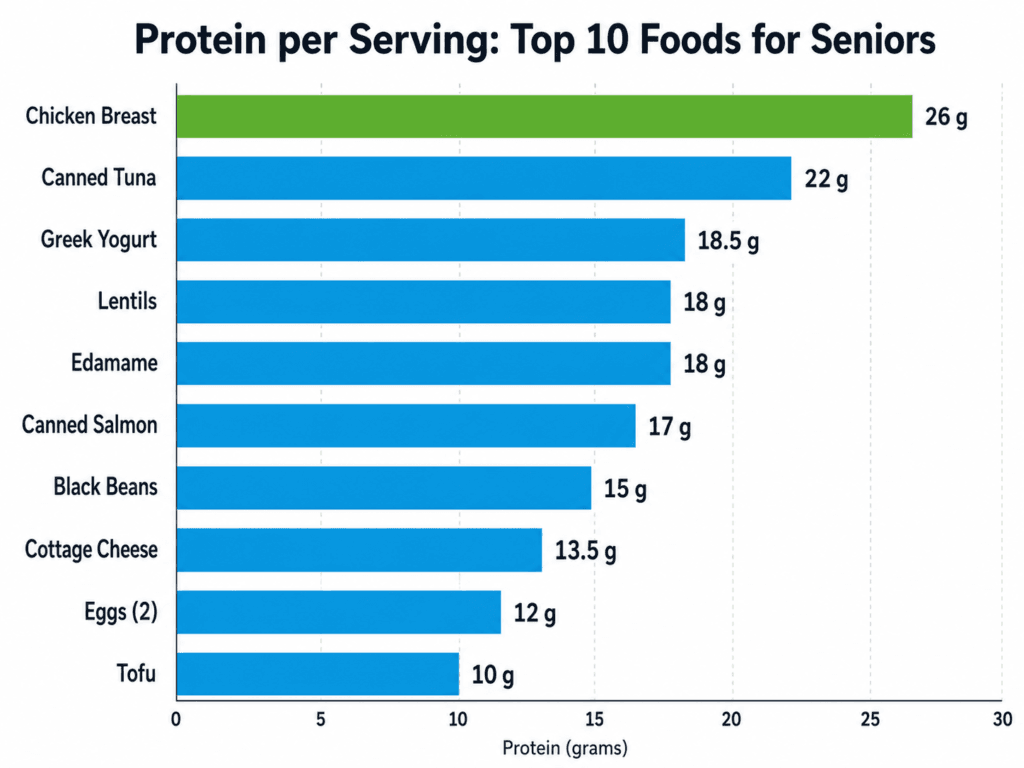
| Food | Protein per Serving (g) | Serving Size | Type | Bioavailability | Ease of Eating | Avg. Cost per Serving | Complete Protein? |
|---|---|---|---|---|---|---|---|
| Eggs | 12 | 2 large eggs | Animal | Very High | Very Easy | $0.35–$0.60 | Yes |
| Greek Yogurt | 17–20 | 7 oz | Animal | High | Very Easy | $1.00–$1.75 | Yes |
| Canned Salmon | 17 | 3 oz | Animal | High | Easy | $1.25–$2.00 | Yes |
| Cottage Cheese | 13–14 | ½ cup | Animal | High | Very Easy | $0.75–$1.25 | Yes |
| Chicken Breast | 26 | 3 oz cooked | Animal | High | Moderate (prep-dependent) | $1.00–$2.00 | Yes |
| Lentils | 18 | 1 cup cooked | Plant | Moderate | Easy | $0.25–$0.50 | No (pair with grain) |
| Canned Tuna | 22 | 3 oz | Animal | High | Easy | $0.75–$1.25 | Yes |
| Edamame | 18 | 1 cup shelled | Plant | Moderate-High | Easy | $0.75–$1.25 | Yes |
| Tofu | 10 | ½ cup firm | Plant | Moderate | Easy–Very Easy | $0.75–$1.50 | Yes |
| Black Beans | 15 | 1 cup cooked | Plant | Moderate | Easy | $0.50–$1.00 | No (pair with grain) |
Cost estimates are approximate national averages as of 2026. Bioavailability reflects general consensus from nutrition literature on protein digestibility-corrected amino acid scores (PDCAAS) and digestible indispensable amino acid scores (DIAAS).
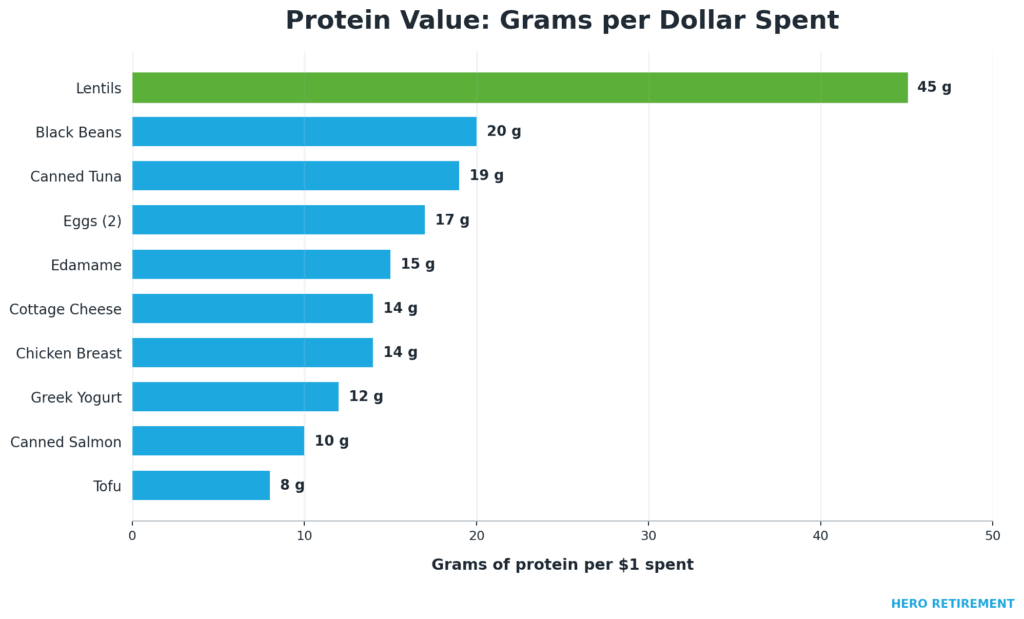
Here’s the bigger picture worth holding onto: every food on this list may cost under $2 per serving. Staying strong and independent — and potentially sidestepping future medical costs tied to muscle loss and falls — is genuinely affordable on a fixed retirement income.
Protein isn’t a luxury. It’s one of the highest-return investments you can make at the grocery store.
Your Protein Action Plan Starts Today
You don’t have to overhaul your entire diet to get more protein. Even adding one or two of these foods more consistently — a Greek yogurt at breakfast, a can of salmon at lunch, a handful of edamame as an afternoon snack — can meaningfully increase your daily intake.
The goal isn’t perfection. It’s consistency.
Pick two or three foods from this list that already appeal to you and focus on fitting them into your regular rotation first. Then add more variety from there.
Protein works best when paired with movement. Resistance exercise — even gentle bodyweight work or resistance bands — signals your muscles to actually use the amino acids you’re eating. For ideas on building that side of the equation, our guide on pairing protein with the right exercise routine is a natural next step.
You have more control over your strength, mobility, and independence than most people realize. The science on this is genuinely encouraging. And it starts with what you put on your plate today.
Frequently Asked Questions
How much protein do seniors need per day?
Current research, including recommendations reviewed by the National Institute on Aging, suggests older adults need roughly 1.0–1.2 grams of protein per kilogram of body weight per day. Some researchers studying sarcopenia (age-related muscle loss) argue for up to 1.5 g/kg for active seniors. That’s meaningfully higher than the general adult RDA of 0.8 g/kg. A 160-pound (73 kg) senior, for example, would aim for roughly 73–110 grams of protein daily depending on activity level. Talk with your doctor or a registered dietitian to find the right target for your individual health situation.
What is the best protein for seniors?
No single food is best for everyone. Eggs rank first on our list for their near-perfect bioavailability, soft texture, low cost, and versatility. But the best protein for you is the one you’ll actually eat consistently. If you dislike eggs, Greek yogurt or cottage cheese may serve you better. If you follow a plant-based diet, edamame and lentils are your top picks. Variety across multiple protein sources throughout the day is genuinely the strongest approach.
Can seniors get enough protein from plant-based foods alone?
Yes, with some intentional planning. The main consideration with plant proteins is completeness — most plant foods are low in one or more essential amino acids. Edamame, tofu, and soy-based foods are the exception, as they are complete proteins. For other plant sources like lentils and black beans, pairing with grains across the day fills the amino acid gaps. Eating a wide variety of plant proteins and hitting adequate total grams per day is the key.
What is a high-protein breakfast for seniors?
A two-egg scramble with a side of Greek yogurt and berries can deliver 25–30 grams of protein before 9 a.m. Other strong options: cottage cheese topped with fruit and a sprinkle of hemp seeds; a smoothie blending silken tofu, milk, and frozen edamame; or smoked salmon on whole-grain toast. The goal is to front-load protein earlier in the day, as research suggests spreading intake across meals (rather than concentrating it at dinner) supports better muscle protein synthesis in older adults.
Are protein shakes or supplements better than whole foods for seniors?
Whole foods generally remain the preferred approach because they deliver protein alongside fiber, vitamins, minerals, and beneficial compounds that supplements lack. However, protein supplements — particularly whey protein, which is high in leucine and rapidly absorbed — have solid clinical evidence supporting their use in older adults who genuinely struggle to meet protein needs through food alone, whether due to appetite loss, swallowing difficulties, or other health factors. If you’re considering a supplement, look for products with simple ingredient lists and no added sugars, and discuss options with a registered dietitian.
What high-protein foods are best for seniors with chewing difficulties?
Eggs (scrambled or soft-boiled), Greek yogurt, cottage cheese, silken tofu, and canned fish (salmon and tuna) are all soft, easy to eat, and require minimal chewing. Lentil soup and well-cooked black beans also qualify. Slow-cooked or pressure-cooked chicken becomes tender enough for most chewing limitations. Silken tofu blended into smoothies or sauces is essentially texture-free. For seniors with significant swallowing disorders (dysphagia), please work with a speech-language pathologist who can recommend specific texture modifications.