

You used your HSA card at the pharmacy. You paid a co-pay out of pocket and planned to reimburse yourself later. Now there’s a shoebox (or a phone camera roll) full of receipts, and you’re wondering: how long do I actually need to keep all of this?
It’s a fair question. And the answer matters more than most people realize.
An HSA gives you a triple tax advantage: 1) contributions go in pre-tax, 2) growth is tax-free, and 3) qualified withdrawals are tax-free. That’s a rare combination. But the IRS expects you to be able to prove every withdrawal was for a qualified medical expense, sometimes years after the fact.
The good news is that the rules are clear once you understand which scenario applies to you. And with a simple system, protecting your records takes minutes, not hours.
The key? Know the right timeframe for your situation, then build a habit that makes compliance automatic.
Article Highlights
- Standard IRS audit window: Keep HSA receipts for at least 3 years from the date you filed the return that claimed the distribution.
- Substantial underreporting rule: If you underreported income by more than 25%, the IRS audit window stretches to 6 years — so many advisors recommend keeping records for 7 years to be safe.
- Lifetime reimbursement loophole: You can reimburse yourself years later for qualified expenses paid today, so receipts dated in 2026 may still be needed in 2036 or beyond.
- No receipts required at the HSA provider level: Your HSA custodian does not collect or verify receipts — the IRS holds you personally responsible for documentation.
- State rules may go longer: Some states that don’t conform to federal HSA tax treatment may require records beyond 7 years — always check your state’s guidelines.
How Long Should You Keep HSA Receipts? The Short Answer
If you want one number, here it is: 7 years is the safe standard that covers most situations. But the right answer depends on your specific circumstances. Here’s the full picture at a glance.
The Quick-Reference Table
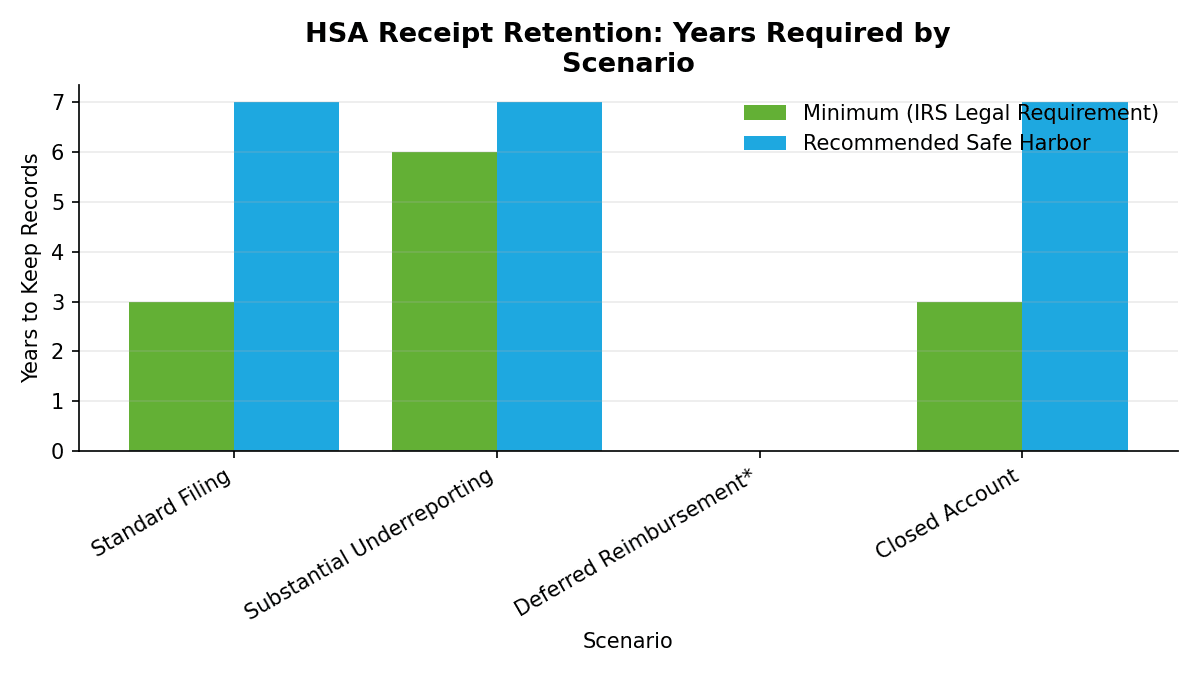
Use this table to find your scenario quickly. The minimum is what the law technically requires. The recommended column is what protects you in practice.
| Scenario | Minimum | Recommended | Key Note |
|---|---|---|---|
| Standard tax return, no issues | 3 years | 7 years | Clock starts from filing date, not expense date |
| Underreported income by >25% | 6 years | 7 years | IRS can audit beyond the normal 3-year window |
| Active HSA with deferred reimbursements | Open-ended | Keep until reimbursed + 7 years | You may reimburse yourself at any future date |
| Closed HSA account | 7 years from closure | 7 years from closure | Account closing does not erase your audit exposure |
| State with non-conforming HSA rules | Varies | Check state guidelines | Some states may require longer retention |
The table above is a starting framework. The sections below explain the reasoning behind each row so you can make a confident, informed decision.
Why “When You Filed” Matters More Than “When You Spent”
Most people anchor the clock to the date of the medical expense. That’s understandable but incorrect. Per IRS guidance on medical expenses, the statute of limitations for auditing a tax return generally begins on the date you filed that return (or the tax deadline, whichever is later).
So if you paid a medical bill in January 2024 but filed your 2024 return in April 2025, your 3-year window closes in April 2028, not January 2027. That distinction can mean the difference between shredding records too early and leaving yourself exposed.
When the Clock Doesn’t Start at All
Here’s the scenario most guides skip: if you never reimburse yourself for an expense, there is no distribution to audit yet.
Many savvy HSA holders pay medical costs out of pocket today and let their HSA keep growing tax-free for years before taking a reimbursement.
In that case, the receipt clock hasn’t started. You need to keep that receipt until you take the reimbursement, and then hold it for the standard period after you file that year’s return. A receipt from 2020 could still be in active use in 2035.
Why the IRS Statute of Limitations Matters for HSA Records
The statute of limitations is simply the window during which the IRS can legally audit your return and assess additional taxes. Understanding how it works gives you a clear, logical reason for every record you keep (and every record you can safely discard).
The Standard 3-Year Window
For most taxpayers in most years, the IRS has 3 years from your filing date to audit your return. If you took an HSA distribution, reported it correctly, and kept your receipts showing it was a qualified medical expense, you’re protected as long as those receipts survive that 3-year window.
This is why some sources say “3 years is enough.”
Technically, they’re right for a straightforward return with no unusual activity. The problem is that not every return is straightforward. Understanding the tax implications of different retirement accounts can help you recognize when your situation might call for longer retention.
The 6-Year Exception for Substantial Underreporting
Here’s where the math gets important.
If you underreported your gross income by more than 25% on a given return, the IRS audit window extends from 3 years to 6 years. This is sometimes called the “substantial omission” exception.
For HSA purposes, this matters if you ever took a non-qualified distribution (which is taxable income) and failed to report it fully. Even if you didn’t realize the distribution was non-qualified at the time, a 6-year exposure window is a real possibility.
Holding records for 7 years gives you a comfortable buffer beyond that threshold.
Fraud and Unlimited Lookback
There is one scenario with no time limit at all: intentional fraud.
If the IRS determines a return was fraudulent, the statute of limitations never closes.
This article focuses on honest record-keeping questions, not fraud. But it’s worth knowing that “7 years” is a practical safe harbor, not a legal guarantee that records can never be examined under extreme circumstances. For everyday HSA users who keep accurate records, the 7-year standard is more than sufficient.
The Lifetime Reimbursement Loophole (And What It Means for Your Records)
This is the feature of HSAs that surprises most people.
You can pay a qualified medical expense out of pocket today and reimburse yourself from your HSA at any point in the future, even decades later, as long as your HSA was open when the expense occurred. It’s completely legal, and it’s one of the most powerful moves available to retirement savers.
How the Strategy Works
Imagine you pay a $500 dental bill out of pocket in 2026…
Instead of reimbursing yourself immediately, you leave the $500 in your HSA to grow tax-free. Five, ten, or twenty years later, you withdraw that $500, completely tax-free, using your 2026 receipt as documentation.
This is the shoebox strategy for tax-free medical reimbursements in action.
It’s one of the most powerful retirement income moves available, and it depends entirely on your ability to produce that original receipt years down the road.
The Receipt Burden Is Entirely Yours
Your HSA custodian (the bank or brokerage holding your account) does not verify receipts.
They process distributions and send you a Form 1099-SA reporting the amount you withdrew. Whether that withdrawal was for a qualified expense is between you and the IRS.
That means no one is holding a backup copy of your receipts.
If you can’t produce documentation during an audit, the IRS can reclassify your withdrawal as a non-qualified distribution, making it fully taxable and subject to a 20% penalty if you’re under 65.
What Counts as Acceptable Documentation
The IRS requires that you be able to show:
- The date of the expense
- The nature of the medical service or product
- The amount paid
- And that the expense was not reimbursed by insurance or any other source.
Acceptable documentation includes itemized receipts, Explanation of Benefits (EOB) statements from your insurer, provider invoices, and credit card or bank statements showing the specific charge.
A general “paid” receipt without a description of the service may not be sufficient on its own.
Best Practices for Organizing and Storing HSA Documentation
Knowing how long to keep receipts is only half the equation.
A receipt you can’t find in five years is as useless as a receipt you threw away. These systems are simple, low-maintenance, and built for real life.
Digital Storage: The Most Reliable Long-Term Option
Physical receipts fade. Thermal paper receipts (common at pharmacies) can become completely blank within a few years. Digital storage is the single most important upgrade you can make to your HSA record-keeping.
Options include: scanning receipts with a free app (like your phone’s built-in document scanner), forwarding email receipts to a dedicated HSA folder, or using a cloud service like Google Drive or Dropbox with a folder labeled by year.
The key is a system you’ll actually use consistently, not a perfect system you abandon after a week.
Organizing by Year and Type
Create a simple folder structure: one parent folder labeled “HSA Records,” then subfolders by tax year (“HSA 2026,” “HSA 2027,” etc.). Inside each year, keep two subfolders: “Receipts Reimbursed” and “Receipts Not Yet Reimbursed.”
The second subfolder is especially important if you’re using the deferred reimbursement strategy.
When you eventually take that reimbursement, move the receipt to the “Reimbursed” folder and note the reimbursement date. Then start your 7-year retention clock from when you file that year’s return.
Staying organized here is part of building a retirement budget that accounts for healthcare costs.
What Your HSA Provider Can (and Can’t) Provide
Most HSA custodians keep transaction records for 5 to 7 years, but those records only show amounts and dates, not what the expense was for. They are useful as supporting context but are not a substitute for itemized receipts.
Log into your HSA portal and download your annual statements and transaction histories each year. Store them in your HSA Records folder. They won’t prove qualified use on their own, but they corroborate your timeline and amounts if questions ever arise.
What Happens If You Can’t Find Your HSA Receipts
Losing a receipt doesn’t automatically mean a tax bill. But it does mean you need to act quickly and think clearly about what documentation you still have available.
Reconstruct What You Can
Start with what’s recoverable.
Your bank or credit card statement may show the provider name and amount. Your doctor’s office, pharmacy, or hospital can often reissue an itemized receipt or statement. Your insurance company’s Explanation of Benefits is often the clearest documentation of what was paid and for what.
Many healthcare providers keep billing records for 7 to 10 years. Calling their billing department and asking for a duplicate itemized statement is often the fastest path to a replacement document.
When Reconstruction Isn’t Possible
If you genuinely cannot reconstruct documentation for a distribution, the safest path is to treat that withdrawal as potentially non-qualified and consult a tax professional before an audit happens.
In practice, the IRS audits HSA accounts far less frequently than it audits large business deductions or complex investment transactions.
Missing a single receipt for a small co-pay is unlikely to trigger scrutiny on its own. But a pattern of undocumented distributions from a large account is a different story.
The Cost of Non-Qualified Distributions
If the IRS determines a distribution was non-qualified, the amount becomes ordinary taxable income plus a 20% penalty tax if you were under 65 at the time of withdrawal. After age 65, the penalty disappears but the income tax still applies.
This is why the paperwork habit is worth building early. The tax consequences of a disqualified distribution can easily exceed the cost of a few minutes of filing each month.
When You Can Finally Stop Keeping HSA Records
There is a finish line. Here’s how to know when you’ve crossed it.
The Clean Cutoff for Reimbursed Expenses
Once you’ve taken a reimbursement and filed the tax return that includes that distribution, your retention clock starts. After 7 years from that filing date, you can confidently discard those records, assuming your return showed no substantial underreporting issues.
Set a calendar reminder each spring. When you file your taxes, mark the year you can purge the corresponding HSA folder. “HSA 2026 records: safe to delete April 2034” is a simple notation that removes all the guesswork.
The Open Question for Unreimbursed Expenses
For expenses you’ve paid out of pocket but haven’t yet reimbursed from your HSA, there is no cutoff yet.
The receipt remains active documentation until you decide to take the reimbursement, or decide you never will.
If you choose to let an expense expire (meaning you’ll never reimburse yourself for it), you can discard that receipt after the standard 7-year window from when you paid it.
There’s no tax event tied to an expense you never reimbursed, so there’s no audit exposure to protect against.
Closed Accounts Still Have an Exposure Window
Closing your HSA account does not reset or erase prior-year audit exposure.
If you closed your account in 2025, distributions you took in 2023 are still within the standard audit window for several more years.
Keep records for 7 years from the filing date of each relevant return, regardless of whether the account is still open. The account’s status is irrelevant to the IRS’s ability to review past distributions.
Common Mistakes to Avoid
Even careful HSA users make a few predictable errors. These are the ones worth knowing before they cost you.
Anchoring the Clock to the Expense Date Instead of the Filing Date
This is the most common mistake. You pay a bill in January, assume your 3-year window closes in January three years later, and shred the receipt. But the audit clock runs from your tax filing date, not the expense date.
A January 2026 expense reported on a return filed in April 2027 is protected until April 2030 at minimum, not January 2029. Always anchor to your filing date.
Assuming Your HSA Provider Keeps Your Receipts
Your custodian keeps transaction records. They do not keep your receipts. This misunderstanding leads people to dispose of documentation they believe is stored somewhere safe.
There is no backup. The responsibility for documentation is entirely yours, and it was that way from the day you opened the account.
Ignoring State-Level Requirements
Federal HSA tax treatment is consistent across all states, except that several states do not conform to federal rules and tax HSA contributions and earnings as ordinary income. As of this writing, 48 states conform to Federal HSA tax treatment. The two that don’t are California and New Jersey.
If you live in one of those states, your state income tax audit window applies separately from the federal window. Your state’s department of revenue is the right source for your specific retention requirements. In some cases, state rules extend beyond 7 years.
Skipping Documentation for Small Expenses
The IRS does not have a minimum dollar threshold below which receipts are unnecessary for HSA purposes.
The federal $75 receipt rule applies to business expense deductions under IRS Section 274, and it has no bearing on HSA documentation requirements.
Every HSA distribution, large or small, requires documentation of a qualified expense. A $12 prescription co-pay needs a receipt just as much as a $1,200 dental bill.
Putting It All Together
Your HSA works hardest for you when your records are airtight.
The 7-year rule covers the vast majority of situations, the deferred reimbursement strategy means some receipts need to live even longer, and a simple digital filing system makes the whole thing manageable in minutes per month.
Keeping good HSA records isn’t just about avoiding audits.
Every dollar of documented, tax-free reimbursement is a dollar you don’t have to pull from taxable accounts, freeing up more of your retirement income for the things that actually matter to you, whether that’s travel, family, or simply the peace of mind of a cushioned budget. That’s the quiet power of an HSA used to its full potential.
Take action now: scan your most recent HSA receipts into a dedicated folder today, label it with the year and your planned purge date, and set a recurring April reminder to file that year’s receipts every time you file your taxes. Future you will be grateful.
Frequently Asked Questions
How long should I save HSA receipts?
The safe standard is 7 years from the date you filed the return that included the HSA distribution. The IRS standard audit window is 3 years, but a 6-year window applies if income was underreported by more than 25%, so 7 years gives you a comfortable buffer beyond both thresholds. If you’re using the deferred reimbursement strategy, keep receipts until you take the reimbursement and then hold them for 7 years after filing that return.
What is the loophole for HSA receipts?
The HSA rules allow you to reimburse yourself for a qualified medical expense at any point in the future, as long as your HSA was open when the expense occurred. This means you can pay out of pocket today, let your HSA balance grow tax-free for years, and then take a tax-free reimbursement later using your original receipt as documentation. The receipt from today could still be in active use a decade from now.
What is the $75 receipt rule, and does it apply to HSAs?
The $75 receipt rule is a business expense documentation standard under IRS Section 274. It does not apply to HSA withdrawals. Every HSA distribution, regardless of size, requires documentation showing the expense was a qualified medical cost. A $10 prescription co-pay needs a receipt just as much as a large hospital bill.
What happens if I lose my HSA receipts?
Start by reconstructing what you can: contact your provider’s billing department for a duplicate itemized statement, request an Explanation of Benefits from your insurer, or pull credit card statements showing the charge. Many healthcare providers keep billing records for 7 to 10 years. If reconstruction isn’t possible, a tax professional can help you assess your exposure before any audit arises.