

Open enrollment runs October 15 through December 7. For you, it’s a chance to fine-tune your coverage. For scammers, it’s the busiest season of the year.
They know you’re paying attention to Medicare right now. They count on that.
A single phone call, a single click, a single number handed over — that’s all it takes for a scammer to hijack your benefits, drain your bank account, or file fraudulent claims in your name.
The losses are significant…
The FBI and the U.S. Department of Health and Human Services Office of Inspector General consistently rank Medicare fraud among the costliest crimes targeting older Americans.
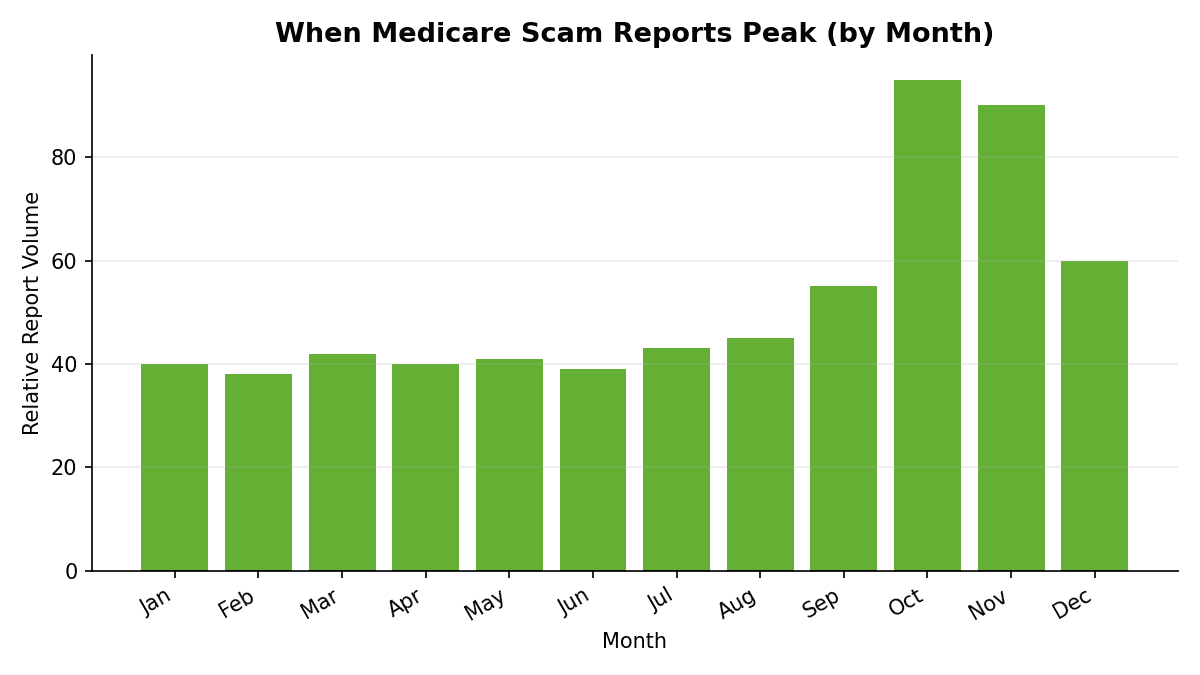
The good news? Every one of these scams has a tell. Once you know what to look for, they lose almost all of their power.
In this article, you’ll learn 9 Medicare scams that spike during open enrollment — and the exact moves that shut each one down.
Knowledge is your best coverage. Let’s use it.
1) The Fake Medicare Representative Call
What’s being missed
Medicare does not call you unsolicited to verify your information, sell you a plan, or help you switch coverage. Period.
Per CMS (Medicare’s administrator), a legitimate Medicare representative will never cold-call you asking for your Medicare number, Social Security number, or bank details. Millions of retirees receive these calls each fall and assume they’re real because the caller sounds official and mentions open enrollment by name.
Why it matters
If you hand over your Medicare Beneficiary Identifier (MBI), a scammer can bill Medicare for services you never received. Those fraudulent claims can complicate your own future care and create a bureaucratic nightmare to untangle.
How to fix it
- Hang up without engaging. Don’t press buttons to be removed from a list.
- Call Medicare directly at 1-800-MEDICARE (1-800-633-4227) if you have any concern about your account.
- Real questions get answered there — by real people.
2) The “Free Gift” Trap
What’s being missed
Someone offers you a free back brace, glucose monitor, or other medical equipment — all you have to do is provide your Medicare number to “confirm eligibility.” This is one of the most common scams reported to the HHS-OIG fraud hotline during open enrollment season.
Why it matters
Your Medicare number is as valuable as a credit card number.
Scammers can submit claims for equipment you never receive, billing Medicare thousands of dollars in your name. Some victims only discover the fraud when Medicare sends an Explanation of Benefits showing charges they never authorized.
How to fix it
- Never give your Medicare number to anyone who contacted you first.
- If you want a specific piece of medical equipment, talk to your doctor.
- Legitimate suppliers work through your physician — they don’t find you on the phone.
3) Door-to-Door “Enrollment Helpers”
What’s being missed
A stranger knocks and offers to help you review or switch your Medicare plan on the spot.
They may carry a clipboard, wear a lanyard, or show a badge. Real Medicare Advantage and Part D plan salespeople do exist, but they are never allowed to show up at your home uninvited, per CMS marketing rules.
Why it matters
A scammer at your door wants your personal information or a forged enrollment form that puts you in a plan you didn’t choose — often one that pays them a kickback. You could lose your current coverage without realizing it until you need care.
How to fix it
- Do not let uninvited visitors review your Medicare card or any documents.
- Contact your State Health Insurance Assistance Program (SHIP) for free, unbiased counseling with no sales pressure.
- Find your state’s SHIP at shiphelp.org.
4) Phishing Emails and Fake Medicare Portals
What’s being missed
An email arrives that looks exactly like official Medicare correspondence — correct colors, logos, even a “Medicare.gov” lookalike URL. It asks you to log in to confirm your enrollment or update your payment information. The link leads to a spoofed site built to harvest your credentials.
Why it matters
Clicking the link can expose your Medicare login, Social Security number, and financial details all at once. Some phishing sites also install malware that monitors your keystrokes long after you close the page.
How to fix it
- Never click Medicare-related links in emails you didn’t request.
- Go directly to medicare.gov by typing it into your browser.
- If the email looks urgent, call 1-800-MEDICARE to confirm. Medicare almost never reaches out by email.
- Read this article and refresh yourself on digital safety tips for seniors to help prevent getting scammed.
5) Text and Social Media Scams
What’s being missed
Scammers have moved well beyond phone calls. Text messages, Facebook messages, and even Instagram ads now mimic Medicare open enrollment announcements. Some use AI-generated voices in short video clips that look like government public service announcements.
Why it matters
These messages feel casual and low-stakes, which makes them easier to click. But the destination is the same: a fake form that collects your Medicare number, date of birth, and financial details.
How to fix it
- Treat any unsolicited Medicare message on social media or by text the same way you’d treat a cold call — ignore it.
- Building sharp digital habits that protect your mind and your data makes every one of these tricks easier to spot.
- Share this article with family members who manage your accounts — concerned relatives sometimes accidentally share fake Medicare links on your feed.
6) The Fake “Medicare Advantage Switch” Pressure Play
What’s being missed
A caller or mailer insists your current Medicare Advantage plan is being discontinued — or that you’ll lose benefits if you don’t switch immediately. The urgency is manufactured. If you have a Medicare Advantage or Part D plan, your insurer is required to ensure you receive an Annual Notice of Change (ANOC) by September 30 each year, per CMS rules. Original Medicare enrollees do not receive ANOCs.
Why it matters
Switching plans under false urgency can land you in coverage that doesn’t include your doctors, your prescriptions, or your preferred hospital. If you’re still sorting out your options, our overview of federal health insurance options for retirees can help you evaluate plans on your own terms.
How to fix it
- Verify any plan-change claim by calling your current plan (number on your member card) or calling 1-800-MEDICARE.
- Never switch based solely on an unsolicited contact.
7) Genetic Testing and Medicare Billing Fraud
What’s being missed
A booth at a health fair, a mailer, or an online ad offers free genetic testing for cancer risk or Alzheimer’s screening — just provide your Medicare number to cover processing. This scam surged in recent years and prompted federal crackdowns by the HHS-OIG and the Department of Justice.
Why it matters
Medicare rarely covers genetic testing ordered this way. The test may never happen, but a bill for thousands of dollars gets submitted to Medicare using your number. Unnecessary testing ordered outside a real physician relationship can also produce confusing results with no clinical follow-up.
How to fix it
- Only pursue genetic testing recommended by your own physician as part of your ongoing care.
- If someone at an event wants your Medicare number for a “free” test, walk away.
- The word free and the words Medicare number should never appear in the same sentence from a stranger.
8) The Medicare Supplement (Medigap) Impersonator
What’s being missed
A caller claims to be from your current Medigap insurer and says your premium is overdue — or that a cheaper plan is available and you need to act before open enrollment ends. Because Medigap plans are sold by private insurers, scammers exploit the fact that you expect to hear from a company, not just “Medicare.”
Why it matters
Medigap coverage helps manage out-of-pocket costs that Original Medicare doesn’t cover — gaps that can run into thousands of dollars per year. Losing it, or paying a fake premium to a scammer, leaves you exposed right when you might need coverage most.
How to fix it
- If a call about your Medigap plan feels off, hang up and call the number on your insurance card.
- Confirm your payment status directly. A legitimate insurer has your account on file — no urgency, no pressure.
- No real insurer will ask you to pay via gift card or wire transfer.
9) AI Deepfake and Robocall Impersonations
What’s being missed
This is the newest frontier…
AI voice-cloning technology can now produce robocalls that sound like a specific government official — or even like a family member. The Federal Trade Commission has flagged AI voice scams as a rapidly growing threat, with impersonators using cloned voices to add false legitimacy to Medicare enrollment pitches.
Why it matters
When a voice sounds familiar or authoritative, your instinct is to trust it. That’s exactly what these tools exploit. The content of the call is still a scam — it still wants your Medicare number, still wants you to act fast, still promises something for nothing.
How to fix it
- Trust the pattern, not the voice. Any call you didn’t initiate that asks for your Medicare number, Social Security number, or payment information is a scam — regardless of how real the voice sounds.
- Hang up, then call the official number to verify.
- Report suspected AI voice scams to the FTC at reportfraud.ftc.gov. Staying sharp is also part of maintaining cognitive health in seniors — awareness itself is protective.
Conclusion
Open enrollment is 54 days. Scammers work all 54 of them.
But now you know their playbook: the fake urgency, the free-gift hooks, the official-sounding voices, and the too-good-to-be-true switches. Every scam on this list has a simple countermove. Hang up. Verify. Go direct.
Save these two numbers somewhere easy to find: 1-800-MEDICARE (1-800-633-4227) and the HHS-OIG fraud hotline at 1-800-HHS-TIPS (1-800-447-8477). They’re your fastest path to real answers and to reporting anything suspicious.
Your Medicare coverage is something you’ve earned and planned for. Protecting it keeps the retirement you’ve built — the travel, the hobbies, the freedom — exactly where it belongs: yours.
Nobody scams a prepared retiree.